
New Jersey’s fee-for-service schedule keeps its 2020 ABA launch rates on every code but 97153. See how its rates compare with five neighbors.
Key Takeaways
- Only one ABA rate differs from the 2020 launch schedule: Every ABA code on New Jersey’s August 2026 fee-for-service schedule matches the rates DMAHS published at the April 2020 launch except 97153, which rose from $11.20 to $15.00 after a 2022 increase funded partly with American Rescue Plan dollars.
- ABA sits outside the behavioral health carve-in: NJ FamilyCare plans have handled ABA for enrolled members since the 2020 launch, and the Phase 1 integration code list, with July 2026 rates, includes no ABA codes.
- Analyst pay trails the region: Per MediRate data, New Jersey’s $21.25 rate for 97155 ranks fifth of six Mid-Atlantic states, above only New York and less than half of Virginia’s $46.63.
- Repricing pressure is building: The CMS ABA Toolkit and the 2027 CPT split of 97155 will require new rate decisions for codes New Jersey has priced the same way since 2020.
New Jersey’s Medicaid fee-for-service schedule lists the same rates for applied behavior analysis that the state published when the benefit launched in April 2020, with one exception. The August 2026 NJ FamilyCare fee-for-service schedule lists analyst-delivered treatment with protocol modification under CPT 97155 at $21.25 per 15-minute unit, family guidance under 97156 at $25.00 and behavior identification assessment under 97151 at $25.00. Those are the same figures in the Division of Medical Assistance and Health Services’ (DMAHS) April 2020 provider newsletter that launched the benefit.
The one code that moved is technician-delivered treatment. CPT 97153 paid $11.20 at launch and pays $15.00 today, a 34 percent increase. MediRate’s records show the rate at $11.20 on December 1, 2021 and $15.00 on December 1, 2022. In February 2022, the Department of Human Services announced federal approval of a $64.9 million ABA investment funded partly with American Rescue Plan matching dollars, under which the state proposed raising the rate to $15 per 15 minutes to preserve access and compete with the commercial market.
What New Jersey Medicaid pays for each ABA code
The August 2026 schedule prices ABA only in its children’s columns, consistent with a benefit limited to members under 21; the adult columns read NA. Beyond the four codes above, supporting assessment by a technician under 97152 pays $11.20, group treatment under 97154 pays $4.80, multiple-family group guidance under 97157 pays $12.40 and group treatment by a qualified professional under 97158 pays $5.60. The two codes for assessing and treating severe destructive behavior, 0362T and 0373T, pay $25.00 and $16.40.
Unlike some neighbors, New Jersey’s fee-for-service schedule does not tier ABA rates by credential or degree. A doctoral-level and a master’s-level Board Certified Behavior Analyst bill 97155 at the same $21.25, which works out to $85 an hour. The technician rate works out to $60 an hour.
The 2022 increase changed the relationship between the two core codes. At launch, 97155 paid 90 percent more per unit than 97153. Today the analyst rate is 42 percent above the technician rate. The state raised pay for technician-delivered treatment without changing the rate for the clinicians who design and adjust the protocols technicians follow.
The schedule’s header states that rates effective July 1, 2026 remain proposed until CMS approves them. The ABA lines, however, carry the same figures as the 2020 launch schedule and the 2022 technician increase. These are fee-for-service rates. The launch newsletter told providers that NJ FamilyCare managed care plans, which handle ABA for enrolled members, are not required to use them.
How New Jersey’s ABA benefit reaches families
Coverage rests on State Plan Amendment 19-0003, which CMS approved on September 18, 2020, with an effective date of January 1, 2019. The benefit is broader than ABA. For members under 21 with an autism spectrum disorder diagnosis, it covers behavioral therapies, augmentative and alternative communication, clinical interventions, skill acquisition, sensory integration therapy, occupational, physical and speech therapy, and Developmental, Individual-difference, Relationship-based (DIR) approaches such as Floortime. A 2023 amendment, SPA 23-0003, widened the pool of providers allowed to deliver DIR services.
Services began April 1, 2020, under the DMAHS launch newsletter. A 2020 legislative statement on bills S3930 and A5629 described provider access as a barrier and sought a $12.5 million supplemental appropriation to raise the managed care reimbursement rate for ABA. The newsletter made each NJ FamilyCare managed care plan responsible for ABA for its enrolled members, with the state covering fee-for-service claims for children still awaiting plan enrollment. Aetna Better Health of New Jersey tells providers today that ABA and DIR services require an assessment, a proposed treatment plan and prior authorization, and may be delivered in an office, the community, the home or through telehealth.
At launch, DMAHS set suggested unit limits that it described as guidance that may be overridden when medically necessary: 32 units, or eight hours, for 97153; 24 units for 97155; and 32 units for 97151 assessment. The newsletter also said services may not be provided within a school facility.
ABA also sits apart from the state’s larger behavioral health restructuring. Phase 1 of NJ FamilyCare behavioral health integration went live January 1, 2025, moving a set of mental health and substance use services, from outpatient counseling to residential treatment, into managed care. The Phase 1 claims code attachment, with procedure codes effective January 1, 2025 and rates effective July 1, 2026, lists psychotherapy, psychological testing, partial care, withdrawal management and drug testing codes. It lists no adaptive behavior codes.
Who can deliver ABA in New Jersey
New Jersey licenses behavior analysts through the State Board of Applied Behavior Analyst Examiners under a law enacted in 2019, according to the Behavior Analyst Certification Board. Behavior analysts still have no interstate licensure compact, as Acuity has reported, so clinicians working across the New York, Pennsylvania and Delaware borders need a license in each state that requires one.
The state plan adds its own minimums. Board Certified Behavior Analysts need a master’s degree in a related field and at least one year of experience developing and implementing behavior support plans for individuals with intellectual or developmental disabilities. Board Certified Assistant Behavior Analysts practice only under a Board Certified Behavior Analyst. Behavior Technicians qualify with a bachelor’s degree and one year of supervised experience, a high school diploma or GED and three years of supervised experience, or certification as a Registered Behavior Technician.
Where New Jersey’s ABA rates land among its neighbors
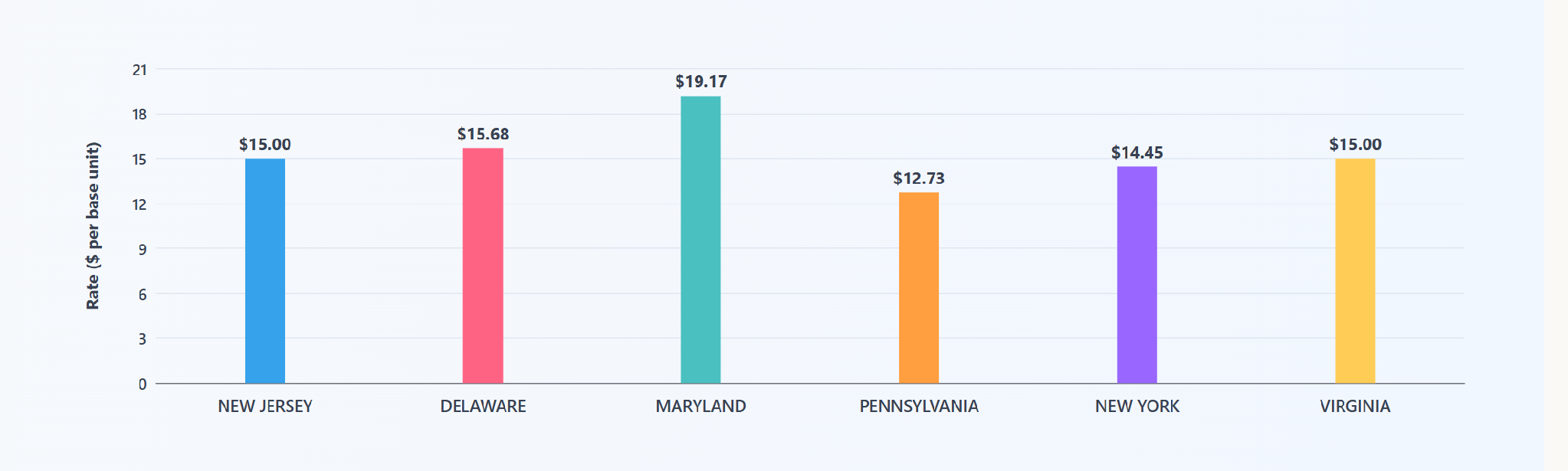
Figure 1: CPT 97153 (adaptive behavior treatment by protocol, technician-delivered) Medicaid rate per 15-minute unit, New Jersey and neighboring states. New York reflects its fee-for-service rate through September 30, 2026; the rate for services on or after October 1 is $9.63. Source: MediRate.
On 97153, New Jersey’s $15.00 ties Virginia for third among six Mid-Atlantic states in MediRate data, behind Maryland at $19.17 and Delaware at $15.68, and ahead of New York and Pennsylvania ($12.73). New York paid $14.45 through September 30, after two fee-for-service reductions authorized by its FY 2025-2026 budget, per the state’s August 2025 Medicaid Update. Under its FY 2026-2027 budget, New York’s fee-for-service rate for services on or after October 1 is $9.63, per its August 2026 Medicaid Update, the lowest published Medicaid rate for 97153 in the country, per MediRate, and below West Virginia’s $9.90, as Acuity has reported. Acuity has tracked New York’s cuts alongside the state’s six-month freeze on new ABA provider enrollments
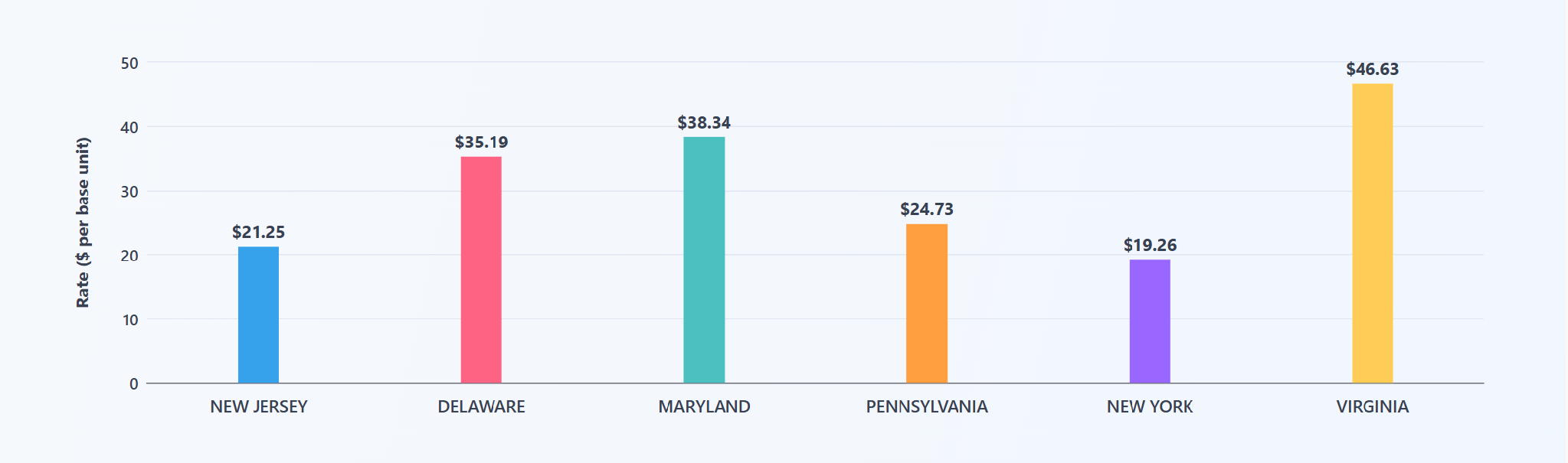
Figure 2: CPT 97155 (adaptive behavior treatment with protocol modification) Medicaid rate per 15-minute unit, New Jersey and neighboring states. Delaware reflects its master’s-level (HO) rate. Source: MediRate.
On 97155, New Jersey ranks fifth of six at $21.25. Virginia pays $46.63, more than double. Maryland pays $38.34, Delaware pays $35.19 at its master’s tier and Pennsylvania pays $24.73. Only New York, at $19.26, pays less.
The gap is widest for analyst time. An hour of protocol modification by a New Jersey Board Certified Behavior Analyst pays $85; the same hour billed at Delaware’s master’s tier pays $140.76. For operators serving families on both sides of the Delaware River, the same analyst hour earns 66 percent more in Delaware. MediRate maintains the underlying rate detail, including modifier-level variation, for state Medicaid programs across the country.
What comes next for New Jersey’s ABA rates
Federal attention to ABA spending is rising. CMS released its State Medicaid and CHIP ABA Toolkit on August 4, citing a 421 percent increase in Medicaid and CHIP ABA spending between 2021 and 2025, against 67 percent growth in the number of children with an autism diagnosis receiving services. CMS describes the toolkit as a resource to help states address rising expenditures, inconsistent clinical practices and fraud schemes, and says it is not a restriction on autism services. Acuity has examined its diagnosis guidance.
The code set is also changing. As Acuity has reported, the 2027 CPT adaptive behavior code set splits 97155, which means New Jersey will need to set rates for new analyst codes. That decision will land on a rate that has held at $21.25 since the benefit launched, in a state whose technician rate has already been raised once to keep providers in the network.
The same code update deletes both Category III codes for severe destructive behavior, according to Acuity’s reporting. New Jersey currently pays $25.00 for 0362T and $16.40 for 0373T, so services for children with the most intensive behavioral needs will also need a new rate home. How DMAHS prices the new codes, and whether it revisits the $21.25 analyst rate at the same time, is the next rate decision for New Jersey providers to watch.
Frequently Asked Questions
What does New Jersey Medicaid pay for ABA in 2026?
New Jersey’s August 2026 fee-for-service schedule lists 97153 at $15.00, 97155 at $21.25, and 97151 and 97156 at $25.00 per 15-minute unit, priced in the children’s columns for members under 21. Managed care plans are not required to use the fee-for-service rates. MediRate maintains the full rate detail.
When did New Jersey last change its ABA rates?
Every ABA code on the August 2026 fee-for-service schedule matches the rates DMAHS published at the April 2020 launch except 97153, which rose from $11.20 to $15.00 after a plan the Department of Human Services announced in February 2022.
Is ABA part of New Jersey’s behavioral health integration?
No. Phase 1 of NJ FamilyCare behavioral health integration, which began January 1, 2025, covers outpatient mental health and substance use services. Its claims code list, with rates effective July 1, 2026, contains no adaptive behavior codes. ABA is administered by NJ FamilyCare plans under the state’s separate autism benefit.
Who can provide ABA under NJ FamilyCare?
New Jersey licenses behavior analysts through the State Board of Applied Behavior Analyst Examiners. The state plan recognizes Board Certified Behavior Analysts, Board Certified Assistant Behavior Analysts working under supervision, and Behavior Technicians who meet education and experience minimums or hold Registered Behavior Technician certification.
How do New Jersey’s ABA rates compare with neighboring states?
Per MediRate data, New Jersey’s $15.00 rate for 97153 ties Virginia for third among six Mid-Atlantic states. Its $21.25 rate for 97155 ranks fifth, above only New York’s $19.26 and less than half of Virginia’s $46.63.