
Virginia has not changed its Medicaid ABA rates since 2021. In July 2026 it capped therapy at 20 hours a week and raised waiver behavior analyst pay.
Key Takeaways
- A fee schedule frozen since 2021: The outpatient rates that govern Virginia’s ABA benefit took effect December 1, 2021 and still carry no end date on the state’s procedure code file. Technician-delivered treatment under 97153 pays $15.00 per 15-minute unit, and analyst-delivered treatment under 97155 pays $46.63 at the Licensed Behavior Analyst tier.
- One budget item, two opposite directions: Item 291 of the 2026 to 2028 budget capped state plan ABA at 20 cumulative hours per recipient each week beginning July 1, 2026. The same item directed the Department of Medical Assistance Services to raise Developmental Disability waiver Therapeutic Consultation rates using an independent study, lifting Behavior Analyst pay 26.3 percent in Northern Virginia.
- A federal court order moved the waiver rates, not a budget surplus: Guidehouse conducted the 2025 rate study under the Permanent Injunction entered in United States v. Commonwealth, and the budget adopted its benchmarks for procedure codes 97139 and 97530. The same study recommended a 63.8 percent increase for Therapeutic Consultation delivered by Psychologists and Psychiatrists, and that code does not appear in the funding language.
- The cap’s real shape is not yet drawn: DMAS must file a State Plan Amendment with the federal Centers for Medicare and Medicaid Services and may promulgate emergency regulations within 280 days. A benefit utilization workgroup that includes the Virginia Association for Behavior Analysis will help decide how readily the EPSDT medical necessity exception is granted.
Two things happened to Virginia’s behavior analysts on July 1, 2026, and they pointed in opposite directions. Under the Commonwealth’s Developmental Disability waivers, the hourly rate for Therapeutic Consultation delivered by a Behavior Analyst rose from $135.93 to $171.71 in Northern Virginia and from $122.83 to $147.07 across the rest of the state, the full amount an independent consultant said the work costs. Under the Medicaid state plan, the benefit that funds most autism treatment in the Commonwealth acquired a ceiling of 20 cumulative hours per child per week. Both changes trace to the same item of the same budget bill.
What did not move was the ABA fee schedule itself. The outpatient rates Virginia Medicaid pays for the adaptive behavior treatment codes took effect on December 1, 2021, and they are the rates today. More than four and a half years of wage growth, several rounds of personal care increases, and a rebasing of eleven Developmental Disability waiver services have all happened around them. Virginia is not alone in that: Kansas has left its ABA rates unchanged since 2019 on every code but one, and MassHealth proposed re-adopting its fee schedule unchanged. What distinguishes Virginia is that the freeze now sits next to a documented, funded increase for closely related work.
How Virginia Prices ABA Therapy
Virginia pays the same rate across its main ABA codes and varies it by the provider type the billing modifier indicates. Across the individual assessment and treatment codes, 97151, 97153, 97155, and 97156, treatment carries an identical rate within each provider tier. Billed without a provider-type modifier, denoting delivery by a technician, the rate is $15.00 per 15-minute unit. The HN modifier, for a Licensed Assistant Behavior Analyst, pays $23.48. The TF modifier, for a Licensed Mental Health Professional, pays $39.40. The HO modifier, for a Licensed Behavior Analyst, pays $46.63. The group and multiple-family codes, 97154, 97157, and 97158, are priced separately and do not follow that pattern.
The design has a consequence providers in other states would find unusual. A Licensed Behavior Analyst who delivers direct treatment bills the technician code, 97153, with the HO modifier, and is paid at the Analyst tier. DMAS describes that billing as an Analyst acting as technician, and the rate follows the credential rather than the code. The underlying model, built for DMAS by Mercer in 2021, assumed a supervisor-to-technician ratio of one to five and folded the cost of that supervision into the technician rate. Supervision without the child present is not separately billable.
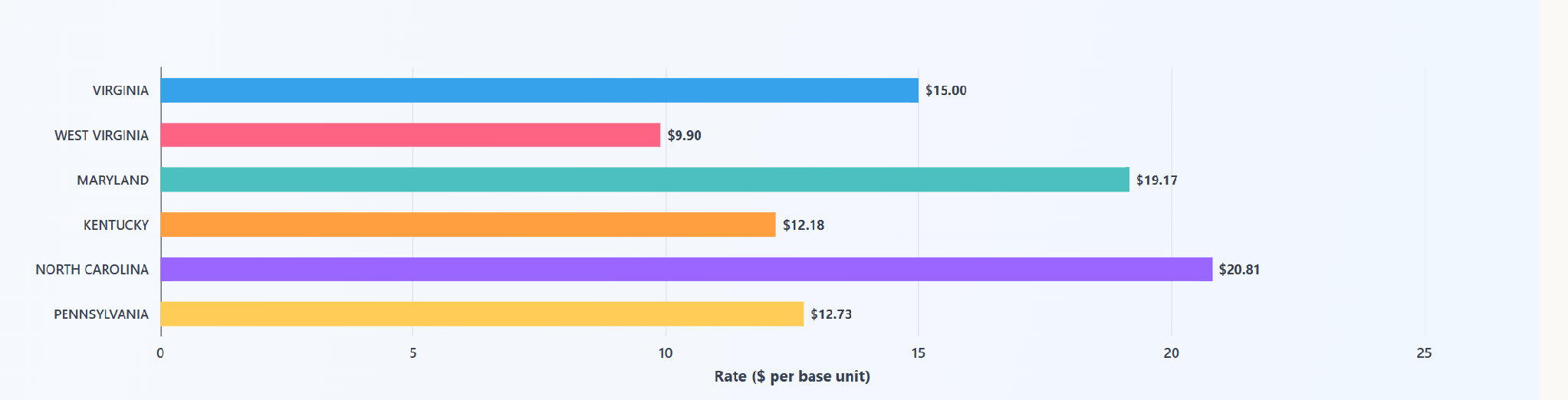
Medicaid 97153 (adaptive behavior treatment by protocol, technician-delivered), maximum allowable rate per 15-minute unit: Virginia and selected neighboring states, as of July 2026. Virginia’s figure reflects the base technician tier. Source: MediRate.
Against its neighbors, Virginia’s technician rate sits in the middle. It pays more than West Virginia, Kentucky, and Pennsylvania, where the statewide schedule has not changed since 2020, and meaningfully less than Maryland and North Carolina, both of which clear $19 per unit. The spread across six contiguous states runs from $9.90 to $20.81, better than a two-to-one difference for the same 15 minutes of the same CPT-defined service. MediRate maintains the underlying rate detail for all fifty states, including the modifier-level variation that a single figure per state cannot capture.
A 20-Hour Cap Written to Bend
The cap arrived through Item 291 of the 2026 to 2028 budget, which Governor Abigail Spanberger signed after negotiators finalized it on June 29. As Acuity reported at the time, the provision directs DMAS to limit ABA to 20 cumulative hours per recipient each week and to require a confirmed autism spectrum disorder diagnosis before services are authorized. The Virginia Association for Behavior Analysis, which pressed to strike both provisions during the session, did not succeed.
The limit is not absolute. The budget allows it to be exceeded where medical necessity is documented under Early and Periodic Screening, Diagnostic, and Treatment, the federal benefit that obligates Medicaid to cover medically necessary care for members under 21. Children age five and younger gained a one-year provisional diagnosis pathway. Behavior therapy delivered by local education agencies through the fee-for-service school-based program sits outside the cap entirely. Whether a weekly hour threshold is the right instrument at all is contested on clinical grounds.
The threshold itself was not new. A DMAS bulletin in December 2025 had already told providers that authorization requests above 20 hours a week required substantial documentation and justification. What changed is where the number lives. A separate change, effective for dates of service beginning October 15, 2025, ended the practice of authorizing all ABA treatment under a single 97155 bucket. Providers must now specify requested units for each treatment code, in both fee-for-service and Cardinal Care Managed Care.
Medicaid 97155 (adaptive behavior treatment with protocol modification, analyst-delivered), maximum allowable rate per 15-minute unit: Virginia and selected neighboring states, as of July 2026. Virginia’s figure reflects the Licensed Behavior Analyst tier. Source: MediRate.
On analyst-delivered treatment, Virginia looks like the regional leader. Its $46.63 for 97155 is the highest of the six states, well clear of Maryland’s $38.34 and North Carolina’s $32.22, set against an active rewrite of that state’s ABA coverage policy. That comparison rests on the Licensed Behavior Analyst tier. Billed at the Licensed Assistant Behavior Analyst tier, the same code pays $23.48, which would place Virginia fifth of six. Where a provider lands in the ranking depends on who is on staff.
The Waiver Rates Moved Because a Federal Court Said So
The Developmental Disability waiver increase came from an entirely different pressure. Guidehouse conducted a rate study for DMAS in 2025 covering eleven services named in the Permanent Injunction entered in United States v. Commonwealth, Civil Action No. 3:12-cv-59-JAG, the order that concluded Virginia’s twelve-year settlement with the United States Department of Justice over community services for people with developmental disabilities. Therapeutic Consultation delivered by Therapists, Behavior Analysts, and Rehabilitation Engineers was one of them. Independent rate studies have become the most reliable route to an increase: Alaska lifted its Medicaid ABA rates roughly 41 percent on a Guidehouse study on the same July 2026 date.
Guidehouse benchmarked Therapeutic Consultation by Behavior Analysts at $171.71 per hour in Northern Virginia and $147.07 in the rest of the state, increases of 26.3 and 19.7 percent over the rates then in effect. Item 291 directed DMAS to adopt the study’s methodology for procedure codes 97139 and 97530, among others, and the waiver schedule effective July 1, 2026 shows exactly those figures.
One recommendation did not make the list. Guidehouse benchmarked Therapeutic Consultation delivered by a Psychologist or Psychiatrist, procedure code H2017, at $201.90 in Northern Virginia and $172.93 elsewhere, increases of 63.8 and 54.8 percent and the largest in the study. That code does not appear in the budget language funding the study’s recommendations, and the July 2026 waiver schedule still shows $123.28 and $111.73. The budget does not explain why one benchmark was funded and the other was not.
Who May Bill, and Under What Supervision
Virginia licenses behavior analysts through the Board of Medicine, and the state plan’s Qualified Healthcare Professional definition tracks that licensure. Codes requiring a Qualified Healthcare Professional must be delivered by a Licensed Behavior Analyst or a Licensed Mental Health Professional. A Licensed Assistant Behavior Analyst may act in that role where the supervising Licensed Behavior Analyst determines it is appropriate under the applicable regulation. Residents, Resident in Psychology, and Supervisee designations within the Licensed Mental Health Professional pathway may deliver the services under their supervising professional, provided they have completed education and training in behavior analysis. Care coordination has no separate code and is billed under 97151 at assessment or under 97155 during ongoing treatment.
What Happens Next
The cap does not take full effect on budget language alone. DMAS must file a State Plan Amendment with the federal Centers for Medicare and Medicaid Services, and it may promulgate emergency regulations within 280 days and implement upon federal approval. VABA has identified the Mental Health Parity and Addiction Equity Act and EPSDT compliance as the grounds on which that filing could meet friction. Provider advocates elsewhere have argued that rate and utilization controls are the wrong tool for program integrity problems, and Virginia’s workgroup will be a live test of that argument.
The rest will be settled in the ABA benefit utilization workgroup the budget requires DMAS to convene, with public meetings and a seat for VABA alongside center-based and home-based providers, managed care representatives, Virginia-licensed behavior analysts, and a Child and Adolescent Psychiatrist. Its charge includes reviewing service authorization and medical necessity criteria and evaluating provider qualification and supervision standards. Providers watching Virginia should watch that room. The outpatient ABA rates have not moved in more than four and a half years, and nothing in the 2026 budget suggests they are about to.
Frequently Asked Questions
What does Virginia Medicaid pay for ABA therapy in 2026?
Virginia pays the same rate across its main ABA codes and varies it by provider type. Per 15-minute unit, technician-delivered treatment pays $15.00, a Licensed Assistant Behavior Analyst $23.48, a Licensed Mental Health Professional $39.40, and a Licensed Behavior Analyst $46.63. Those tier rates are identical across the individual codes 97151, 97153, 97155, and 97156. The group and multiple-family codes are priced separately.
When did Virginia Medicaid last change its ABA rates?
December 1, 2021. The outpatient tier rates that govern the ABA benefit carry no end date on the state’s procedure code file and remain in effect as of August 2026, unchanged through the 2026 to 2028 budget.
Does Virginia’s 20-hour weekly ABA cap apply to every child?
No. The budget permits the limit to be exceeded where medical necessity is documented under EPSDT, which makes it a soft cap rather than a hard ceiling. Behavior therapy delivered by local education agencies through the fee-for-service school-based program is exempt, and children age five and younger may use a one-year provisional diagnosis pathway.
How does Virginia ABA reimbursement compare with neighboring states?
For technician-delivered treatment under 97153, Virginia’s $15.00 sits above West Virginia at $9.90, Kentucky at $12.18, and Pennsylvania at $12.73, and below Maryland at $19.17 and North Carolina at $20.81. For 97155 at the Licensed Behavior Analyst tier, Virginia’s $46.63 is the highest in that six-state group.
Do behavior analysts need a Virginia license to bill Medicaid?
Yes. Virginia licenses behavior analysts through the Board of Medicine, and codes requiring a Qualified Healthcare Professional must be delivered by a Licensed Behavior Analyst or Licensed Mental Health Professional. A Licensed Assistant Behavior Analyst may serve as the Qualified Healthcare Professional where the supervising Licensed Behavior Analyst determines it is appropriate.
Did Virginia raise any behavior-related Medicaid rates in 2026?
Yes, on the Developmental Disability waiver side. Effective July 1, 2026, Therapeutic Consultation delivered by Behavior Analysts rose to $171.71 per hour in Northern Virginia and $147.07 in the rest of the state, adopting the benchmark from the 2025 Guidehouse rate study. The state plan ABA fee schedule was not part of that action.