Alaska’s July 2026 autism fee schedule raised 97153 to $31.95 and 97155 to $41.97 per unit, a rate-study-driven reset that tops its Western peers.
Key Takeaways
- Alaska’s autism rates had drifted out of balance. Before July 2026, the state adjusted its autism fee schedule only for inflation, and a state-commissioned rate study found that some Medicaid services were paid more generously than ABA. The result was a schedule that no longer reflected the cost of delivering care.
- A rate study, not routine indexing, reset the numbers. Effective July 1, 2026, Alaska raised its core autism codes by roughly 41 percent, implementing benchmark work from a Guidehouse rate evaluation. The prior year’s adjustment had been a 3.2 percent inflation bump.
- The new rates lead the region. MediRate places Alaska’s 97153 at $31.95 and 97155 at $41.97 per 15-minute unit. Both figures sit above Washington, Oregon, Hawaii, and Montana.
- Higher rates will not, by themselves, fix access. Alaska’s providers concentrate in Anchorage and Fairbanks, and rural Medicaid youth still receive fewer ABA hours. Distribution and workforce supply remain the binding constraints.
Alaska Medicaid reset its autism reimbursement on July 1, 2026, and the change was not the usual cost-of-living nudge. The state’s Medicaid Procedure Codes and Rates for Autism Services raised the technician treatment code 97153 to $31.95 per 15-minute unit, up from $22.63, and the analyst code 97155 to $41.97, up from $29.78. Both jumped roughly 41 percent. The family-guidance code 97156 more than doubled, from $18.69 to $41.97. A year earlier, Alaska had raised the same schedule by just 3.2 percent, an inflation adjustment noted on the face of the fee chart itself. The 2026 numbers are a different kind of event, and they place Alaska at the top of its regional peer group at a moment when much of the country is moving the other way.
The increase lands as a wave of state Medicaid programs trims ABA payments. Acuity has tracked reductions and new authorization hurdles from Indiana’s phased rate cuts to New York’s 25 percent reduction on 97153, alongside a widening set of federal ABA audits. Against that backdrop, Alaska stands out for raising rates, and for tying the increase to a formal rate study rather than a budget maneuver.
What Alaska’s 2026 Autism Fee Schedule Pays
Alaska covers ABA for Medicaid-enrolled children under 21 through the Early and Periodic Screening, Diagnostic, and Treatment benefit, with an autism diagnosis and a finding of medical necessity. The autism rate chart lists seven codes, all billed in 15-minute units and delivered by or under the direction of a qualified health care professional. Effective July 1, 2026, the assessment code 97151 pays $41.97, technician treatment (97153) pays $31.95, analyst protocol modification (97155) pays $41.97, and family guidance (97156) pays $41.97. Group and multiple-family codes round out the schedule at lower rates. The methodology behind these numbers is set in state regulation at 7 AAC 145.580, the same provision that governs Alaska’s broader behavioral health rate setting.
Credentialing shapes who can deliver and bill those units. Alaska licensed behavior analysts in 2014 and requires BCBA certification as a prerequisite, and its autism codes flow through the qualified health care professional standard rather than a technician-level billing pathway. For multi-state operators reading the schedule, the practical point is that the analyst and assessment codes now carry the same $41.97 figure as the highest-value treatment work, a flat top band that rewards analyst depth.
Set against its neighbors, the new schedule is not close.
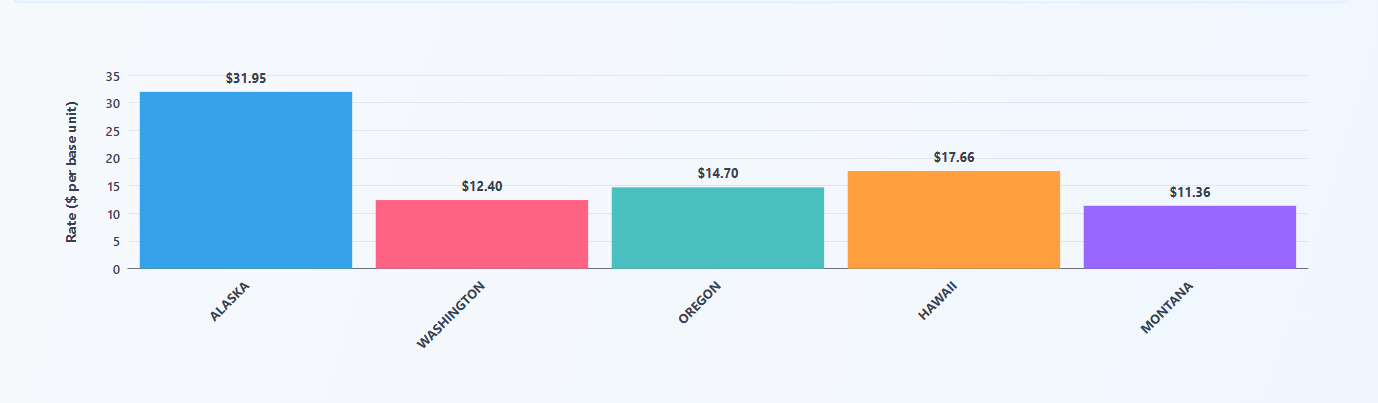
Medicaid 97153 (adaptive behavior treatment by protocol, technician-delivered), maximum allowable rate per 15-minute unit: Alaska and selected Western states, as of July 2026. Source: MediRate.
On 97153, MediRate’s comparison puts Alaska at $31.95, well ahead of Hawaii’s $17.66, Oregon’s $14.70, Washington’s $12.40, and Montana’s $11.36. For granular state-by-state detail across the full ABA code set, MediRate maintains the underlying datasets.
Why Alaska Raised ABA Rates: A Rate Study, Not Inflation
The increase traces to a comprehensive rate evaluation the Alaska Department of Health commissioned from Guidehouse to review how Medicaid pays for behavioral health and related services. That review, portions of which were filed with the Legislature in early 2026, benchmarked reimbursement against the cost of delivering care and flagged imbalances in the existing schedule. Among them: Alaska’s Medicaid reimbursement for some peer support services had drifted higher than its reimbursement for autism (ABA) services, an inversion the study identified as it modeled cost-based benchmark rates. The July 2026 autism increase reads as an implementation of that benchmarking work rather than a one-off appropriation.
There is an important caveat in reading Alaska’s rates against other states. Alaska Medicaid pays more than most states across many service lines, a reflection of the state’s unusually high cost of delivering care in a remote, sparsely populated geography. A high nominal ABA rate is therefore partly a policy choice to correct an internal imbalance and partly a feature of the environment those rates sit in. The two readings are not in conflict, but they matter for anyone comparing Alaska’s $31.95 to a Lower 48 figure without adjusting for what a unit of care costs to deliver in Bethel versus Boise.
The gap is even wider on the analyst code.
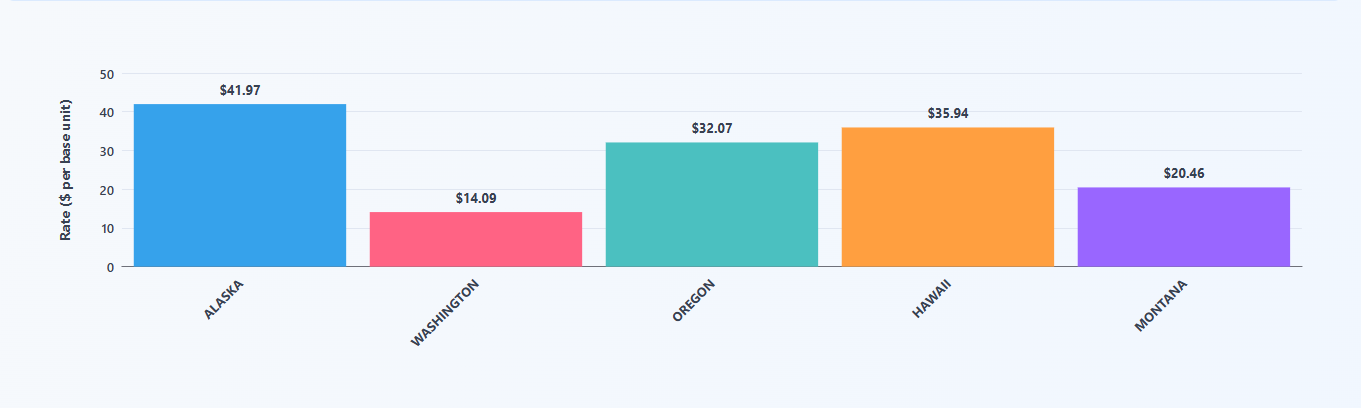
Medicaid 97155 (adaptive behavior treatment with protocol modification, analyst-delivered), maximum allowable rate per 15-minute unit: Alaska and selected Western states, as of July 2026. Source: MediRate.
On 97155, MediRate places Alaska at $41.97, ahead of Hawaii’s $35.94 and Oregon’s $32.07, and roughly three times Washington’s $14.09. According to MediRate, the reset makes Alaska’s 97153 the highest technician rate in the country, while its 97155 analyst rate ranks third nationally.
What Higher Rates Mean for Alaska ABA Access
A rate increase changes the economics of serving Medicaid families, but it does not, by itself, put a behavior analyst in a rural community. Alaska’s ABA providers tend to concentrate in urban hubs such as Anchorage and Fairbanks, and families outside those areas often rely on telehealth or travel. A 2025 short report in the journal Autism, analyzing Medicaid claims for more than 1,000 autistic youth nationally, found that those in rural areas received about 11 fewer hours of ABA per month than their non-rural peers, a gap the authors attributed to geographic barriers. The study was not specific to Alaska, but its findings map onto the state’s geography. Higher pay may help recruit and retain the credentialed workforce that access depends on, but distribution and workforce supply remain the constraints that a fee schedule alone cannot solve.
The same pressures the field is debating nationally apply in Alaska. Prior authorization and the long-running argument over treatment hours and intensity shape what a provider actually collects and delivers, independent of the posted rate. And as states set ABA rates one at a time, some providers have begun pressing for a national Medicaid conversation that would align reimbursement and program-integrity rules rather than leaving each state to move on its own.
For operators weighing where to expand, Alaska now offers a rare combination in 2026: a rising headline rate, a documented rate-study rationale behind it, and an access gap in rural regions that higher reimbursement alone will not close. Whether the new rates draw enough new providers to move the access numbers is the question the next year will answer.
Frequently Asked Questions
Does Alaska Medicaid cover ABA therapy?
Yes. Alaska Medicaid covers applied behavior analysis for enrolled children under 21 who have an autism diagnosis, through the Early and Periodic Screening, Diagnostic, and Treatment benefit, subject to medical necessity and prior authorization.
How much did Alaska raise ABA rates in 2026?
Effective July 1, 2026, Alaska raised its core autism codes by roughly 41 percent. The technician code 97153 rose from $22.63 to $31.95 per 15-minute unit, and the analyst code 97155 rose from $29.78 to $41.97.
Why did Alaska raise ABA rates?
The increase implements benchmark recommendations from a Guidehouse rate evaluation commissioned by the Alaska Department of Health, which found that the prior schedule paid ABA less than the cost of care implied and less than some other Medicaid services.
Are Alaska’s ABA rates the highest in the country?
On the technician code (97153), Alaska’s new rate is the highest in the country, according to MediRate. On the analyst code (97155), it ranks third nationally. Alaska also pays above most states across other service lines because of its high cost of delivering care, so the ranking reflects both a deliberate reset and the state’s cost environment.