
Pennsylvania’s statewide Medicaid ABA rates have held since 2020, but delivery runs through county behavioral health plans that are now tightening authorization.
Key Takeaways
- Pennsylvania’s statewide Medicaid ABA rates sit at the low end of its region, particularly for technician-delivered care. The base technician code 97153 pays $12.73 per 15-minute unit, near the bottom of its border group, and the analyst code 97155 pays $22.09, or $24.73 for the behavior-analytic line MediRate uses for comparison.
- Those statewide rates have not changed since January 2020, when Pennsylvania first broke ABA out as a distinct service. ABA is delivered through Intensive Behavioral Health Services and carved out to county behavioral health managed care plans, so the statewide schedule functions as a floor.
- The real activity is at the county and credentialing level. In Philadelphia, the county payer tightened medical-necessity and authorization rules for ABA in late 2025, and a statewide April 2026 update raised the training bar for the behavioral health technicians who deliver most direct hours.
- Providers face a tighter authorization environment rather than a rate change. The near-term questions center on county-level medical-necessity reviews, the regionalized IBHS model, and federal Medicaid pressure heading into the 2026-2027 budget year.
Pennsylvania’s Medicaid ABA rates look simple on paper and are anything but in practice. A single statewide fee schedule sets the price for every adaptive behavior code, and those prices have not moved since January 2020. But the schedule is only a reference point. Pennsylvania delivers behavioral health through county-based managed care, and the counties differ in how much of the rate setting they keep. Some are prescriptive about what their behavioral health plans pay, while others delegate rate setting to the plans themselves. Either way, what a provider is actually paid, and what gets authorized, is settled locally rather than in Harrisburg.
That structure is the key to reading the state. The statewide rate is a floor, the real action is local, and in 2025 and 2026 the most significant developments came not from a change to the fee schedule but from a county payer’s authorization rules and from a national change to technician credentialing. Neighboring Maryland recently moved its ABA administration to a single carve-out vendor, and New York cut its technician rate by 25 percent; Pennsylvania’s rates held flat while the pressure showed up elsewhere.
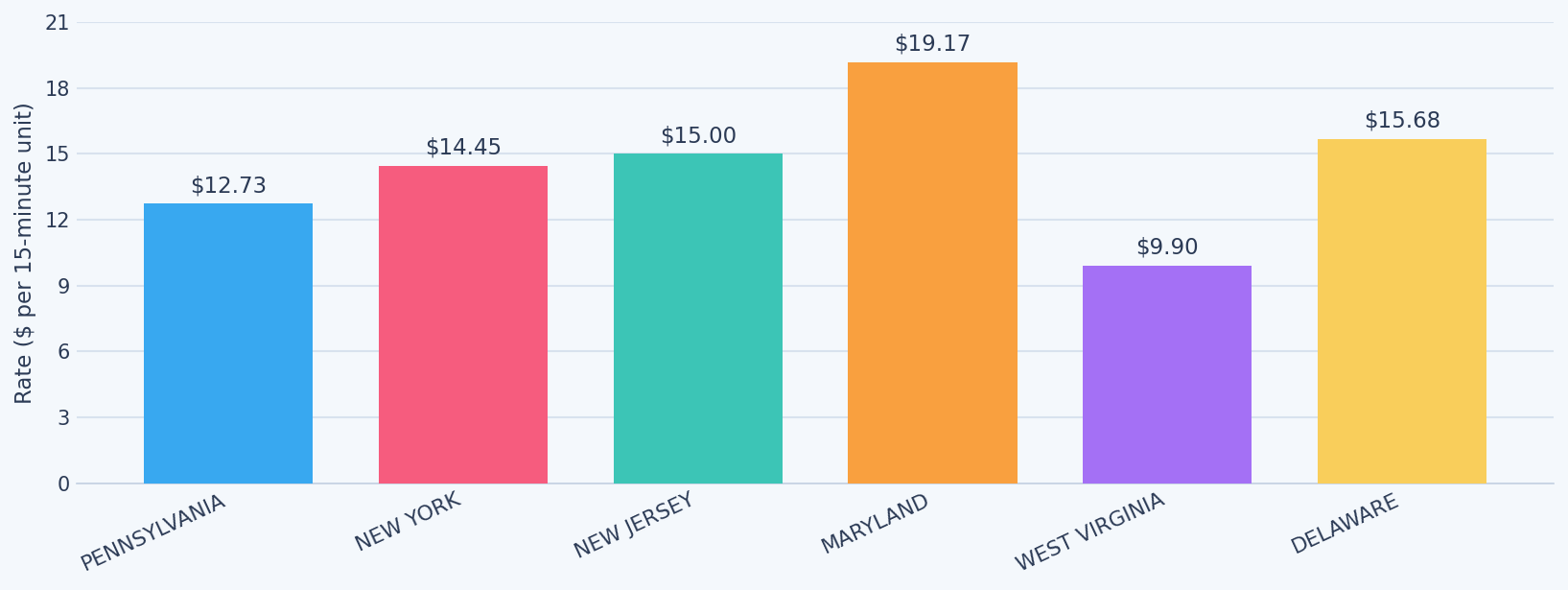
State Rate Comparison: Medicaid ABA Reimbursement, CPT 97153 (adaptive behavior treatment by protocol, technician-delivered), per 15-minute unit. Pennsylvania and border states. Source: MediRate.
How Pennsylvania Medicaid Pays for ABA: IBHS and the County Carve-Out
Pennsylvania delivers ABA through Intensive Behavioral Health Services (IBHS), the framework it adopted in January 2020 to replace the older Behavioral Health Rehabilitation Services, or wraparound, model. Under 55 Pa. Code Chapter 5240, ABA became a distinct, licensed service for the first time, with its own procedure codes added to the Medical Assistance fee schedule. The benefit serves Medicaid-eligible children and youth under 21 through the Early and Periodic Screening, Diagnostic, and Treatment mandate.
The billing codes map to familiar roles. Code 97153 covers behavioral health technician-delivered ABA, the direct-service hours that make up most of a treatment plan, and 97155 covers the analyst-level work of protocol modification. Pennsylvania administers behavioral health through HealthChoices, and each county contracts with a behavioral health managed care organization, such as Community Behavioral Health in Philadelphia or the Magellan and PerformCare networks elsewhere. A physician or other qualified professional writes an order, an assessment and individual treatment plan follow, and the county plan decides whether to authorize the requested hours. Because those plans administer authorization and payment, the statewide fee schedule sets a baseline rather than a guaranteed payment. What sits above that floor varies by county: some counties are prescriptive about the rates their behavioral health plan pays, while others delegate rate setting to the plan itself.
The Statewide Fee Schedule, Credentialing, and the 2026 Training Update
On the current Medical Assistance fee schedule, the base rate for 97153, billed as behavioral health technician-ABA, is $12.73 per 15-minute unit, or $50.92 an hour; a separate line for assistant behavior consultation-ABA (modifier U8) pays $15.76. The analyst side runs through 97155: behavior consultation-ABA pays $22.09 per unit, or $88.36 an hour, and the behavior-analytic line delivered by a behavior analyst (modifier U7) pays $24.73, the figure MediRate uses in its state comparison. Every one of those figures carries an effective date of January 17, 2020, when IBHS took effect. In other words, Pennsylvania’s statewide ABA rates have not changed in more than six years.
What has changed is the credential expected of the workforce delivering most of those hours. In a letter to IBHS providers dated April 2, 2026, the Department of Human Services notified agencies that the Behavior Analyst Certification Board had replaced the RBT Task List (2nd edition) with the RBT Test Content Outline (3rd edition), effective January 1, 2026, with an expanded 40-hour training curriculum and a one-year phase-in for existing staff. The letter did not touch reimbursement. The practical effect is a higher training bar on the technician workforce at the same time the technician rate has stood still since 2020, a squeeze that providers in a thin-margin, labor-intensive service feel directly.
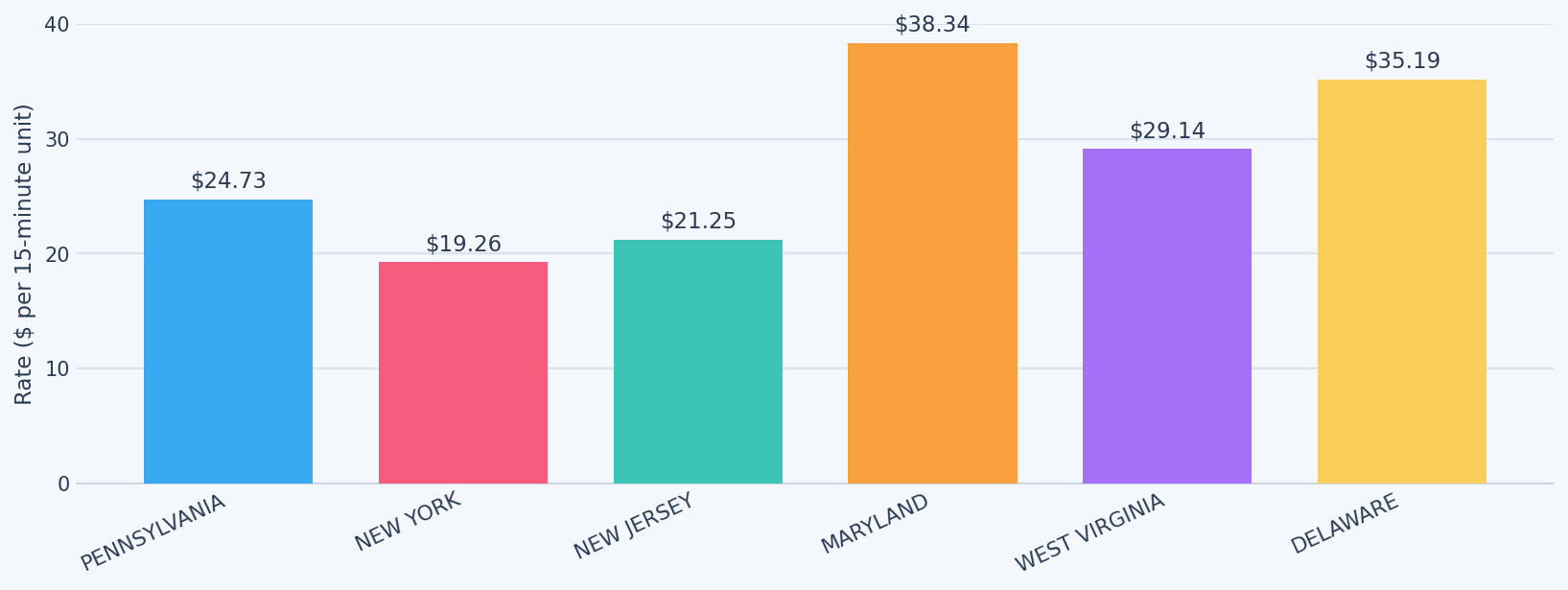
State Rate Comparison: Medicaid ABA Reimbursement, CPT 97155 (adaptive behavior treatment with protocol modification, analyst-delivered), per 15-minute unit. Pennsylvania and border states. Pennsylvania reflects the credentialed-tier rate used in the MediRate comparison. Source: MediRate.
What Pennsylvania ABA Providers Should Watch: County Authorization and Federal Pressure
Because authorization is local, the developments that matter most are happening at the county level. In Philadelphia, Community Behavioral Health, the county’s Medicaid behavioral health payer, issued bulletins in mid-2025 that reshaped how it authorizes IBHS and ABA. Effective September 1, 2025, CBH put new medical-necessity criteria in place for early-childhood intensive ABA and for one-to-one ABA delivered in a center, required that every individual treatment plan include at least two family goals before services are authorized, and added medical-necessity reviews for youth with an individualized education program and enhanced reviews for ABA requested for children over age 12. It also set a daily cap of 32 units for technician services beginning October 1, 2025, matching the limit already on the statewide fee schedule. CBH framed the changes as an effort to keep treatment clinically justified and family-centered and to reinforce ABA as a service that transfers skills across home, school, and community.
Those rules apply to CBH’s regionalized IBHS providers, a Philadelphia-specific network model built around school-based clusters, and not to the rest of the state. Each county behavioral health plan sets its own authorization rules, so providers operating across county lines cannot assume Philadelphia’s requirements apply elsewhere. The statewide framework beneath all of it is the one the Office of Mental Health and Substance Abuse Services set in January 2020, when 55 Pa. Code Chapter 5240 established IBHS and its procedure codes; the recent tightening is a county-payer overlay on that framework. Families and their advocates, including the Pennsylvania Health Law Project, focus on the access side, particularly members’ rights to appeal when authorization is denied or reduced. That concern connects to the federal picture: the One Big Beautiful Bill Act, signed in July 2025, carries Medicaid reductions that phase in over several years and will bear on Pennsylvania’s 2026-2027 budget. Utilization limits, not posted rates, are where that pressure tends to land first, as providers have seen with Virginia’s new 20-hour weekly ABA cap and the federal audit wave that has raised the stakes for documentation and compliance. For ABA providers, Pennsylvania’s next round of change is far more likely to arrive through county authorization practice and federal budget math than through the statewide rate itself.
Frequently Asked Questions
What are Pennsylvania Medicaid’s ABA reimbursement rates?
On the statewide Medical Assistance fee schedule, the base technician code 97153 (behavioral health technician-ABA) pays $12.73 per 15-minute unit, and the analyst code 97155 pays $22.09 for behavior consultation-ABA and $24.73 for the behavior-analytic line delivered by a behavior analyst. Those rates have been in effect since January 17, 2020.
How is ABA delivered under Pennsylvania Medicaid?
ABA is delivered through Intensive Behavioral Health Services and carved out to county behavioral health managed care organizations under HealthChoices. A written order, assessment, and individual treatment plan are submitted to the county plan, which authorizes services. The statewide fee schedule functions as a floor.
Have Pennsylvania’s ABA rates changed recently?
No. The statewide rates have not changed since January 17, 2020. An April 2026 update to IBHS providers concerned technician training and certification, not reimbursement.
What changed in Philadelphia’s IBHS-ABA rules?
Effective September 1, 2025, Community Behavioral Health tightened medical-necessity and authorization rules, requiring at least two family goals in every individual treatment plan and adding enhanced reviews for youth with an IEP and for ABA requested for children over age 12. A daily cap of 32 technician units took effect October 1, 2025. These rules are specific to Philadelphia County.
Who can deliver ABA under Pennsylvania Medicaid?
ABA is provided by IBHS-licensed agencies. Direct hours are delivered by behavioral health technicians working toward or holding RBT certification, now under the Behavior Analyst Certification Board’s 3rd-edition training standard, while behavior consultant-ABA and behavior analytic services are delivered by qualified and analyst-level staff.
How does Pennsylvania compare to neighboring states?
Pennsylvania is near the bottom of its region on the 97153 technician code, per MediRate, sitting just above West Virginia. On the 97155 analyst rate it falls in the lower-middle of the group, below Maryland, Delaware, and West Virginia but above New York and New Jersey.