
North Dakota Medicaid pays the lowest ABA technician rate among its neighboring states, and two straight 2 percent increases have not lifted it off the bottom of the range.
Key Takeaways
- North Dakota sets the region’s lowest technician rate. Under the fee schedule reissued in April 2026, Medicaid paid $10.60 per 15-minute unit for CPT code 97153, the technician-delivered treatment that typically carries most ABA hours, less than half of South Dakota’s $21.73 and the lowest in the six-state comparison. A 2 percent increase took effect July 1, 2026, but it does not change North Dakota’s position at the bottom of the range.
- The rate reflects small annual increases, not a freeze. A 2 percent inflationary increase took effect on July 1, 2025, and a second 2 percent increase took effect on July 1, 2026, both authorized and funded by the 2025 Legislative Assembly. The increases are real, but too modest to lift North Dakota off the bottom of the range.
- The schedule is lopsided between technician and analyst work. While the technician rate sits at the bottom, North Dakota’s analyst rate of $31.14 for 97155 lands in the upper-middle of the neighbor set, above Minnesota, Montana, and Nebraska. The imbalance concentrates margin pressure on the direct-therapy hours that dominate most treatment plans.
- Coverage is solid; access is the open question. North Dakota covers the core ABA codes, credentials an unusually broad range of skills trainers, and runs a separate autism waiver that expanded in late 2025. Whether that structure can sustain provider supply at a rock-bottom technician rate is the question facing families and operators in a frontier state.
North Dakota’s Medicaid ABA story is, at its core, a story about one number. The state paid $10.60 per 15-minute unit for adaptive behavior treatment delivered by a technician, the code known as 97153, under the fee schedule that underlies the comparison below, and that rate is the lowest among the six states in this comparison. Because technician-delivered therapy typically makes up the largest share of authorized hours in an ABA plan, the 97153 rate does more than any other line on the fee schedule to define what it costs to run a practice in the state, and what a practice can earn.
Set against its neighbors, North Dakota sits alone at the bottom of the technician band. South Dakota, directly to the south, pays $21.73 for the same code, more than double North Dakota’s figure. Even Montana, the other sparsely populated neighbor, pays slightly more at $11.36.
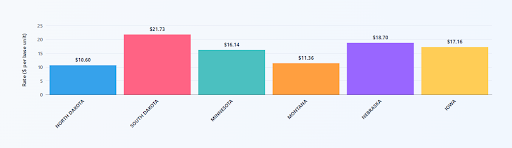
Medicaid 97153 (adaptive behavior treatment by a technician), maximum allowable rate per 15-minute unit: North Dakota and selected neighboring states. Source: MediRate.
What North Dakota Medicaid Pays for ABA
North Dakota folds its autism services into the broader General Services fee schedule, in the version reissued effective April 5, 2026. Across the adaptive behavior code set, the schedule pays $31.14 for behavior identification assessment by a professional (97151), $23.05 for the technician assessment (97152), $10.60 for technician treatment (97153), $2.67 for group technician treatment (97154), $31.14 for analyst-delivered protocol treatment (97155), and $28.90 for family treatment by a professional (97156). It also covers the destructive-behavior treatment code 0373T at $12.74. Two codes that some states pay, the multiple-family guidance code 97157 and the professional group code 97158, are not covered.
The structure is unusual in how it splits technician and analyst pay. On the analyst code 97155, North Dakota’s $31.14 is competitive and actually lands in the upper-middle of the regional group, ahead of Minnesota, Montana, and Nebraska. The gap between a floor-level technician rate and a mid-pack analyst rate is the defining feature of the state’s schedule, and it falls hardest on the direct-therapy hours that carry most treatment plans.
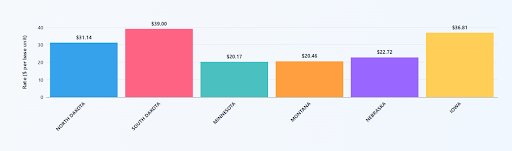
Medicaid 97155 (adaptive behavior treatment by a professional), maximum allowable rate per 15-minute unit: North Dakota and selected neighboring states. Source: MediRate.
A Small Increase, Not a Freeze
The temptation is to read a $10.60 rate as evidence of neglect, a number frozen in place while costs climbed. The record is more specific. North Dakota applied a 2 percent inflationary increase to most Medicaid provider rates effective July 1, 2025, lifting 97153 from $10.39 to $10.60, and a second 2 percent increase took effect July 1, 2026. Both were authorized and funded by the 2025 Legislative Assembly, which estimated the autism services increase under the EPSDT benefit at roughly $70,000 over a twelve-month period. The comparison charts reflect the fee schedule in effect through the April 2026 reissue; with the July 1, 2026 increase now in effect, posted rates run about 2 percent higher, which does not change North Dakota’s standing at the bottom of the range.
In a national environment where a number of states have cut ABA pay outright, a small increase is not nothing. New York finished phasing in a 25 percent reduction to its technician rate this spring, and managed-care plans in states like Georgia have imposed their own cuts. Others have simply held still: Oregon left its 2026 rates unchanged, and in Illinois, rates have not moved since 2022. North Dakota’s approach, steady 2 percent steps off a low base, keeps its rates rising, but not fast enough to change where the state sits regionally.
Two Tracks: The EPSDT Benefit and the Autism Waiver
North Dakota reaches children through two distinct Medicaid pathways. The first is the state-plan ABA benefit delivered under the Early and Periodic Screening, Diagnostic, and Treatment (EPSDT) mandate, grounded in federal Medicaid law and North Dakota Administrative Code 75-02-02. To qualify, a child must be under 21, carry an autism spectrum disorder diagnosis, and complete an annual North Dakota Health Tracks wellness screening within six months of approval. Approval runs for twelve months, care plans are updated every 180 days, and the state reviews medical necessity throughout.
The second pathway is a separate 1915(c) autism waiver, which covers supports such as respite and service management rather than direct therapy. That waiver expanded in late 2025: effective November 1, 2025, North Dakota raised the qualifying age ceiling from 17 to 20, increased waiver capacity to 400 slots per year (with 345 active at any one time), and applied 2 percent provider increases for 2025 and 2026 to waiver service management and respite. Pairing a state-plan therapy benefit with a separate autism waiver is a structure other states use as well, including Maryland, where an oversubscribed waiver has pushed most families toward the state-plan benefit.
Who Can Deliver ABA in North Dakota
North Dakota’s credentialing rules are notably broad, which matters in a state where providers are thinly spread. Clinical oversight must come from a licensed board-certified behavior analyst, a BCBA-D, a registered behavior analyst, or a licensed clinical psychologist. Skills training, the hands-on delivery, can be provided by a registered behavior technician or board certified autism technician, but also by a wide range of licensed professionals: social workers, professional clinical counselors, marriage and family therapists, speech-language pathologists, occupational therapists, and physical therapists. Degree-holders who enter through that wider door must become a registered behavior technician or board certified autism technician within six months.
The credential itself sits under North Dakota Century Code chapter 43-64, enacted through Senate Bill 2236, with licensure now administered by the North Dakota Board of Integrative Health Care rather than the psychology board that once handled it. The state recognizes both a Licensed Applied Behavior Analyst and a Registered Applied Behavior Analyst designation.
Why the Technician Rate Carries the Most Weight
For an operator weighing whether to serve North Dakota families, the analyst rate offers some comfort and the technician rate takes it back. Because most authorized hours in an ABA plan are typically delivered by technicians, the 97153 rate sets the ceiling on what most of a practice’s labor can earn, and it does so in a state where recruiting and retaining technicians is already hard. A relatively healthy analyst rate cannot fully offset a technician rate that trails every neighbor, particularly for practices built on high technician-to-analyst ratios.
The rate environment sits inside a period of intensifying scrutiny of Medicaid ABA spending nationally, from a federal audit series that has recouped payments in several states to the aggressive reform cycle underway in neighboring Indiana. North Dakota’s low base rate and modest volume place it at the opposite end of that spectrum from the high-growth states drawing federal attention, but the underlying question is the same everywhere: whether the rate a state sets is enough to keep qualified providers in the program. In North Dakota, the answer will turn less on any single policy change than on whether steady 2 percent increases can eventually meet the real cost of delivering care across a rural state.