
Key Takeaways
- Carelon replaced Optum as the Behavioral Health Administrative Services Organization on January 1, 2025: The transition consolidates ABA prior authorization and claims administration under a single carve-out vendor across HealthChoice and fee-for-service Medicaid populations.
- PT 42-26 reshaped the service-combination rules for ABA effective January 1, 2026: Most concurrent-service prohibitions tightened, with limited exceptions for Therapeutic Behavioral Services (96156, 96158, 96159) and electroconvulsive therapy (90870); H2012 sunset February 1, 2026.
- BCBA supervision pays at the high end of the Mid-Atlantic: Maryland’s 97155 BCBA rate of $38.34 per 15-minute unit trails only Virginia ($46.63) among Mid-Atlantic neighbors and exceeds Delaware, DC, West Virginia, Pennsylvania, and New Jersey, per MediRate fee schedule data.
- RBT direct-service pays in the upper-middle of the regional pack: Maryland’s 97153 RBT rate of $19.17 per 15-minute unit sits below DC ($27.50) but above Virginia ($15.00), Delaware, Pennsylvania, New Jersey, and West Virginia.
Maryland’s Medicaid ABA program enters 2026 under a meaningful set of structural changes. As of January 1, 2025, Carelon Behavioral Health replaced Optum as the state’s Behavioral Health Administrative Services Organization, taking over prior authorization and claims administration for ABA services across HealthChoice managed care and fee-for-service Medicaid. As of January 1, 2026, the Maryland Department of Health’s combination-of-service rules tightened under PT 42-26, sunsetting H2012 effective February 1, 2026 and recasting which behavioral-health services may be billed concurrently with ABA.
The state-plan ABA benefit was added effective January 1, 2017 and remains the operative pathway for most Medicaid-enrolled children with autism spectrum disorder. Maryland’s Autism Waiver, administered by the Maryland State Department of Education, has historically served a smaller cohort with a broader service mix; the waiver waitlist has run roughly eight years for new applicants, which has functionally shifted demand to the state-plan ABA benefit and intensified the importance of the rate and authorization environment.
Carelon’s January 2025 transition and the PT 42-26 service-combination rules
The Carelon transition consolidates ABA administration under a single carve-out vendor for both HealthChoice and fee-for-service populations. Per the Maryland Medicaid ABA Provider Manual and provider transmittals issued by MDH in 2025, all ABA prior authorization, concurrent review, and claims administration moved from Optum to Carelon as of January 1, 2025. A subsequent Carelon alert dated April 30, 2026 announced that, effective July 1, 2026, the National Provider Identifier of the referring practitioner must be included on ABA claims; absence of the NPI will trigger denials.
PT 42-26, issued by MDH on December 18, 2025 and effective January 1, 2026, recast Maryland’s combination-of-service rules. Most ABA services now cannot be billed concurrently with other services classified as behavioral health services, with limited exceptions for Therapeutic Behavioral Services delivered under codes 96156, 96158, and 96159 and for electroconvulsive therapy under code 90870. The transmittal also sunset code H2012 (behavioral health day program) effective February 1, 2026, removing it from the ABA-allowable service set entirely.
The combined effect is a tighter authorization environment for providers serving children with co-occurring needs. PT 12-26 and PT 13-26, issued earlier in 2025, addressed related provider-qualification and assessment-coding clarifications but did not alter the core combination-of-service framework that PT 42-26 restructured.
Where Maryland’s rates land regionally
Per the FY 2026 fee schedule published by Carelon Health, the 97153 (adaptive behavior treatment by protocol) base rate is $24.41 per 15-minute unit when delivered by a psychologist, BCBA-D, or BCBA; $20.91 when delivered by a BCaBA; and $19.17 when delivered by a Registered Behavior Technician or Behavior Technician. Higher-tier codes 97151 (behavior identification assessment) and 97155 (protocol modification) are paid at $38.34 per 15-minute unit; 97156 (family adaptive behavior treatment guidance) is paid at $20.91 and $12.21 depending on provider tier. The QHCP diagnostic-experience requirements in the Maryland ABA Provider Manual apply across all qualified health care professional categories.
The chart below isolates the BCBA tier for 97155 — the supervisor responsible for protocol modification — where Maryland’s rate stands out most relative to regional neighbors. RBT-tier rates for 97153 are discussed in prose below.
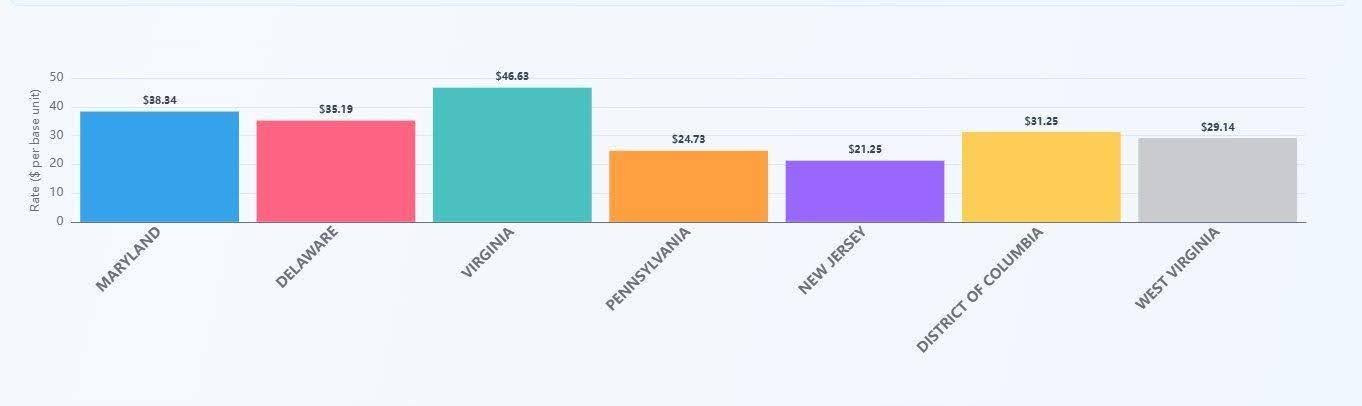
Figure 1: 97155 BCBA-tier rate per 15-minute unit, Maryland and Mid-Atlantic neighbors. Source: MediRate.
On 97153, Maryland’s $19.17 RBT rate sits toward the upper-middle of the Mid-Atlantic pack, above Virginia ($15.00), Delaware ($15.68), Pennsylvania ($12.73), New Jersey ($15.00), and West Virginia ($9.90), and below DC ($27.50). Virginia publishes a base RBT rate of $15.00 and a separate $23.48 BCaBA/LABA bachelor’s-level rate under the HN modifier (non-mapped network); the bachelor’s-level figure is not directly comparable to RBT-tier rates in other states.
On 97155, Maryland’s $38.34 BCBA rate places the state second in the regional comparison set, behind only Virginia ($46.63) and ahead of Delaware ($35.19), DC ($31.25), West Virginia ($29.14), Pennsylvania ($24.73), and New Jersey ($21.25). The contrast between Maryland’s upper-middle RBT rate and high-tier BCBA rate is the central rate-policy story for the state: supervision is paid relatively well, direct-service hours are paid above regional norms but well below DC.
In national context, Maryland’s carve-out structure under Carelon is closer to states like Indiana and Texas in administrative architecture than to integrated managed-care states. The combination of a single BHASO administering authorization across populations and a state-plan benefit with a tiered fee schedule produces a rate-and-authorization environment that is more uniform than fragmented multi-MCO states but more administratively complex than fee-for-service-only states.
For ABA operators considering Maryland as part of a multi-state footprint, the takeaway is that the carve-out structure adds a layer of operational complexity beyond a typical fee-for-service or HealthChoice market, but rates support a clinical-staffing model that leans on BCBA-led supervision. The PT 42-26 combination-of-service tightening narrows what can be billed alongside ABA, which puts a premium on intake clarity for children with co-occurring behavioral health needs.
Frequently Asked Questions
Who administers Maryland Medicaid ABA services?
As of January 1, 2025, Carelon Behavioral Health serves as Maryland’s Behavioral Health Administrative Services Organization, replacing Optum. Carelon administers prior authorization, concurrent review, and claims for ABA services across HealthChoice managed care and fee-for-service Medicaid populations.
What are Maryland Medicaid’s ABA rates in FY 2026?
Per the FY 2026 fee schedule published by Carelon Health, 97153 is paid at $24.41 per 15-minute unit at the top provider tier (psychologist, BCBA-D, BCBA), $20.91 at the BCaBA tier, and $19.17 for RBTs and Behavior Technicians. Codes 97151 and 97155 are paid at $38.34. Per MediRate, Maryland’s 97155 BCBA rate ranks second among Mid-Atlantic neighbors, behind only Virginia.
What did PT 42-26 change?
PT 42-26, issued December 18, 2025 and effective January 1, 2026, restructured Maryland Medicaid’s combination-of-service rules for ABA. ABA cannot be billed concurrently with other services classified as behavioral health services, with limited exceptions for codes 96156, 96158, 96159 (Therapeutic Behavioral Services) and 90870 (electroconvulsive therapy). Code H2012 sunset February 1, 2026.
What is changing on July 1, 2026?
Per a Carelon alert dated April 30, 2026, the National Provider Identifier of the referring practitioner must be included on ABA claims effective July 1, 2026. Claims submitted without the referring NPI will be denied.
How does Maryland’s Autism Waiver relate to the state-plan ABA benefit?
Maryland’s Autism Waiver is administered by the Maryland State Department of Education and serves a smaller cohort with a broader service mix; the waiver waitlist has run roughly eight years for new applicants. The state-plan ABA benefit, added effective January 1, 2017, is the operative Medicaid pathway for most children with autism spectrum disorder.