
New York Medicaid cuts its ABA technician rate to $9.63 on October 1, half the 2025 rate. State officials told lawmakers in February that this was the plan.
Key Takeaways
- The cut: Effective October 1, CPT 97153 drops to $9.63 per 15-minute unit, the third reduction in a year and half of what New York paid before October 2025.
- The design: Last year’s 25 percent reduction was a negotiated compromise. At a February budget hearing, the Department of Health told lawmakers the new proposal “gets back to what the executive proposed last year.”
- The national floor: Across the 47 states and jurisdictions MediRate tracks for 97153, West Virginia’s $9.90 is currently the lowest. On October 1, New York goes below it.
- What providers say: A CASP and NYSABA survey put provider exits at nearly three-quarters after the April cut, and preliminary results from a survey still in the field put it at 97 percent. Autism Learning Partners closed its New York Medicaid panels to new patients in April.
New York’s Medicaid Update arrives every month with the tone of a utility bill. The August 2026 edition runs to a few dozen pages of policy notices, billing reminders, and pharmacy changes. On page 10, under a heading about applied behavior analysis reimbursement, are four sentences that will reset the economics of autism services across the state.
As authorized by the FY 2026-2027 enacted budget, the notice reads, New York Medicaid fee-for-service will reimburse CPT code 97153 at $9.63 per 15-minute unit for dates of service on or after October 1. The code covers adaptive behavior treatment delivered by a technician, the line that accounts for most of the hours in a typical ABA plan and pays the people who deliver them. The change, the notice says, “ensures providers of ABA services are compensated equitably for their training and experience.”
That sentence is not new. It appeared word for word in the August 2025 Medicaid Update, which announced the two previous reductions to the same code. Three cuts in twelve months have now been carried by one sentence of explanation.
How New York Medicaid’s ABA Rate Reached $9.63
The arithmetic is unusually clean. New York’s current fee schedule pays $19.26 per 15-minute unit for its other individual ABA codes, including behavior identification assessment, adaptive behavior treatment with protocol modification, and family treatment guidance. Before October 2025, 97153 was paid at that same $19.26, a figure documented in provider testimony to state lawmakers and in Autism Learning Partners’ written testimony this February, which called the original rate competitive with surrounding states. The first reduction took it to $16.85, the second to $14.45. Each step was 12.5 percent of the original rate. The October 1 figure of $9.63 is exactly half of $19.26, and it completes a 50 percent reduction inside a single year.
The pattern matters because it suggests a destination rather than a series of separate budget decisions. New York came to Medicaid coverage of applied behavior analysis later than nearly every other state, after more than a decade of advocacy that followed a commercial insurance mandate in 2012. Acuity reported in April that the two-step cut had erased much of a 2022 rate increase that providers credited with drawing them into the program in the first place, and that the Executive Budget paired the latest reduction with roughly $28.5 million in savings over two years and a proposed Centers of Excellence designation, carried in Article VII language that providers identified as S9007 and A10007, Part M, Section 10, and which provider associations and Representative Ritchie Torres publicly opposed.
The benefit, in other words, has spent more of its short life being cut than being built. NYSABA told lawmakers it had brought the administration a detailed proposal in October, including program integrity guardrails and alignment with national certification standards for supervision, and that what came back was a one-paragraph proposal in the Governor’s briefing book and a second rate reduction. The association has said it supports reforms that make the benefit sustainable. Its objection is to the sequence in which the state has pursued them.
The figure itself was not new either. In a February 11, 2025 letter to the Senate and Assembly health committees, the Council of Autism Service Providers told lawmakers that New York Medicaid then paid a blended $19.26 per 15-minute unit across its one-on-one codes, and warned that if the state moved to rates differentiated by provider type and set the technician rate at $9.63 for 97153, it “would become the lowest rate in the country and would decimate provider networks.” The letter is signed by Mariel Fernandez. Nineteen months later, the department published that number.
What the State Told Lawmakers About the ABA Rate Cut
The clearest account of the state’s intent came seven months before the notice was published. At the February 10 joint legislative budget hearing on health and Medicaid, a legislator asked the Department of Health to explain the applied behavior analysis proposal in the Governor’s executive budget. The answer, roughly three hours and fifteen minutes into the archived hearing video, was direct.
“Last year we had made a proposal,” the department’s witness said. “We negotiated reducing the reimbursement rate for unlicensed techs. We only reduced that by 25 percent. But I think this proposal gets back to what the executive proposed last year in getting that rate further reduced.”
The exchange establishes two things the published notices do not. The 25 percent reduction enacted in 2025 was not the state’s opening position but the outcome of negotiation with a legislature that had pushed back. And the further cut was understood, at least by the executive, as unfinished business from the prior year.
Mariel Fernandez, Vice President of Government Affairs at the Council of Autism Service Providers, said that history is why the current figure is not a surprise to the associations that have been working the issue. The executive proposed a 50 percent reduction last year, she said, and CASP and NYSABA pushed back with support in the Senate and the Assembly, which is how the state arrived at a 25 percent reduction split into two steps. “It is very deliberate,” she said of the return to the original number.
The same answer offered a rationale that appears nowhere in the Medicaid Update. Asked about the accompanying statutory proposal to create a Centers of Excellence designation for ABA providers, the witness described the model as based on work in Washington State and called rising ABA utilization “a very large national issue for all Medicaid programs,” adding that other states are experiencing the same growth. Utilization, in other words, rather than the equity language the department has published twice.
What the Department of Health Says About the ABA Rate Reduction
The Department of Health, responding to questions from Acuity, said it recognizes the vital role ABA providers play in supporting children and families and remains committed to ensuring access to high-quality, medically necessary care while managing Medicaid resources effectively. It pointed to the Medicaid Scorecard, which records the ABA reforms enacted in both the SFY 2026 and SFY 2027 budgets, as the vehicle for both rounds of change.
On the two-tier structure, the department drew the line at licensure. Technicians who deliver 97153 work under the supervision of Licensed Behavior Analysts, it said, but are not licensed, certified or registered as ABA providers by the State Education Department. Measured hourly, it added, the Medicaid rate for licensed practitioners remains above $77 and the rate for unlicensed technicians exceeds $38.
The department also answered the question raised by 97152, the supporting assessment code that technicians deliver and that still pays $19.26. That code is an assessment code rather than a treatment code, it said, is not generally appropriate for unlicensed individuals in New York, is rarely used in practice, and was therefore not subject to the adjustment.
On managed care, the department said plans negotiate rates with the Licensed Behavior Analysts in their networks. It did not say whether plans will be required to implement $9.63 on October 1 or on a later date. It also confirmed that the Centers of Excellence designation proposed in last year’s executive budget was not supported by the Legislature.
Where New York’s ABA Rate Sits Against Other State Medicaid Programs
A national comparison of 97153 run through MediRate, the Medicaid rate-tracking platform Acuity partners with for state rate reporting, shows how far the October 1 rate falls outside the national range.
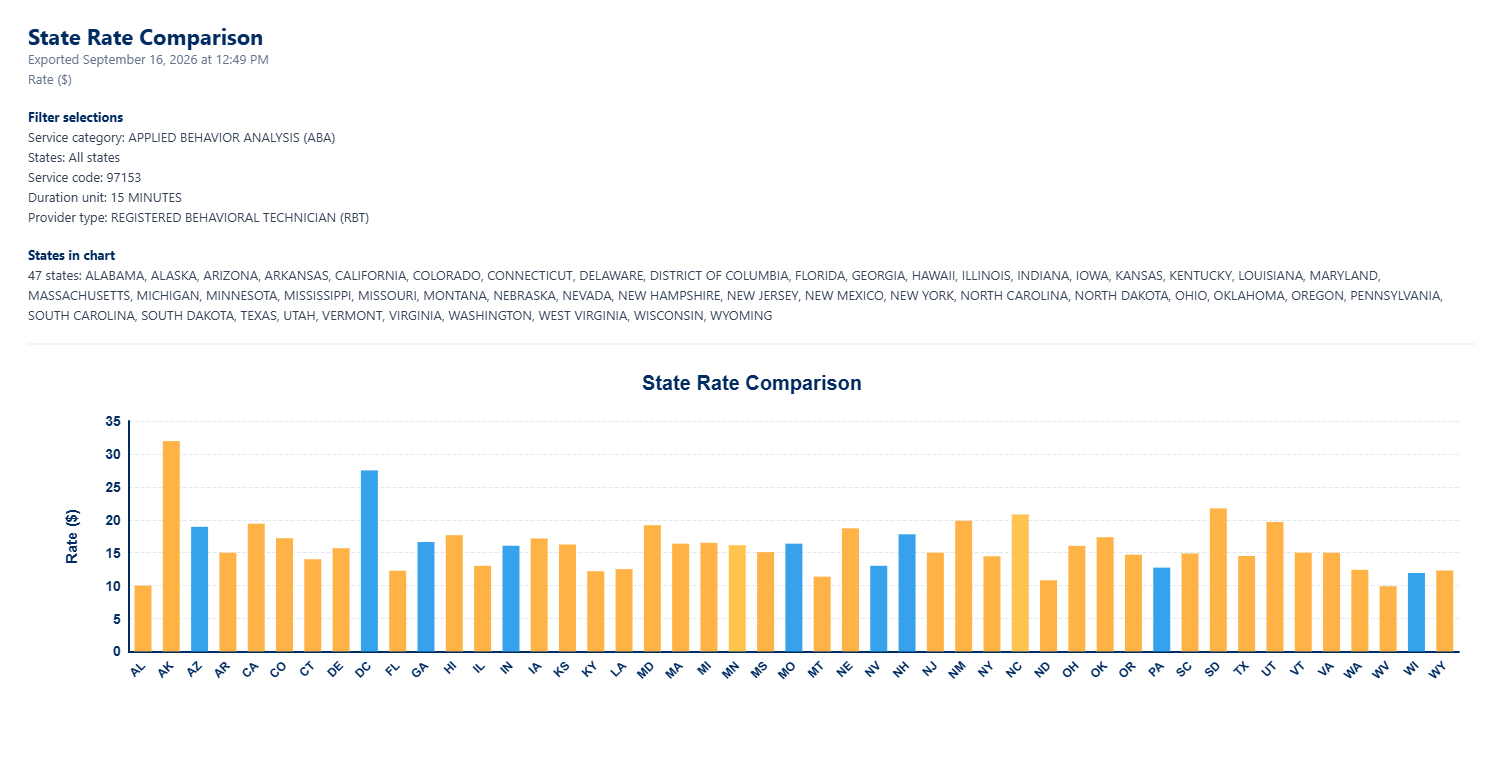
Across the 47 states and jurisdictions MediRate tracks for 97153 at the technician level, West Virginia currently pays the least at $9.90, with Alabama next at $10.00. Every other state pays $11 or more, and the national median sits near $15. New York’s current $14.45 places it slightly below that midpoint. On October 1 it will fall beneath West Virginia, a state with roughly a twelfth of New York’s wage base and none of its cost pressures, to become the lowest published Medicaid rate for the code in the country.
The comparison is imperfect in one direction that favors the state’s position. MediRate tracks published fee-for-service rates, and in managed care states the rates negotiated between plans and providers are not public. New York is a managed care state for most of its ABA volume, which is what makes the timing question consequential. When the second reduction took effect for fee-for-service on April 1, plans were not required to follow until December 1. The August notice does not say whether the same lag applies this time.
What New York ABA Providers Told the State Would Happen
Provider associations put their warnings on the record in February, before the third cut was proposed in the form that passed. In written testimony to the Senate Health Committee on February 6, the Council of Autism Service Providers told lawmakers that 73 percent of enrolled Medicaid providers may be forced to exit the network after the April reduction, and asked that the rate be left at $16.85. Four days later, the New York State Association for Behavior Analysis put the figure from the same joint survey at 74 percent and wrote that while most of its members had weathered the October cut, some had already suspended Medicaid services. Fernandez said a newer joint survey, still open and therefore preliminary, now puts the share of providers who may exit at 97 percent.
At least one national operator followed through. Autism Learning Partners told the same February hearing that the first cut was already threatening its services and that a second “will make our ability to deliver services in New York unsustainable.” On April 17, sixteen days after the second reduction took effect, the company announced that it had closed all of its New York Medicaid and Child Health Plus panels to new patients. It was serving 523 children in the state at the time, 480 of them covered by Medicaid or Child Health Plus, with 118 more waiting, and it halted planned centers in Albany and Yonkers. “These reductions come at the exact moment when New York families are finally gaining access to autism services through Medicaid,” President and Chief Executive Officer Gina Chang said in the announcement.
What New York ABA Providers Say $9.63 Does to the Math
Jim Spink, Chief Executive Officer at Autism Care Partners, said the current figure cannot be understood without the rate history that preceded it. When New York first set a Medicaid rate for 97153 in 2022, he said, it worked out to about $29 an hour, and providers told the state uniformly that operating a Medicaid ABA practice at that rate was impossible. Some refused to join managed care panels, others sent termination notices to the plans. The state paused implementation and came back with a rate of roughly $76 an hour, which he said the Department of Health described at the time as an actuarially sound blended rate, sufficient to ensure access to care and sustain a provider network.
“How did they go from $29 to $76 to $39, while operating costs (salaries, rents, health insurance costs, etc.) have only increased year over year in the state of New York?” he asked. The state has offered no account of its rate-setting methodology, he said, which further confirms for providers that the reduction is an arbitrary budget goal rather than a methodologically sound rate-setting outcome.
Ivy Chong, Chief Clinical Officer at Autism Care Partners, said the $38.52 hourly equivalent has to cover far more than a technician’s pay. In Brooklyn, the Bronx, and on Long Island, where the company operates, technician wages run north of $30 an hour, against a national norm closer to $25. Out of the same rate come payroll taxes, workers’ compensation, benefits, paid time off, recruiting, background checks, onboarding, training, supervision, scheduling, electronic records, billing and authorizations, accreditation, clinical leadership, space, and travel. “That $38.52 an hour does not cover a large proportion of what goes into care for an individual child,” she said.
The supervision requirement, she added, understates what quality providers actually do. New York’s five percent minimum is half the ten percent that generally accepted standards of care call for, and Autism Care Partners staffs to the higher figure because supervision is what drives technician retention, protocol fidelity, and outcomes. Her concern is less about providers leaving than about the ones who stay. Squeezed, some will trim the parts of the operation that are invisible to a claim: training, documentation audits, professional development, caseload limits. If the aim is to push out providers cutting corners, she said, the effect will be the opposite.
Spink expects the managed care plans to follow. “We have no reason to believe they will not,” he said. “They have followed every other rate reduction.” He spent years on the payer side before joining the provider community, and he said plans have no room to pay above what the state’s capitation supports. The knock-on effect reaches beyond Medicaid, because large payers operating several lines of business, including Child Health Plus and commercial products, typically require a contracted provider to serve all insured members across product lines. A provider that cannot afford the Medicaid rate may find itself outside the commercial network too, which he said sends an implicit message the state does not intend: that commercial subscribers’ care is valued more than the care of people on Medicaid.
Neither argued that the state has no cost problem, though Spink disputes how the state reads it. Autism prevalence has risen with broader screening, he said, and utilization rises with it; cutting the rate does not reduce the need. Chong pointed to medical necessity review, authorization consistency, and outlier billing monitoring as tools that target volume without flattening the rate. Spink sketched an alternative in which a smaller reduction is held back as a withhold that providers earn by demonstrating quality and cost outcomes such as family satisfaction, developmental gains, and appropriate titration of care. What is missing, he said, is the conversation. CASP has repeatedly asked to meet with the Department of Health about rate adequacy, and he said the provider community would welcome it.
Andy Lopez-Williams, a clinical neuropsychologist who leads ADHD and Autism Psychological Services and Advocacy in Utica, put the upstate case more bluntly. About 85 percent of the ABA his practice provides is Medicaid, he said, and the practice was already operating on a razor’s edge after the first two cuts. He described the October reduction as a death blow to his ability to stay in the Medicaid network, one that would mean the immediate discontinuation of medically necessary care for roughly 40 autistic children.
By the end of last week, that had stopped being a projection. Lopez-Williams said his practice is now notifying families that September 30, 2026, will be the final day it can provide ABA therapy to their children, and called it the most surreal moment of his career.
The timing leaves providers little room. Insurers ordinarily give contracted providers a notice period, commonly 90 days, before reimbursement changes take effect. That requirement does not apply to a change in a government fee schedule, Lopez-Williams said, which means the $9.63 rate would simply apply on October 1 without a plan having to notify anyone. When his practice contacted its provider representative at Fidelis Care for clarification, he said, she was unaware that a rate cut was coming and had no substantive response to the practice’s stated intent to discharge its ABA cases.
His objection to $9.63 is arithmetic before it is anything else. To make the rate work, he said, behavior technicians would have to be paid less than the minimum wage. “The math and the morality do not add up,” he said. He also said he knows providers who left the Medicaid network after the earlier reductions, and others who have said plainly that another cut would end their ability to deliver the service. On the clinical side, he returned to timing: the evidence on early, comprehensive, intensive intervention is strong enough that delay carries its own cost, and denial of services to children who need them produces lasting effects on social, language, intellectual, and adaptive functioning.
What $9.63 Means for ABA Provider Economics
What $9.63 means operationally is easier to state than to solve. The rate works out to $38.52 an hour for the technician code. Out of that, a provider pays the technician’s wage, payroll taxes and benefits, the Licensed Behavior Analyst supervision New York has required at a minimum of five percent of technician hours since last October, scheduling and billing staff, and space. The other codes on the fee schedule, including 97152, which is also delivered by a technician, remain at $19.26.
The department’s answer on 97152 is that the comparison does not hold: it treats that code as an assessment rather than a treatment service, one it says is rarely used and not generally appropriate for unlicensed staff. What the department has not published is an analysis showing how $9.63 was derived, or how it relates to what delivering an hour of technician time costs in New York.
The supervision requirement is part of the same picture. New York tightened its rules last October to align with national certification standards, setting a minimum of five percent Licensed Behavior Analyst supervision for technician hours. Those are costs the technician code carries. Raising the clinical floor while halving the rate that funds it is the tension providers have pressed on since the first reduction, and it is the question the department has not addressed in writing.
The state is not alone in reexamining what it spends on ABA. Indiana has adopted a 4,000-hour lifetime limit, North Carolina shortens authorizations for higher-intensity cases, and Florida has convened a task force that meets again this month. Federal auditors have pressed states on documentation and improper payments, and the 2027 CPT revisions will rewrite the code set these schedules are built on. Not every state is moving the same direction: Nevada now pays $30.10 for the same code. What distinguishes New York is the instrument. Other states are rewriting authorization rules and testing utilization controls. New York has chosen price, and has cut the same code three times while the rules around it stayed the same.
The October 1 date is days away. Whether managed care plans follow immediately, and whether the providers who told the state in February that they would leave actually do, are the two questions the next quarter will answer.