
Nevada’s Medicaid ABA rate hit $30.10 per 15-minute unit for professional care, $13.01 for technicians, in 2025. See the fee schedule and the access gaps.
Key Takeaways
- A substantial professional rate increase. Nevada’s professional ABA code (97155), and care billed under a Board Certified Behavior Analyst, reached $30.10 per 15-minute unit, a rate loaded into the state system in March 2025. Technician-delivered treatment (97153), which carries most direct therapy hours, pays $13.01 per unit (about $52 per hour), roughly the level set by 2021’s SB96, leaving a wide gap between the two rates.
Spending has surged. Medicaid ABA spending has climbed since 2021, lifted by higher reimbursement and rising autism prevalence. That growth has made ABA one of the most closely watched line items in the state’s behavioral health budget. - Access still lags the dollars. A January 2021 legislative audit (report LA22-04) found Medicaid and state-program ABA rates ran well below commercial pay and that only about a third of licensed providers served Medicaid children. Lawmakers have kept scrutinizing wait times and waitlists since, signaling the access question remains unresolved.
- Coverage is broad but gated by prior authorization. Nevada covers ABA for recipients of all ages with a qualifying diagnosis, across fee-for-service and managed care. Treatment runs through focused (15 to 25 hours) or comprehensive (25 to 40 hours) delivery models, each subject to prior-authorization limits.
Nevada has moved part of its Medicaid reimbursement for applied behavior analysis (ABA) sharply upward, and the state’s own fee schedule shows how far. On the schedule reflecting data through January 2026, adaptive behavior treatment by a professional (CPT 97155), and the same treatment billed under a Board Certified Behavior Analyst, pays $30.10 per 15-minute unit, a rate the state loaded into its claims system in March 2025. That works out to roughly $120 per hour of professional time. Adaptive behavior treatment by a technician (97153), the code that carries most direct ABA hours, pays $13.01 per unit, about $52 per hour, when delivered by a Registered Behavior Technician, roughly the level set by 2021’s SB96 and effective in 2022. The March 2025 increase, in other words, lifted the professional rate well above the technician rate that most therapy is billed under.
The increase lands in a program whose costs have grown fast. Medicaid ABA spending has climbed sharply since 2021, lifted by higher reimbursement, beginning with the 2022 increase that raised technician pay to about $52 per hour under SB96, and by rising autism prevalence. That kind of growth tends to draw scrutiny, and in Nevada it has: the Legislature, state auditors, and a developmental-disabilities council have all turned attention to how ABA is paid and whether children can actually get it.

What Nevada Medicaid Pays for ABA in 2026
Nevada’s ABA schedule is not a single column of prices. It lists multiple rates for each procedure code, broken out by provider specialty and modifier, which is why the same code appears several times at different amounts. Professional-delivered treatment (97155), and care billed under a Board Certified Behavior Analyst, pays $30.10 per 15-minute unit, effective March 10, 2025, while technician-delivered treatment (97153) pays $13.01, the rate that applies to the Registered Behavior Technicians who deliver most direct hours. The schedule also carries older entries dated 2022 and 2023 for specific specialty and modifier combinations, a reflection of the program’s layered, specialty-based pricing. The two charts below, from MediRate’s state Medicaid ABA database, compare Nevada with its neighbors on 97153 and 97155.
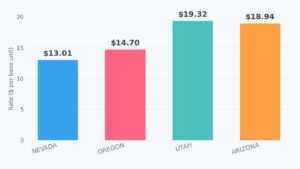
Adaptive behavior treatment by technician (97153), per 15-minute unit. Source: MediRate.
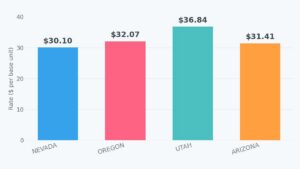
Adaptive behavior treatment by professional (97155), per 15-minute unit. Source: MediRate.
Nevada’s rate structure is shaped in part by state law. A 2017 statute, Assembly Bill 108, requires Nevada Medicaid to conduct a comprehensive rate review for every provider type at least once every four years, a cycle that includes the ABA provider type. Those reviews do not guarantee increases, but they create a recurring checkpoint at which rates can move, and the March 2025 figures reflect upward movement from the schedule’s older entries.
For providers, the multiplicity of rates is more than a formatting quirk. Which figure applies depends on the billing specialty and any modifier attached, so two organizations delivering the same service can be paid differently depending on how they are enrolled and how they code, a tiered approach that echoes Arizona’s AHCCCS fee schedule. Assessment by a professional (97151) carries its own figures by specialty, and several group and family codes pay considerably less than one-on-one treatment, so a provider’s economics depend heavily on its service mix. Nationally, Medicaid ABA rates for these codes range from roughly $12.50 to above $40 per 15-minute unit, which places Nevada’s $30.10 professional rate in the upper-middle of the field, while its $13.01 technician rate sits near the bottom.
Why Nevada’s ABA Spending Surged, and What Lawmakers Are Watching
The dollars have climbed, but access has not kept pace, and the state’s own record documents the gap. A January 2021 report from the Nevada Legislative Auditor (LA22-04) found that the providers delivering most one-on-one therapy, Registered Behavior Technicians, were paid by Medicaid and the state’s autism assistance program at about half the rate private insurers paid, and that only roughly a third of licensed ABA providers served Medicaid children in fiscal year 2020. The same report flagged enrollment as burdensome and documented waitlists for children covered by Medicaid.
State attention has continued since. In 2025, at the Legislature’s request, Nevada Medicaid sought provider data on the time from evaluation to diagnosis to treatment and on waitlist sizes. The Governor’s Council on Developmental Disabilities has stayed active on ABA access into 2026, alongside Nevada Medicaid and state insurance regulators. State staff have acknowledged a provider shortage driven primarily by workforce limitations, with some providers pausing or exiting over staffing and administrative demands. The tension between rising reimbursement and persistent access gaps now runs through nearly every official discussion of the benefit, and it mirrors a national pattern in which managed care rate decisions, like CareSource’s Georgia rate cut, can quickly reshape what providers are willing to deliver. Indiana’s aggressive reform cycle shows how fast a fast-growing ABA line item can become a target for cost containment, and the ABA Coding Coalition has pushed back as states restrict concurrent billing and telehealth.
The audit also traced how children move between programs. Nevada’s Autism Treatment Assistance Program has shifted qualifying children onto Medicaid over time, and auditors noted that school hours themselves are a barrier, since time in the classroom competes with the intensive weekly hours ABA plans call for. Taken together, the findings described a system where coverage existed on paper but the supply of providers willing to serve Medicaid families, at the rates then on offer, did not match the need. The 2025 rate increase is the state’s most direct answer to that gap, though whether it pulls more providers into Medicaid participation will not be clear for some time.
Coverage, Provider Types, and the Delivery Pathway
Nevada covers ABA through its own Medicaid provider type, Type 85, established to handle these services distinctly from the broader rehabilitative behavioral health provider category that covers traditional psychotherapy. The state’s coverage is unusually broad on age: Nevada Medicaid covers ABA for recipients of all ages, including those with autism spectrum disorder, fetal alcohol spectrum disorder, or other conditions for which it is medically necessary, not only children under 21.
Authorization is its own gate. Before treatment begins, a licensed psychologist or BCBA must take responsibility for clinical direction, supervision, and case management, and the initial request must rest on a functional assessment and a qualifying diagnosis documented on the state’s authorization forms. The decision to give ABA its own provider type, rather than leaving it inside the rehabilitative behavioral health category that covers traditional psychotherapy, gave the state a cleaner way to set ABA-specific rates, rate-review cycles, and billing rules, the same machinery now producing the upward movement in the fee schedule.
Delivery runs through two models, each gated by prior authorization. Under the focused model, providers may deliver 15 to 25 hours of ABA per week for a limited set of behavioral targets; under the comprehensive model, 25 to 40 hours per week across multiple domains. Those limits can be exceeded with prior authorization and documentation of medical necessity. Services reach families through both fee-for-service and managed care, and the managed care side widened on January 1, 2026, when Nevada extended mandatory managed care statewide and moved roughly 75,000 rural residents out of fee-for-service. The program now contracts with five plans: Anthem Blue Cross and Blue Shield Healthcare Solutions, CareSource, Health Plan of Nevada, Molina Healthcare, and SilverSummit Healthplan, and plan rates may differ from the published fee-for-service schedule. For providers evaluating Nevada, and for the buyers who weigh state Medicaid economics in due diligence, that mixed structure means the published rates are a starting point, not the whole story, a point underscored by how the largest national ABA providers pick their markets.
For operators, the takeaway is that Nevada has put real money behind the benefit, raising technician pay under SB96 in 2022 and the professional rate more recently, while leaving the harder problem, a workforce thin enough that dollars alone may not fill it, only partly addressed. The higher professional rate makes Nevada more competitive on paper than it was, but the state’s own audits and surveys suggest reimbursement is one variable among several that determine whether a child actually starts therapy.