
The state with the highest share of residents on Medicaid has 186 behavior analysts, and no published review of the rate providers say is driving them out.
Key Takeaways
- The workforce numbers track the rate. At $9.90 per 15-minute unit, West Virginia pays less for code 97153 than any other state, roughly a third below the national median of about $15.
- Demand is concentrated in Medicaid. The state has 10.5 behavior analysts per 100,000 residents, sixth lowest nationally, while every neighboring state runs higher, from Ohio at 12.6 to Virginia at 24.4.
- Geography does the rest. West Virginia has the highest share of residents on Medicaid of any state, and 53 percent of its children are covered. A provider who declines Medicaid forgoes most of the market.
- A rate review surfaced in March and has not been seen since. A newly appointed state ABA program manager told providers a rate study was underway. Nothing has been published, and the ABA schedule carries no revision stamp.
There are 186 board certified behavior analysts in West Virginia. Not 186 clinics, or 186 open positions. That is the entire supervisory workforce for applied behavior analysis in the state, counted across every setting: private practice, hospital, school, research and consulting.
The figure comes from Behavior Analyst Certification Board certificant data measured against Census population estimates, and it works out to 10.5 analysts per 100,000 residents. Only five states run thinner. Every state on West Virginia’s borders runs higher: Ohio at 12.6, Kentucky at 15.5, Maryland at 19.7, Pennsylvania at 22.6 and Virginia at 24.4. Averaged, the five neighbors sit 81 percent above West Virginia.
Acuity reported in August that West Virginia pays $9.90 per 15-minute unit for CPT code 97153, which covers adaptive behavior treatment delivered by a technician. It is the bulk of the hours in a typical ABA plan and the line that pays the registered behavior technicians who deliver them.
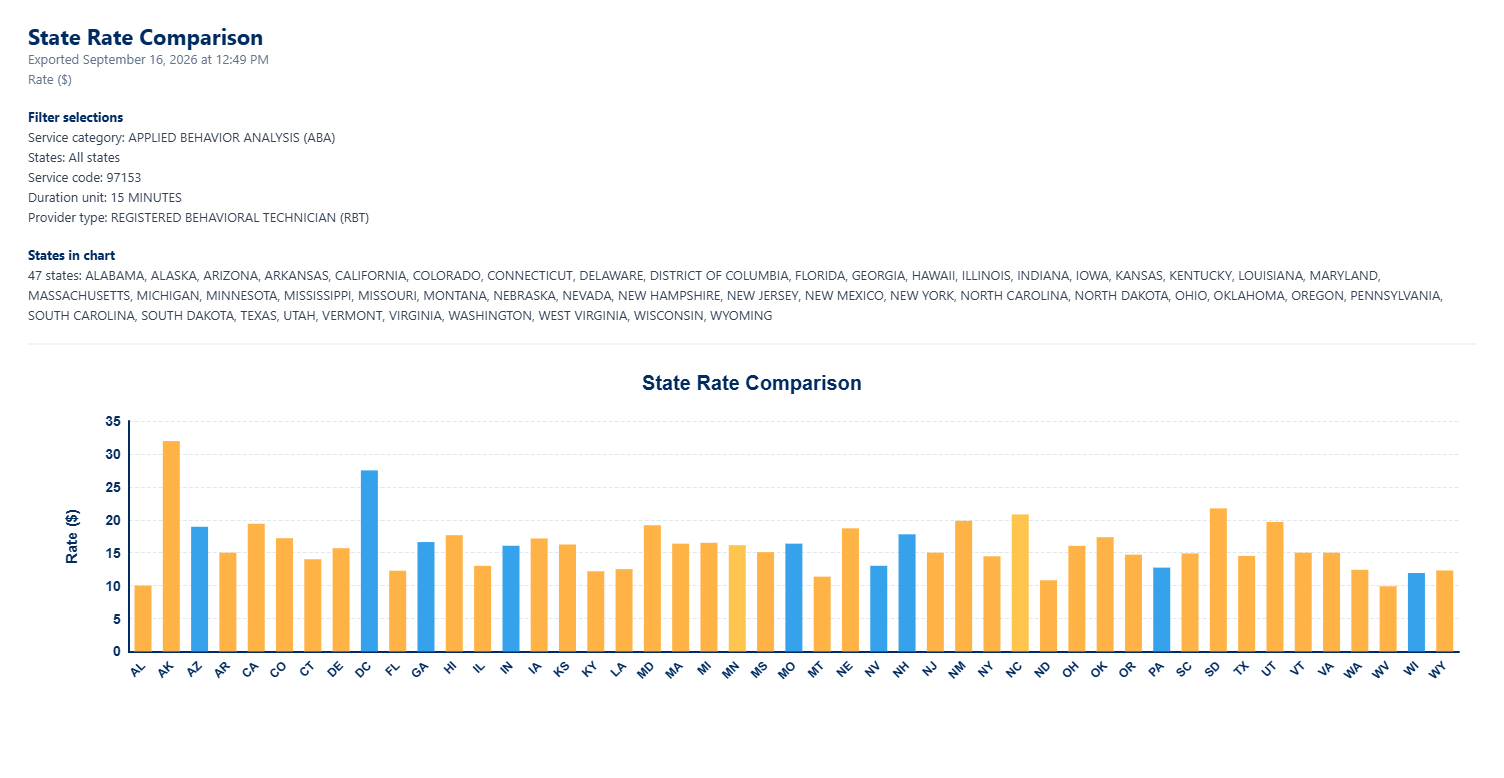
A national comparison of that code run through MediRate, the Medicaid rate-tracking platform Acuity partners with for state rate reporting, places West Virginia at the bottom of the country.
Source: MediRate
Across the 47 states and jurisdictions MediRate tracks for 97153 at the technician level, no state pays less. Alabama is next at $10.00, and every remaining state pays $11 or more. The national median sits near $15, which puts West Virginia roughly a third below it. A separate 2026 compilation of published state fee schedules reaches the same conclusion, placing the national range from $9.90 in West Virginia to $30.10 in Nevada. Four states sit outside the MediRate comparison, among them Tennessee, which publishes no statewide fee-for-service rate because its Medicaid program routes ABA entirely through managed care contracts. The West Virginia rate has not moved in years, while other codes on the same fee schedule have. That distinction is about to change hands: New York has cut 97153 three times in a year and will pay $9.63 as of October 1, which will make it the national floor.
Two numbers, one about price and one about supply, do not by themselves establish that the first caused the second. What follows is the case that providers in the state have been making to the Bureau for Medical Services, and the public data that can be checked against it.
Acuity spoke with multiple West Virginia ABA providers who agreed to describe the situation only on background, each citing a fear of retaliation from the state Medicaid agency. Where those accounts appear below, they are identified as such, and the figures around them come from public sources that can be checked independently.
Why the West Virginia ABA Provider Shortage Is a Medicaid Shortage
West Virginia is the state with the highest share of its population enrolled in Medicaid, at 29 percent. Among children the figure is 53 percent, and among children with special health care needs it is 56 percent, according to KFF. Autism qualifies many children for coverage through waiver pathways regardless of household income, which pushes the share higher still within the population that needs ABA.
That concentration is what makes a single code decisive. In a state where most children who need the service are covered by Medicaid, a provider cannot build a business on commercial payers unless it sits somewhere with enough commercially insured families to fill a caseload. West Virginia has few such places. It is rural, mountainous, and its metropolitan areas are small and widely separated.
Providers describe the result as a map problem rather than a willingness problem. Agencies cluster where commercial volume supports them, which leaves the majority of the state’s geography without a provider within a reasonable drive at any reimbursement level. Even inside those metropolitan pockets, providers report waits of a year or more for commercially insured families, which is consistent with what national workforce data would predict.
Applying the CDC’s current prevalence estimate of about 1 in 31 children to West Virginia’s under-18 population gives roughly 11,000 autistic children statewide. Set against 186 analysts, that is about 59 children per supervisory clinician before accounting for the roughly 72 percent of analysts who practice primarily in autism, or for the share who do not see clients at all. Planning benchmarks used in workforce research assume closer to eight. The arithmetic is rough, and the direction is not in doubt.
The RBT Workforce Pipeline Runs Through Medicaid Code 97153
A workforce expansion project called We Develop ABA has operated in the state since 2023, aimed at growing the registered behavior technician pipeline. The logic is straightforward: technicians deliver the hours, technicians grow into analysts, and a state that trains more technicians can serve more children.
The constraint is that 97153 is the code technicians bill under. An agency can recruit and train as many as it wants and still be unable to pay them from what the rate returns. The analyst pipeline nationally has not kept pace with demand, with roughly 1.6 posted positions for every certified analyst in the country, and a state competing for that workforce at the bottom of the regional pay range starts from behind.
Providers have also raised, and largely dismissed, the possibility that managed care organizations might close the gap through preferred-provider rates above the Medicaid floor. The structural obstacle is that West Virginia’s ABA agencies are almost entirely small businesses. Preferred rates tend to go to organizations large enough to move an MCO’s network adequacy numbers, and no provider in the state is that size. Rate pressure has moved the other way in other states, where an MCO cut ABA reimbursement 20 percent with no negotiation window.
Private Equity Has Skipped West Virginia ABA, and the Rate Is Why
There is a finding here that runs against the national pattern. Private equity, which acquired 574 autism therapy centers across 42 states in a decade, has essentially not entered West Virginia. Providers in the state describe occasional one-off contracts and no sustained interest, including from operators working across state lines in border markets.
The reason they give is the same rate. At $9.90 there is no margin to consolidate, and analyst and technician pay in West Virginia sits below the surrounding states, which removes the second lever a buyer would ordinarily pull. The state’s ABA sector has stayed local and small by default rather than by design, in a market where the largest operators are measured in hundreds of locations.
Providers are candid that this is not an unmixed benefit, and that a rate increase would likely bring outside capital with it. It does mean that West Virginia offers something unusual: a state where the consolidation debate has not yet started, and where whatever policy follows a rate change will be tested on a sector still composed of the kind of small practices that elsewhere close without leaving a public record.
A West Virginia Medicaid ABA Rate Study Providers Heard About and Have Not Seen
A manager newly appointed to run the state’s ABA Medicaid program in February joined a virtual meeting of a provider committee focused on Medicaid credentialing and authorization. On March 2 she mentioned that a rate study was underway. Multiple providers on that call have described the disclosure as the first they had heard of it.
Nothing about that study has been published since. The Bureau for Medical Services has not announced findings, a timeline, or a decision. West Virginia posted a rate analysis section alongside its fee schedules in July, which aligns with the federal compliance deadline under the 2024 Medicaid Access Rule for states to publish comparative payment rate analyses. That requirement covers primary care, obstetric and outpatient behavioral health codes, and ABA codes sit outside its scope. The ABA schedule itself carries no revision stamp.
Providers first raised the 97153 rate with the Bureau in writing more than a year ago, in correspondence that included state officials. The argument they made then was narrow: not that West Virginia is a low payer generally, but that this particular code appears to have been set once and left, while comparable therapy codes on the same schedule were maintained.
Acuity asked the Bureau for Medical Services whether a rate study covering ABA codes has been completed, what its status is, whether code 97153 is under review, and what the Bureau makes of the state’s position at the bottom of the national range. The Bureau did not respond before publication. Acuity has also requested the study, its transmittal and the underlying contract under the West Virginia Freedom of Information Act.
Jill Scarbro, a Board Certified Behavior Analyst and owner of Bright Futures Learning Services, began taking Medicaid through managed care plans on a limited basis last year and has not been able to expand since. At $9.90 a unit, or $39.60 an hour in gross revenue, she said the figure has to cover technician pay and benefits, onboarding, credentialing and ongoing training, non-billable time, administrative staff, compliance, facility overhead, clinical supplies, and unbilled cancellations. Her clinic can serve roughly ten percent of the families who contact it. “We are forced to make heartbreaking decisions about who gets care,” she said, “knowing that if we risk sinking our organization financially, no child will receive help.”
She also pointed to an administrative difference that compounds the rate. West Virginia requires technicians to be fully credentialed before they serve a single Medicaid recipient, while neighboring states allow a grace period for supervised in-house training. Small providers absorb the entire cost of recruitment, background checks, and training with no state support, which she said creates a bottleneck before care begins.
Her comparison is geographic. Acuity’s rate data puts Maryland at roughly $19, Ohio at about $16, Virginia near $15, Pennsylvania close to $13, and Kentucky around $12 for the same code. “A child in Wheeling, West Virginia, and a child directly across the river in Ohio can have the exact same autism diagnosis, the same clinical needs, and parents who are equally desperate for support,” she said. “Yet one state has decided that child’s care is worth paying for, while ours has not.”
The Medicaid Pathways Around Chapter 519, and What They Cost
The ABA fee schedule is not the only way West Virginia buys behavior analysis, and the alternatives complicate the picture in both directions. Nathel Lewis, a Board Certified Behavior Analyst and Executive Director of Children and Youth Services at Diversified Assessment and Therapy Services, pointed to two adjacent Medicaid policies that recognize the BCBA credential: Chapter 503, which governs licensed behavioral health centers, and Chapter 502, the waiver for children with serious emotional disorders.
Those policies are in some respects more flexible than the ABA benefit. Chapter 503 pays for group codes and for services delivered in community settings, where most commercial plans confine ABA to a clinic or a home. Chapter 502 allows ABA under its specialized therapy authorization. Both let a master’s-level, non-licensed therapist deliver services as long as a licensed clinician supervises the caseload, which means Lewis’s BCBA fieldwork students can provide ABA under these programs. A later change expanded the service location from the home alone to the home, school, or office. The state made those changes, she said, to increase access and reduce the number of children waitlisted for therapy.
Two things limit how much relief that provides. The first is the gate: to bill under these policies, an ABA center has to become a licensed behavioral health center, and by Lewis’s count only four ABA centers in West Virginia have done so. The second is the rate, which does not improve much on the way through. The LBHC fee schedule pays $10.50 per 15-minute unit for one-to-one skills training delivered by a paraprofessional, about sixty cents above 97153. On the waiver side, in-home respite pays $5.01 per unit, roughly half the ABA rate.
The RBT credential is not written into either policy, which is where Lewis says the arithmetic stops working. She would not expand service at the technician level under these codes, because the rates would not cover the travel time she would have to pay for. One of her fieldwork students, based in rural Greenbrier County, drives an average of an hour and 45 minutes each way to see families.
Her larger warning is that a rate increase alone may not solve what the state is facing. West Virginia is ahead of much of the country in writing behavior analysts into multiple Medicaid policies, she said, and in not restricting ABA to an autism diagnosis. What it struggles to sell is the work itself. “How do you sell our culture and way of life to the next generation that want everything at their fingertips for easy access?” she asked. Young clinicians in West Virginia drive back roads with spotty cell service on winter nights, and the states hiring them away offer both higher salaries and clinic-based caseloads.
What Changing the West Virginia ABA Medicaid Rate Would Take
The ask from providers is unusually contained. Not a benefit redesign, not a new waiver, not a restructuring of how the state buys behavioral health. One code, reviewed, with findings published. Federal law requires state Medicaid payments to be sufficient to enlist enough providers that covered care is available to beneficiaries to the same extent it is available to the general population, a standard West Virginia’s own numbers invite scrutiny against. The Supreme Court held in 2015 that providers cannot enforce that provision themselves, which leaves CMS and the state as the only parties who can act on it.
West Virginia does not license behavior analysts, one of roughly ten states without a licensure law, so there is no state registry through which to track the workforce independently of national certification data. That makes the certification counts the only reliable measure available, and those counts have the state near the bottom while demand sits near the top.
The rate is not the only gap in what West Virginia buys. The state does not cover 97157, the multiple-family group adaptive behavior treatment code, and does not cover 0362T and 0373T, the codes used for assessment and treatment of severe harmful behavior, according to the Council of Autism Service Providers. Those two codes are being discontinued in the 2027 CPT set and converted to permanent category I status with add-on codes, which gives the state a scheduled occasion to revisit what its fee schedule covers alongside what it pays.
What the West Virginia ABA Rate Looks Like From a Waiting Room
Susannah Poe, Ed.D., BCBA-D, president of the board of directors at Mountaineer Autism Project and a professor emerita at the West Virginia University School of Medicine, has watched the coverage question from both sides. Before Medicaid covered ABA in the state, she said, West Virginia law required state-regulated private plans to cover it for qualifying children, but the mandate reached only non-grandfathered individual plans and fully insured small and large group plans. Self-funded employer plans sat outside it. By one contemporaneous account she recalls from an advocacy presentation, only about 20 percent of West Virginia families held coverage that met the mandate. When Medicaid began covering ABA in 2019, it opened the door for more than half the children in the state.
More clinics opened after that, and the number of providers grew, she said, in part because of work by Mountaineer Autism Project to build the profession in the state. The growth ran into the same wall each time. Most clinics could not afford to take Medicaid children at reimbursement rates that would not cover overhead.
Her current numbers describe the result. Of roughly 10,000 children with autism in West Virginia, Poe estimates about four percent receive ABA treatment, and those who do are concentrated in population centers. Forty-four of the state’s 55 counties have no ABA services at all. The clinics operating in the remaining counties, she said, carry waitlists of nine to 12 months. Mountaineer Autism Project’s own published findings put it similarly: 96 percent of autistic young people in the state lack access to early intervention ABA, and the 44 counties without a clinic include four of West Virginia’s ten most populous.
A provider who runs a licensed behavioral health center in the state, and who spoke on background citing the risk of retaliation, described what the rate means inside an operating budget. Before 2021, the state paid $5.50 per 15-minute unit for technician services under its old code, which he said made it financially impossible for organizations to enter the system at all. The 2021 increase to $9.90 let a small number of providers open limited Medicaid capacity. Costs have risen since; the rate has not.
A license, he added, carries obligations that go well beyond therapy: staffing ratios, supervision, HIPAA compliance, documentation standards, quality assurance, training mandates, safety protocols, all of them fixed costs. At $9.90, he said, the rate “doesn’t come close to covering the cost of a registered behavior technician, let alone the infrastructure required to legally operate,” and is “structurally incompatible with the regulatory environment we are required to maintain.” Every Medicaid hour, in his account, is delivered at a loss, which limits hiring, restricts growth, and forces constant triage over which families can be served.
West Virginia Families Describe the Search for an ABA Provider
Jamie, a parent in southern West Virginia who asked to be identified by her first name, called roughly five ABA providers looking for services for her son. Three told her directly, usually within the first ten minutes of the conversation, that they did not accept Medicaid because of the reimbursement rates. “It almost came off as a ‘let me tell you now, before we go any further’ type of statement,” she said. “It’s not that the providers don’t want to enroll; they can’t afford to accept traditional WV Medicaid at the current reimbursement rates and stay open.” Several were in network with other Medicaid plans that pay differently.
Her son has commercial insurance as his primary coverage and Medicaid as secondary, which introduced a second obstacle. A clinic about an hour away accepted his commercial plan but not Medicaid, and a provider that does not participate in Medicaid cannot bill it for the remaining patient responsibility. The family was left with the balance. To her knowledge, one ABA center in West Virginia accepts Medicaid. It is about four hours from her home and has a long waitlist. “A provider may technically exist somewhere in the state,” she said, “but when that provider is four hours away with a long waitlist, it is not realistically accessible for ongoing therapy for a family in rural southern West Virginia.”
Vanessa, a West Virginia parent, ran into the same wall in 2023. Her daughter’s provider did not take Medicaid, so she called every practice in the surrounding areas to confirm what she was hearing. She found one that did. It was an outpatient setting offering about an hour a week, closer to a weekly therapy appointment than to the intensive model ABA is built around.
Kayla Lycans, a parent in Wayne County, is waiting on a different line. Her daughter was denied a state disability waiver three times and has now been on the waitlist for the intellectual and developmental disability waiver for three years, currently number 298. Reaching the waiver would bring Medicaid coverage; until then the family pays out of pocket. She calls every four to six months and is told the same thing, that there is not enough funding to add more children. “I know moms who have been on the waitlist for 10-plus years and still are waiting to get it,” she said.
Ranzi Stacy, a West Virginia parent of two children with autism, said a provider that opened in the state within the past two years does not accept Medicaid, which she understood to be a deliberate choice about rates rather than a temporary gap.
Not every account runs in one direction. Michelle Ramey, a parent in Putnam County, said the corridor between Huntington and Charleston has improved markedly over 15 years, with more ABA, occupational therapy and speech available and better readiness among medical providers. Her concern is what happens outside those corridors, and what happens at diagnosis: in her surveys of other parents, she said, the most common complaint is that a doctor delivered the diagnosis with no next steps attached. Every April she takes resource lists to local pediatricians so families hear their options from someone.
What keeps providers awake, Scarbro said, is what arrives next. CMS has reported that Medicaid and CHIP spending on ABA grew from $1.94 billion in 2021 to $10.1 billion in 2025, and the federal toolkit published this summer is built around that growth, with chapters on fraud, waste, and overutilization. National overuse is not West Virginia’s story. By her estimate fewer than five percent of autistic children in the state, roughly 400, receive ABA at all, and almost none of them through Medicaid. Guardrails written for states with high spending, applied uniformly, would not curb waste in West Virginia. They would close the few doors still open to families who have already waited years.