
West Virginia’s Medicaid ABA fee schedule carries effective dates between 2019 and 2021, paying $9.90 per unit for technician-delivered autism treatment.
Key Takeaways
- The lowest technician rate in the region: West Virginia Medicaid pays $9.90 per 15-minute unit for CPT 97153, adaptive behavior treatment delivered by a Registered Behavior Technician. Every contiguous state pays more, from Kentucky at $12.18 to North Carolina at $20.81.
- A fee schedule and a coverage policy both frozen: The entries on West Virginia’s Applied Behavior Analysis fee schedule carry effective dates between August 1, 2019 and April 1, 2021, and none later, and the file posted on the Bureau for Medical Services website today is that same document. Chapter 519.23 of the provider manual, which governs coverage, took effect April 1, 2020 and has not been revised since.
- Rate-setting reached the waiver, not the state plan: The state’s rate study contractor was engaged for the Intellectual/Developmental Disabilities, Aged and Disabled, and Traumatic Brain Injury waivers and the Personal Care program. Behavior Support Professional rates under the I/DD Waiver rose about 6 percent on October 1, 2025, while Applied Behavior Analysis, which sits in the state plan, received nothing.
- Capacity is the constraint alongside price: West Virginia has no behavior analyst licensure statute and relies on Behavior Analyst Certification Board credentials instead. Local reporting describes a statewide waitlist in the thousands and in-state graduates taking positions across the border, figures Acuity has not independently verified.
The Applied Behavior Analysis fee schedule on the West Virginia Bureau for Medical Services website is a single page. It lists fourteen line entries covering thirteen codes, and the newest effective date on any of them is April 1, 2021. Most other fee schedules on that page, from anesthesia to private duty nursing to the comparative rate analysis, carries a revision stamp from June or July of 2026. The ABA schedule carries none.
That is most of the story of Medicaid autism reimbursement in West Virginia, and it is worth stating plainly, because the state has not been standing still on everything else. In October 2025, following a rate study and an announcement from Governor Patrick Morrisey, West Virginia raised Home and Community Based Services rates across four programs. Behavior Support Professional I, delivered one-to-one under the Intellectual/Developmental Disabilities Waiver, went from $12.80 to $13.58 per 15-minute unit. Behavior Support Professional II went from $15.34 to $16.27. The published scope of that study covers the Intellectual/Developmental Disabilities, Aged and Disabled, and Traumatic Brain Injury waivers and the Personal Care program. Applied Behavior Analysis is not among them, and it did not move. Frozen schedules are not unique to West Virginia, as Louisiana’s unchanged rates since 2022 and Kansas’s unchanged since 2019 on every code but one show. What is distinctive here is that the freeze runs alongside a documented increase for behavior work under a different authority.
What the West Virginia ABA Fee Schedule Actually Pays
West Virginia prices ABA on a flat statewide schedule with no geographic adjustment and no credential tiers. Behavior identification assessment under 97151 and adaptive behavior treatment with protocol modification under 97155 both pay $29.14 per 15-minute unit. The assessment support code 97152 and technician-delivered treatment under 97153 both pay $9.90. Group treatment by a technician under 97154 pays $4.50. Family adaptive behavior treatment guidance under 97156 pays $17.43, and group treatment with protocol modification under 97158 pays $11.79. The schedule also carries H0031 for a functional assessment by a non-physician at $120.00 per event.
One code is missing. Multiple-family group adaptive behavior treatment guidance, 97157, does not appear on the ABA fee schedule, does not appear in the provider manual chapter, and is listed as not covered on the state’s physician fee schedule effective April 1, 2026. Group caregiver training is not a billable West Virginia Medicaid service. The remaining ABA codes appear on the state’s physician schedule as carrier priced with zero relative value units, meaning that schedule assigns them no value and their pricing is set elsewhere.
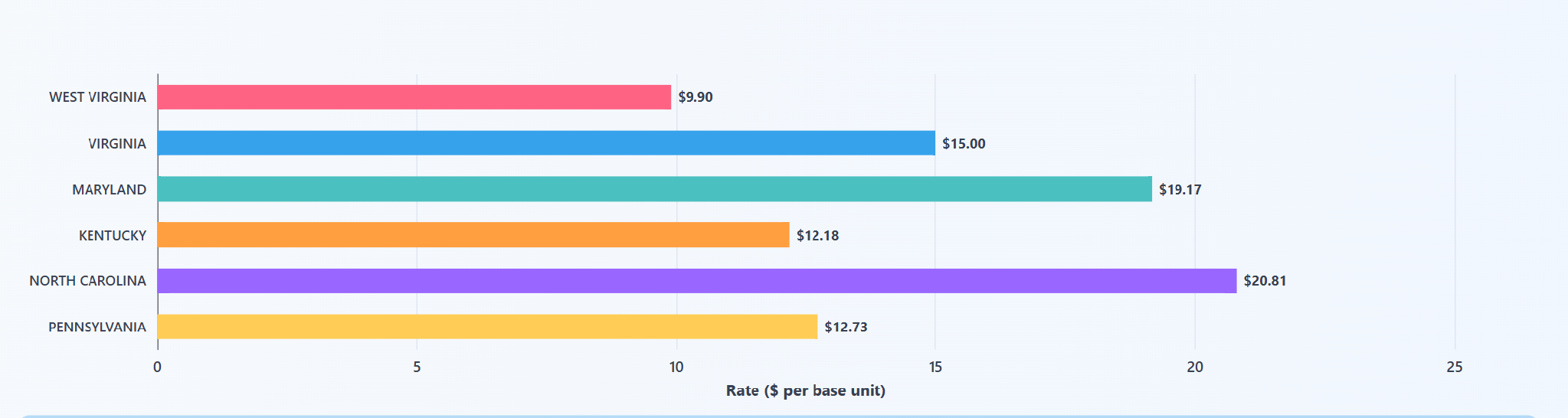
Medicaid 97153 (adaptive behavior treatment by protocol, technician-delivered), maximum allowable rate per 15-minute unit: West Virginia and selected neighboring states, as of July 2026. West Virginia’s ABA CPT rates carry 2020 and 2021 effective dates. Source: MediRate.
The $9.90 figure is what most providers will notice first. Across the six-state ring it is the floor. Kentucky pays $12.18, Pennsylvania $12.73 on a schedule unchanged since 2020, Virginia $15.00, Maryland $19.17, and North Carolina $20.81. A West Virginia clinic delivering an hour of technician treatment collects $39.60. The same hour, delivered under the same national credential to a child of the same acuity, is worth $83.24 across the North Carolina line. Readers who need the underlying code-level and modifier-level detail across all fifty states will find it maintained by MediRate.
Who Can Deliver ABA in West Virginia, and Who Qualifies for It
West Virginia has no behavior analyst licensure statute, one of a small number of states in that position. Published licensure surveys trace the absence to a 2012 Sunrise Report to the Joint Standing Committee on Government Organization, which concluded that oversight by the Behavior Analyst Certification Board provided adequate consumer protection. Medicaid recognizes Board Certified Behavior Analysts, including doctoral-level certificants, Board Certified Assistant Behavior Analysts working under supervision, and Registered Behavior Technicians working under supervision. The gatekeeping credential is national rather than state-issued, which is the opposite of the approach in states like South Dakota, where only Licensed Behavior Analysts may enroll to bill.
Eligibility is narrower than in most states. Chapter 519.23 covers Medicaid members from 18 months through age 20 who carry a primary autism spectrum disorder diagnosis rendered before their eighth birthday, and the provider must submit documentation establishing that the diagnosis predates the eighth year. A child diagnosed at nine does not qualify regardless of clinical need. Prior authorization is required for every service, retrospective review requests are denied outright, and the combined weekly limit across all ABA codes is 40 hours, with no more than eight hours in any 24-hour period. Family members and other non-credentialed individuals delivering ABA are expressly not a covered benefit.
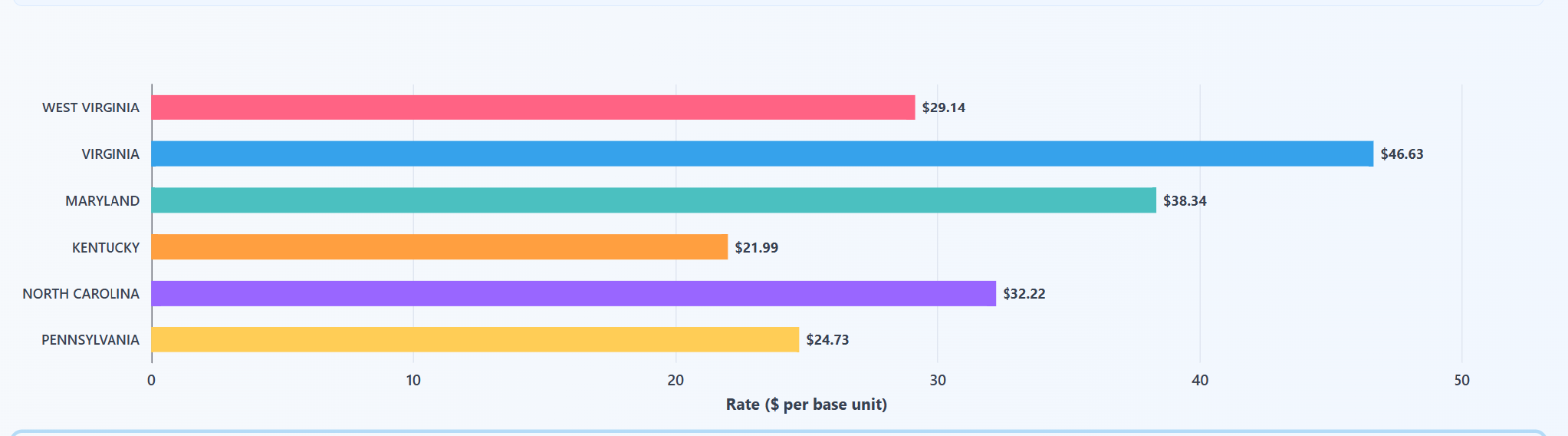
Medicaid 97155 (adaptive behavior treatment with protocol modification, analyst-delivered), maximum allowable rate per 15-minute unit: West Virginia and selected neighboring states, as of July 2026. West Virginia’s ABA CPT rates carry 2020 and 2021 effective dates. Source: MediRate.
On analyst-delivered treatment the picture improves, but only in relative terms. West Virginia’s $29.14 for 97155 sits above Kentucky’s $21.99 and Pennsylvania’s $24.73 and below North Carolina, Maryland, and Virginia, which pays $46.63 at its Licensed Behavior Analyst tier. That is a mid-pack analyst rate attached to a bottom-of-the-range technician rate, and the ratio matters. West Virginia pays roughly 2.9 times more for an analyst unit than a technician unit; in Maryland the multiple is about 2.0, and in North Carolina about 1.5. A West Virginia practice earns proportionally more from analyst time than its neighbors do, which cuts against the staffing model most comprehensive programs are built on.
The Commercial Mandate Runs on Different Rules
West Virginia’s autism insurance mandate, at Section 33-16-3v of the state code, requires group accident and sickness policies to cover diagnosis, evaluation, and treatment of autism spectrum disorder for individuals from 18 months to 18 years, again conditioned on a diagnosis at age eight or younger. Applied behavior analysis must be provided or supervised by a Certified Behavior Analyst, and the Certified Behavior Analyst must file progress reports with the insurer twice a year. The annual benefit is capped at $30,000 for three consecutive years from the start of treatment, then $2,000 per month until the individual turns 18. Employers with 25 or fewer eligible employees are exempt.
The result is three rulebooks for the same therapy in one state. The Medicaid benefit has a 40-hour weekly ceiling and no dollar cap. The commercial benefit has a dollar cap and no hour ceiling. The I/DD Waiver behavior support track is priced on a separate schedule under separate codes, and it is the one that received an increase last fall.
The Access Problem Underneath the Rates
Rates are only half of what determines whether a West Virginia child receives treatment. Capacity is the other half, and by the accounts of the people building it, capacity is short. West Virginia MetroNews reported in May 2026, in an article on a Marion County provider, that at least 17 ABA service providers operate in the state and that a waitlist of more than 2,000 families persists. In a separate report that month, WAJR quoted the Mountaineer Autism Project describing graduates of behavior analysis programs at West Virginia University, Marshall University, and Martinsburg College taking jobs out of state. Acuity has not independently verified the waitlist figure, and West Virginia does not publish an ABA-specific access report. The mismatch between demand for behavior analysts and the supply pipeline is a national condition, but a low-rate rural state feels it first.
The state’s own waiver utilization data shows how thin the specialist layer is. In calendar year 2025, Behavior Support Professional I generated 42,548 paid claims across 2,468 beneficiaries. Behavior Support Professional II, the higher-credentialed tier, generated 1,312 claims across 73 beneficiaries. Small practices absorbing fixed compliance costs on a $9.90 unit have little room, and closures at that end of the market leave almost no public record.
What Would Have to Change
Nothing in the current public record suggests West Virginia is preparing to revisit its ABA schedule. The rate study that produced the October 2025 increases was scoped to home and community based services, and its methodology and cost survey materials are published on the contractor’s site. Extending that machinery to the state plan ABA benefit would take a separate engagement, a separate appropriation, and a State Plan Amendment. North Dakota has demonstrated that small percentage increases do not lift a state off the bottom once the gap is this wide.
In the meantime the arithmetic sits where it has since 2021. A technician hour is worth $39.60 in West Virginia. The provider manual chapter governing what that hour must contain was written in 2020, before the pandemic reshaped the ABA workforce and before most surrounding states rewrote their autism coverage policies. Providers operating across state lines in the Eastern Panhandle or the Northern Panhandle are running two sets of economics at once, and only one of them has moved.
Frequently Asked Questions
What does West Virginia Medicaid pay for ABA therapy in 2026?
Per 15-minute unit, West Virginia pays $29.14 for 97151 and 97155, $9.90 for 97152 and 97153, $4.50 for 97154, $17.43 for 97156, and $11.79 for 97158. A functional assessment by a non-physician under H0031 pays $120.00 per event. The rates are flat statewide with no geographic or credential adjustment.
When did West Virginia last update its Medicaid ABA rates?
The fee schedule’s entries carry effective dates between August 1, 2019 and April 1, 2021. The seven ABA CPT codes carry April 1, 2020 and April 1, 2021 dates. The schedule currently posted by the Bureau for Medical Services is that same document.
Who qualifies for Medicaid-funded ABA in West Virginia?
Medicaid members from 18 months through age 20 with a primary autism spectrum disorder diagnosis rendered before their eighth birthday. Prior authorization is required for all services, and the combined weekly limit across ABA codes is 40 hours, with a maximum of eight hours in any 24-hour period.
Does West Virginia license behavior analysts?
No. West Virginia has no behavior analyst licensure statute, one of a small number of states in that position. Published licensure surveys attribute this to a 2012 Sunrise Report that found Behavior Analyst Certification Board oversight sufficient. Medicaid recognizes Board Certified Behavior Analysts, Board Certified Assistant Behavior Analysts, and Registered Behavior Technicians on that basis.
How do West Virginia ABA rates compare with neighboring states?
For technician-delivered treatment under 97153, West Virginia’s $9.90 is the lowest among Virginia, Maryland, Kentucky, North Carolina, and Pennsylvania. For 97155, its $29.14 sits above Kentucky and Pennsylvania and below Maryland, North Carolina, and Virginia.
Did West Virginia raise any behavior-related Medicaid rates recently?
Yes, on the waiver side. Effective October 1, 2025, Behavior Support Professional I under the Intellectual/Developmental Disabilities Waiver rose from $12.80 to $13.58 per 15-minute unit and Behavior Support Professional II from $15.34 to $16.27. Those are waiver codes, separate from the state plan ABA benefit, which was not part of the rate study.