
Georgia pays $15.58 per RBT unit in clinic and $37.78 for BCBA care outside it, but CareSource and Amerigroup have cut what they pay some providers.
Key Takeaways
- Published rates are a ceiling for many providers. Georgia’s schedule pays $15.58 per unit for in-clinic RBT care, but CareSource moved providers it notified to 80 percent of it in May.
- The state’s own move was a raise. A 3 percent increase took effect July 1, 2025, while an appropriation to equalize in-home and in-clinic rates was vetoed in May.
- Georgia ranks high in its region. Its $37.78 out-of-clinic BCBA rate tops the neighbor set, and only North Carolina pays more for in-clinic RBT care.
- Plans and codes will shape 2027. Amerigroup’s 30 percent cut, a pending plan transition, and January’s CPT changes are next.
Georgia’s Medicaid fee schedule for applied behavior analysis (ABA) sets rates by the credential of the person delivering care and by where a session takes place. For a growing share of Georgia providers in 2026, though, the published number has become a ceiling rather than a price. At least two of the state’s three Medicaid care management organizations (CMOs) have cut ABA reimbursement this year, and the Department of Community Health (DCH) has said its review of those decisions comes largely after the fact.
The schedule’s most recent change was an increase. A 3 percent raise funded through House Bill 68, the fiscal year 2026 budget, reached every autism spectrum disorder (ASD) service code under State Plan Amendment GA-25-0008, which the Centers for Medicare & Medicaid Services (CMS) approved with a July 1, 2025 effective date. A separate appropriation to equalize in-home and in-clinic autism reimbursement rates ended in May, when Governor Brian Kemp vetoed the parity funding.
How Georgia’s Medicaid ABA Fee Schedule Is Built
DCH sets ABA rates in Appendix A of its Part II Policies and Procedures for Autism Spectrum Disorder Services manual. Each code carries a practitioner-level modifier, from U1 for a physician or psychiatrist to U5 for a Registered Behavior Technician (RBT), and a location modifier: U6 for in-clinic services, U7 for services delivered outside the clinic, and GT for telehealth, which pays the in-clinic rate.
For 97153, adaptive behavior treatment by protocol, RBT-delivered care pays $15.58 per 15-minute unit in the clinic and $18.69 outside it, or $62.32 and $74.76 an hour. The same code billed at the Board Certified Behavior Analyst (BCBA) level pays $30.91 and $37.78, and at the physician level $59.96 and $76.31. For 97155, protocol modification by a qualified professional, BCBAs are paid $30.91 per unit in the clinic and $37.78 outside it, or $123.64 and $151.12 an hour.
Supervision is built into those rates rather than billed on its own, the July manual says, while a BCBA directing a technician during a session bills 97155 alongside the technician’s 97153. Claims for RBT and Board Certified Assistant Behavior Analyst (BCaBA) services list the supervising BCBA as the rendering provider.
Georgia Medicaid ABA Rates Compared With Neighboring States
On technician-delivered care, Georgia sits in the upper half of its region. Its in-clinic 97153 rate of $15.58 trails North Carolina’s $20.81 but exceeds South Carolina ($14.88), Florida ($12.26), and Alabama ($10.00), which Acuity has described as the Southeast floor. Georgia’s out-of-clinic rate of $18.69 is second only to North Carolina’s. In hourly terms, in-clinic RBT care pays $62.32 in Georgia, against $83.24 in North Carolina and $40.00 in Alabama.
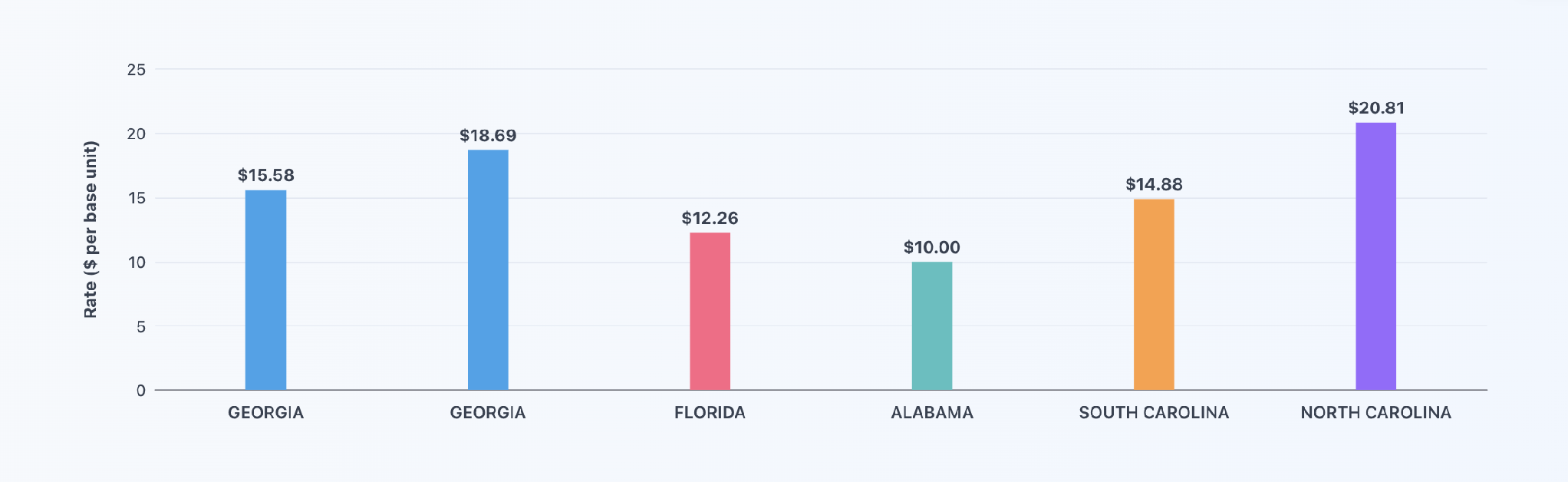
State Rate Comparison: Medicaid ABA Reimbursement, CPT 97153 (Adaptive Behavior Treatment by Protocol), per 15-minute unit. Source: MediRate. Georgia’s fee schedule differentiates by delivery setting; the first Georgia bar reflects in-clinic delivery ($15.58) and the second reflects out-of-clinic delivery ($18.69).
The analyst code shows the same pattern at a higher level. Georgia’s in-clinic 97155 rate of $30.91 is just below North Carolina’s $32.22, and its out-of-clinic rate of $37.78 is the highest in the group. Florida pays $19.17, South Carolina $21.25, and Alabama $15.00.
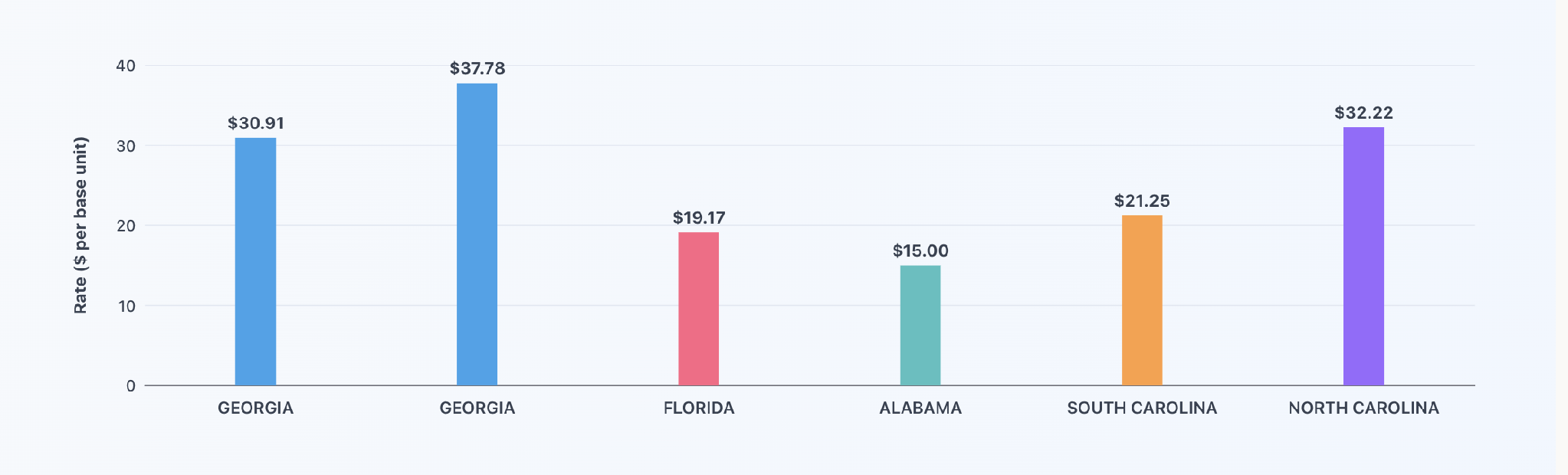
State Rate Comparison: Medicaid ABA Reimbursement, CPT 97155 (Adaptive Behavior Treatment with Protocol Modification), per 15-minute unit. Source: MediRate. Georgia’s fee schedule differentiates by delivery setting; the first Georgia bar reflects in-clinic delivery ($30.91) and the second reflects out-of-clinic delivery ($37.78). For granular state-by-state rate detail across the full ABA code set, MediRate maintains the underlying datasets.
Tennessee, Georgia’s northern neighbor, does not appear in either chart. TennCare’s ABA rates are negotiated privately between its managed care organizations and providers, so there is no public state rate to compare. North Carolina’s figures reflect the reversal of a 10 percent cut that a state court blocked in November 2025.
Why Georgia Providers Often Collect Less Than the Published Rate
Georgia contracts with three CMOs, Amerigroup, CareSource, and Peach State Health Plan, to administer its Medicaid managed care programs. The DCH schedule sets what fee-for-service Medicaid pays, but Autism Providers of Georgia told Acuity in May that the current CMO contracts contain no language tying ABA payment to that schedule.
CareSource used that room first. In a Notice of Material Amendment dated March 27, first reported by Acuity, it moved reimbursement to 80 percent of the fee schedule effective May 11. At 80 percent, the in-clinic RBT rate of $15.58 becomes about $12.46, close to Florida’s published rate. In July, CareSource sent rescission letters restoring full reimbursement to some providers, and DCH told Atlanta News First the rescission “does not apply to all providers in the CareSource network.”
Amerigroup followed with a deeper cut. Clinics received notices in August of a 30 percent reduction in ABA reimbursement effective September 1, the Georgia Recorder reported on October 5, and it reaches every child in foster care, because Amerigroup is the only plan that serves them. According to the Recorder, the notice described the change as a way to align reimbursement across autism services, and an Amerigroup email to DCH said the plan would raise rates for parent and caregiver training instead. An Amerigroup spokeswoman told the paper that medically necessary services remain covered, and DCH said Amerigroup must arrange out-of-network care when no in-network provider is available.
Stuart Portman, Executive Director of DCH’s Medical Assistance Plans Division, told the Recorder that the agency’s oversight comes later in the process: “Our ability to review things is much more on the back end.”
The plan roster is also unsettled. After a procurement that began in 2023, the state announced its intent to award new CMO contracts to CareSource, Humana, Molina Healthcare, and UnitedHealthcare, but Amerigroup, CareSource, and Peach State remain the plans listed on DCH’s Medicaid website. The Recorder also reported that all three current plans have changed their ABA policies within the past year. Acuity requested comment from DCH, CareSource, and Amerigroup.
What Georgia’s Medicaid ABA Rules Require of Providers
The benefit covers members under 21 through Early and Periodic Screening, Diagnostic, and Treatment (EPSDT), requires prior authorization for every service, and authorizes care in two parts, behavioral assessment and treatment services, with treatment approved in six-month periods. For members already in care, DCH now requires a single consolidated authorization covering assessment and treatment codes, and in April it shortened its fee-for-service review turnaround from 45 days to seven. Requests above 30 hours a week receive an enhanced review. A diagnosis must rest on at least one clinician tool and one caregiver tool from DCH’s approved list, and school-based services require a separate school plan with behavior reduction goals specific to that setting.
DCH’s October 1 manual then reworked enrollment and telehealth, as Acuity detailed this month. It dropped a requirement that enrolling behavior analysts live in Georgia or within 50 miles of its border, kept a Georgia behavior analyst license as the condition, and moved telehealth rules into a dedicated section that requires a completed readiness checklist with each request, with more frequent audits for providers delivering more than 25 percent of assessments or 50 percent of units remotely.
Those changes arrive under heavier federal scrutiny. CMS reported in its August State Medicaid and CHIP ABA Toolkit that Medicaid and CHIP spending on ABA rose 421 percent from 2021 to 2025, reaching $10.1 billion.
What Georgia ABA Providers Should Watch
Several deadlines sit close together. The 2027 CPT code set takes effect January 1, deleting 0362T and 0373T, which Georgia’s Appendix A still lists, and splitting the treatment component of 97155 into a new code. DCH has also committed to issuing an abandoned-care reporting template by the same date.
The larger question is whether the incoming plans will pay the published schedule when they launch. Autism Providers of Georgia has asked the state to write that requirement into the new contracts, along with a rate floor in future procurements. Until that happens, a Georgia provider’s effective rate depends on its CMO contract as well as on Appendix A.
For code-level rates beyond 97153 and 97155, including every Georgia modifier combination, MediRate maintains the underlying state datasets.
Frequently Asked Questions
What does Georgia Medicaid pay for ABA in 2026?
For RBT-delivered 97153, Georgia pays $15.58 per 15-minute unit in the clinic or by telehealth and $18.69 outside the clinic. For BCBA-delivered 97155, it pays $30.91 and $37.78. The rates appear in Appendix A of the DCH autism services manual and include a 3 percent increase effective July 1, 2025.
Why does Georgia pay different rates for the same ABA code?
Each code carries two modifiers. One reflects the practitioner level, from physician (U1) to RBT (U5), and the other reflects the setting: in-clinic (U6), out-of-clinic (U7), or telehealth (GT), which pays the in-clinic rate.
Do Georgia Medicaid plans have to pay the published fee schedule?
Not under the current contracts, according to Autism Providers of Georgia. CareSource moved providers to 80 percent of the schedule in May before rescinding the cut for some, and the Georgia Recorder reported that Amerigroup cut ABA reimbursement by 30 percent from September 1, a reduction that reaches every child in foster care because Amerigroup alone serves them.
Who can deliver ABA under Georgia Medicaid?
Licensed physicians and psychologists, doctoral-level BCBAs, and BCBAs may enroll as qualified health care professionals. BCaBAs and RBTs deliver services under supervision and are not enrolled directly. Since October 1, the enrollment section requires a Georgia behavior analyst license and no longer includes the 50-mile residency condition.
Why is Tennessee missing from the rate comparison?
TennCare’s ABA rates are negotiated privately between its managed care organizations and providers, so there is no public state rate to chart.