
Montana’s latest published ABA schedule pays $11.36 per technician unit, and its BCBA rate trails Wyoming and both Dakotas after a withheld raise.
Key Takeaways
- The scheduled raise never arrived. DPHHS declined to implement SFY 2027 provider rate adjustments, citing budget shortfalls, and the latest ABA schedule DPHHS has published is from July 2025.
- Most providers were held budget neutral. MAR Notice No. 2026-127.1 lists no net SFY 2027 budget impact for BCBA providers, while physician conversion factors rise 3.4 percent under state law.
- Montana ranks low in its region. Its $20.46 rate for BCBA-delivered 97155 is the lowest in the comparison, and South Dakota pays nearly double on both codes.
- The benefit reaches beyond autism. Montana covers autism, developmental disability, and serious emotional disturbance in 1,260-unit blocks as federal guidance narrows.
Montana Medicaid providers expected a second 3 percent rate increase on July 1. On May 29, the Department of Public Health and Human Services (DPHHS) told them it was not coming. Citing projected budget shortfalls it attributed largely to actions taken by the 2025 Legislature, the department said it “would not be fiscally sound” to implement additional provider rate adjustments in state fiscal year (SFY) 2027, apart from those required by statute, federal regulation, or federally set fee schedules. The notice said department leadership prioritized approaches that preserved current rates and protected access to existing services.
For applied behavior analysis (ABA), the most recent fee schedule DPHHS has published is still the July 2025 version. It pays $11.36 per 15-minute unit for technician-delivered treatment under CPT 97153, or $45.44 an hour, and $20.46 for protocol modification by a Board Certified Behavior Analyst (BCBA) under 97155. Both rates sit at or near the bottom of Montana’s neighbor group.
Montana Withheld Its SFY 2027 Medicaid Provider Rate Increase
ABA rates did rise in the first year. Montana’s July 2025 ABA fee schedule raised 97151, behavior identification assessment, to $40.41 per unit from $39.23 on the July 2024 schedule, a 3 percent increase. DPHHS has described the withheld raise as the second year of those adjustments, and in a statement to Montana Public Radio it said, “To be clear, these aren’t cuts.” Health officials have said lawmakers did not accurately estimate how much members would use Medicaid, the station reported.
The department carried the decision into its proposed SFY 2027 rate rule, MAR Notice No. 2026-127.1, published July 24 and referenced on its proposed fee schedule page, which it intends to apply retroactively to July 1. The notice raises the physician and anesthesia conversion factors 3.4 percent, an increase state law ties to medical inflation, and holds other services budget neutral overall, lowering the mental health conversion factor from $22.24 to $21.48 and acknowledging that some service categories will see decreases while others see increases. Its fiscal impact table shows no net budget impact for the BCBA and BCBA-D provider type, which counts 79 active providers.
Whether ABA rates moved at all on July 1 is not clear from the public record. A June 30 provider notice listed ABA among the provider types receiving July 1 fee schedule updates, which applied 2026 relative value units on a budget-neutral basis, but the department’s ABA provider page still lists the July 2025 schedule as its most recent.
The decision to withhold the raise drew partisan criticism. Democratic lawmakers held a news conference at the Capitol in June urging Governor Greg Gianforte’s administration to reverse it, KXLH reported, while DPHHS maintained that the Legislature had underfunded the program. Acuity requested comment from DPHHS on whether ABA rates changed on July 1.
How Montana Prices ABA Under Its Fee Schedule
DPHHS administers the ABA benefit directly: it sets eligibility, reviews authorizations through the department or a designated reviewer, and pays claims under its fee schedule. Every service is billed under the supervising BCBA’s National Provider Identifier, and the BCBA assumes professional responsibility for work by Registered Behavior Technicians (RBTs) and Board Certified Assistant Behavior Analysts (BCaBAs). Rates come from the department’s Resource-Based Relative Value Scale (RBRVS) system, which multiplies relative values by a conversion factor the department sets each fiscal year. Members pay no cost sharing.
The July 2025 schedule separates analysts from assistants on two professional codes. 97155 pays $20.46 per unit when a BCBA delivers it and $15.17 when a BCaBA bills with the TC modifier, and 97151 pays $40.41 and $29.91. Family guidance under 97156 pays $20.46, the group codes 97157 and 97158 pay $6.84, and group technician treatment under 97154 pays $3.78. The rule also carries a 115.8 percent policy adjuster for BCBA and BCBA-D services, in effect since July 2021.
Montana Medicaid ABA Rates Compared With Neighboring States
Montana’s technician rate sits inside a low cluster. Its $11.36 for 97153 is above North Dakota’s $10.81 and below Wyoming’s $12.30, while South Dakota pays $21.73, nearly double. In hourly terms, a technician hour pays $45.44 in Montana, $49.20 in Wyoming, $43.24 in North Dakota, and $86.92 in South Dakota.
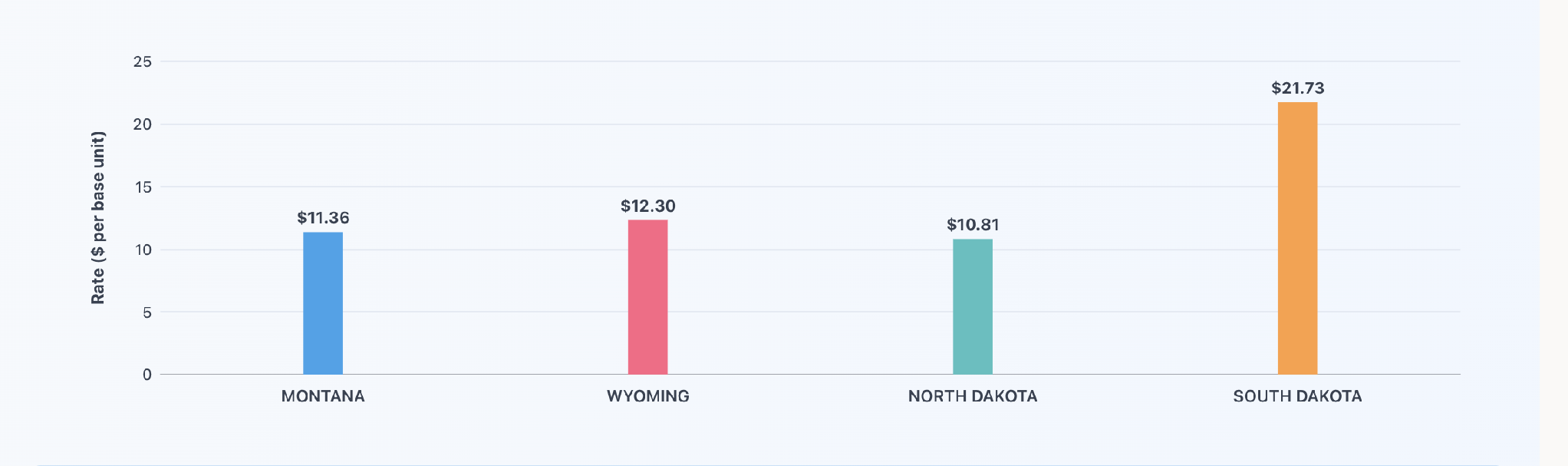
State Rate Comparison: Medicaid ABA Reimbursement, CPT 97153 (Adaptive Behavior Treatment by Protocol), per 15-minute unit. Source: MediRate. Idaho is not shown because MediRate’s Idaho data lists Medicaid behavioral intervention under HCPCS codes rather than CPT 97153 and 97155.
On the analyst code, Montana ranks last. Its $20.46 for 97155 trails Wyoming ($24.60), North Dakota ($31.76), and South Dakota ($39.00). North Dakota pays about 55 percent more per unit, and South Dakota nearly twice as much. Converted to hourly terms, BCBA protocol modification pays $81.84 in Montana and $156.00 in South Dakota.
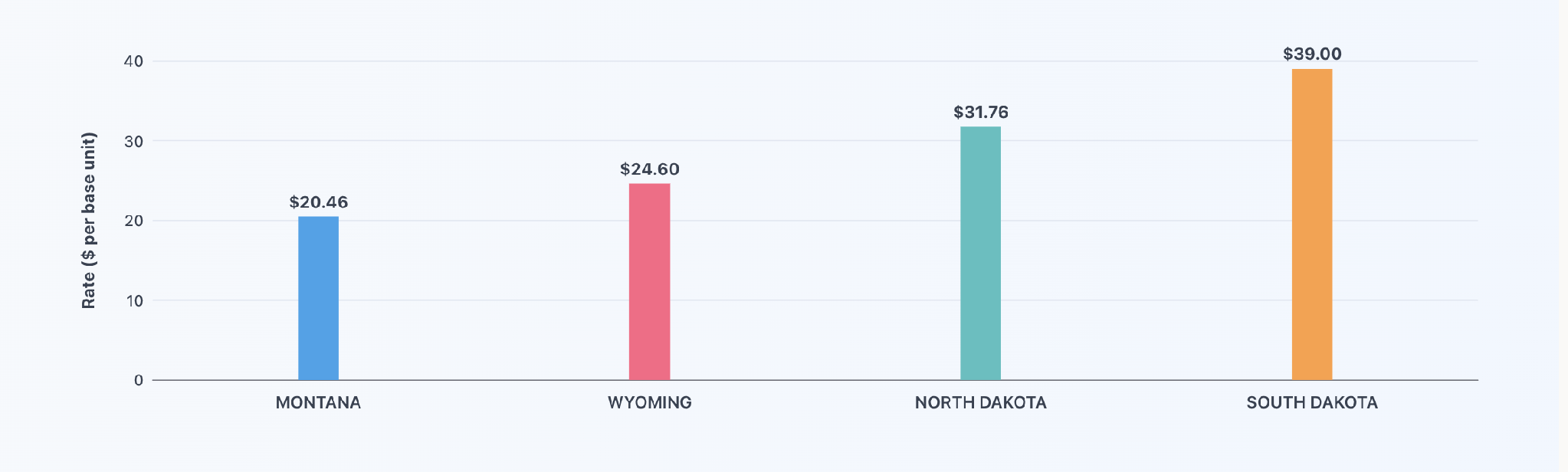
State Rate Comparison: Medicaid ABA Reimbursement, CPT 97155 (Adaptive Behavior Treatment with Protocol Modification), per 15-minute unit. Source: MediRate. Montana’s rate reflects BCBA delivery; BCaBA delivery billed with the TC modifier pays $15.17. For granular state-by-state rate detail across the full ABA code set, MediRate maintains the underlying datasets.
Flat or falling rates are common this year. Wisconsin has held its technician rate at $11.91 since February 2023, a figure still above Montana’s, and Indiana is phasing its ABA rates down in two steps through 2027. Montana’s situation differs in one respect: its Legislature had already approved the next step up.
Who Qualifies for ABA Under Montana Medicaid
Montana’s benefit reaches further than autism. Under its ABA services manual, members qualify with an autism spectrum disorder diagnosis or eligibility for state developmental disabilities services through age 20, or with a serious emotional disturbance (SED) diagnosis through age 17, extended to age 20 for students still enrolled in secondary school. Every member must also meet at least two of six functional impairment criteria, such as disruptive behavior serious enough to isolate them at school or home.
Services can begin on a provisional diagnosis from a physician, licensed mental health professional, nurse practitioner, or psychologist, but continued authorization requires confirmation by a qualified diagnostician. The manual’s list runs from child and adolescent psychiatrists and developmental pediatricians to clinical professional counselors and clinical social workers. Within 30 days of starting services, the provider must complete a behavior identification assessment and an individualized treatment plan, and delivery by telehealth requires a separate exception request.
Care is authorized in packages of 1,260 units, or 315 hours, over 180 days. Spread evenly, a package covers about 12 hours a week. Unlike the 20-hour weekly cap Virginia wrote into its budget this year, Montana’s limit works through authorization packages rather than a weekly ceiling. Providers who need more units, or who use a package before 180 days pass, must file a request at least 14 days before services continue, with a current assessment and a treatment plan that shows progress or explains its absence.
ABA can also run alongside several Children’s Mental Health Bureau services, including day treatment, therapeutic foster care, and Comprehensive School and Community Treatment, as long as ABA hours fall outside those programs’ authorized hours. The manual bars combining it with community-based psychiatric rehabilitation and support, psychiatric residential treatment, acute inpatient care, or intensive outpatient services, which it treats as duplicative. Providers who stop serving a member for any reason other than a transfer must notify the Developmental Disabilities Program and explain why.
That design sits apart from where federal guidance is heading. The CMS ABA toolkit released in August recommends that states tie sustained ABA coverage to a confirmed autism diagnosis and reports that $1.47 billion in 2025 Medicaid and CHIP ABA spending went to conditions other than autism. The toolkit is guidance rather than regulation, and Early and Periodic Screening, Diagnostic, and Treatment (EPSDT) rules still require states to cover medically necessary services for members under 21.
What Montana ABA Providers Should Watch
The budget question returns when the Legislature meets for its 2027 session. DPHHS told an interim budget committee in March that it would file a supplemental budget request for fiscal year 2027. Democratic lawmakers and some providers have already called for the withheld increase to be restored.
The coding ground also shifts on January 1, when the 2027 CPT changes take effect and split the treatment component of 97155 into a new code. Montana’s most recent ABA schedule does not yet list the new codes. Federal auditors, meanwhile, have focused on documentation in their reviews of other state ABA programs.
For full code-level detail across Montana and its neighbors, MediRate maintains the underlying fee schedule data.
Frequently Asked Questions
What does Montana Medicaid pay for ABA in 2026?
Montana pays $11.36 per 15-minute unit for RBT-delivered 97153 and $20.46 for BCBA-delivered 97155, or $15.17 when a BCaBA bills 97155 with the TC modifier. Assessment under 97151 pays $40.41. These are the rates on the July 2025 ABA fee schedule, the most recent DPHHS has published.
Did Montana raise ABA rates for SFY 2027?
Not through the planned 3 percent increase. DPHHS announced on May 29 that it would not implement SFY 2027 provider rate adjustments outside statutory and federal requirements. A June 30 notice listed ABA among provider types receiving budget-neutral relative value updates on July 1, but DPHHS has not posted a July 2026 ABA schedule.
Who qualifies for ABA under Montana Medicaid?
Members with autism or developmental disabilities eligibility through age 20, and members with a serious emotional disturbance through age 17, or age 20 if enrolled in secondary school. All must meet functional impairment criteria.
How much ABA does Montana authorize at once?
Montana authorizes 1,260 units, or 315 hours, over 180 calendar days. Providers can request additional units at least 14 days before continuing services.
Why is Idaho missing from the rate comparison?
MediRate’s Idaho data lists Medicaid behavioral intervention under HCPCS codes rather than CPT 97153 and 97155, so its rates do not compare directly with Montana’s.