
Missouri’s July 2026 ABA schedule reissues 2022 rates. Its Developmental Disability waivers price some codes higher and require no prior authorization.
Key Takeaways
- Missouri’s analyst rate is four years old: The MO HealthNet fee schedule effective July 1, 2026 pays $25.26 per 15-minute unit for 97155 at the Behavior Analyst or Psychologist tier, a rate carrying an effective date of July 1, 2022. The technician code 97153 last moved on July 1, 2024, to $16.37.
- Two pathways cover the same codes on different terms: The state plan and the four Developmental Disability waivers list an identical adaptive behavior code set, but the waivers pay $20.13 for 97155 at the Assistant Behavior Analyst tier where the state plan pays $17.73, and $16.37 for 97152 at the technician tier where the state plan pays $15.00.
- The waiver track carries no prior authorization and higher unit caps: Every adaptive behavior line on the four waiver schedules is marked as not requiring prior authorization, while most state plan lines require it. Code 97155 is capped at 24 units on the state plan and 32 in the waivers, and 97156 at 16 against 99.
- Recent movement has been in codes, not prices: The only rate effective dates on the schedule later than 2024 sit on group treatment under 97154, at May 1, 2025, and multiple-family guidance under 97157, at December 18, 2025, both priced in low single digits. The four Developmental Disability waivers went out for renewal and amendment in February 2026.
What Missouri Medicaid Pays for ABA in 2026
The MO HealthNet Division published its Applied Behavioral Analysis fee schedule effective July 1, 2026, and the useful information sits in a column most readers skip. Alongside each rate the schedule carries a rate effective date, and that field updates when a price changes. On 97153 it reads July 1, 2024, on 97154 May 1, 2025, and on 97157 December 18, 2025. On 97151, 97152, 97155, 97156, and 97158, it reads July 1, 2022.
That makes the freeze legible rather than inferred. Missouri has repriced the technician treatment code once in four years, and the only other recent dates sit on two group and multiple-family codes. The assessment and analyst codes that anchor a comprehensive program are priced today at what the state set in the summer of 2022.
Missouri tiers by credential using billing modifiers. HO denotes a Behavior Analyst or Psychologist and HN an Assistant Behavior Analyst; adding HM as a second modifier drops the line to the Registered Behavior Technician rate. At the analyst tier, 97151 and 97155 each pay $25.26 per 15-minute unit, or $101.04 an hour. Family guidance under 97156 pays the same. At the technician tier, 97153 pays $16.37, or $65.48 an hour, and 97152 pays $15.00. The Assistant Behavior Analyst tier pays $20.13 on 97153 and $17.73 on 97155.
Two wrinkles matter for revenue modeling. A U8 modifier designating the home setting lifts several analyst-tier lines from $25.26 to $27.46, so Missouri effectively publishes two analyst rates. And the group and multiple-family codes sit far below the individual ones: 97154 at $2.05, 97157 at $3.16, and 97158 at $3.16, roughly an eighth of the individual rate.
Missouri’s Two ABA Pathways Price the Same Codes Differently
Most states running a second autism pathway put a different benefit through it. Kansas operates an Autism Waiver that funds respite and parent training and no ABA at all, and Arkansas routes waiver children away from the fee-for-service benefit entirely. Missouri does something less common. Its four Developmental Disability waivers each carry the same adaptive behavior codes as the state plan, delivered by the same credential tiers. What differs is the terms.
On four lines the waivers pay more, and all four sit at the technician and assistant tiers. Code 97152 pays $16.37 to a technician on the waiver schedules against $15.00 on the state plan, and $20.13 to an Assistant Behavior Analyst against $17.12. Code 97155 at the assistant tier pays $20.13 against $17.73, a gap of $2.40 per unit, or $9.60 an hour, for the same CPT-defined service delivered by the same credential in the same state. Group treatment under 97158 pays $2.52 at the assistant tier against $2.14. At the analyst tier the schedules largely converge at $25.26, with one exception running the other way: only the state plan carries the U8 home-setting modifier, so an analyst working in the home bills $27.46 there and $25.26 on a waiver.
The larger divergence is administrative. Every adaptive behavior line on the four waiver schedules is marked as not requiring prior authorization. On the state plan it is required on most lines, with exceptions attaching to specific modifier combinations rather than the benefit as a whole. Maximum units diverge too: 97155 is capped at 24 units on the state plan and 32 in the waivers, and 97156 at 16 against 99. A provider serving two children with the same diagnosis and treatment plan may face a prior authorization on one and none on the other.
The waiver schedules also stop short in one respect. They price 97158 but list no 97154 and no 97157, the state plan’s two newest codes.
The effective dates show how the gap opened. Every waiver line that now pays more carries a rate effective date of July 1, 2023. The state plan caught up on two codes a year later, moving 97153 and 97156 at the assistant tier on July 1, 2024, but 97152 and 97155 at that tier still read July 1, 2022. Nobody cut anything. One schedule was raised, the other was raised in part, and the remainder is a four-year-old number. Missouri is not alone in running two tracks that came apart: Virginia left its outpatient ABA rates untouched since 2021 while raising Developmental Disability waiver analyst pay by as much as 26 percent, and Wyoming cut and then restored its waiver ABA rate while its pediatric schedule sat still.
Who Can Bill Missouri ABA Codes
Missouri licenses behavior analysts, and the Department of Mental Health states that waiver behavior service providers must be licensed in the state under 20 CSR 2063-4.005 and 20 CSR 2063-5.010. Those providers are typically Licensed Behavior Analysts or Licensed Assistant Behavior Analysts, though the Department also recognizes Licensed Professional Counselors, licensed psychologists, and licensed social workers with training and experience in applied behavior analysis. That is a wider door than the fee schedule alone suggests, and the state plan names the tier as Behavior Analyst or Psychologist rather than restricting it to certified analysts.
The state plan also prices a Rural Health Clinic line on nine of its ten adaptive behavior codes, the exception being group treatment under 97154. On most of them that line pays the analyst rate of $25.26. On 97153 it pays $17.73, above the $16.37 the schedule pays a Registered Behavior Technician for the same code.
On capacity, the state has said the quiet part in writing. The Department of Mental Health tells families there is a recognized shortage of behavioral service providers and that the Division is working to recruit them. Its guidance walks families through looking in neighboring regions, contacting an Area Behavior Analyst for prioritized access, and, failing both, joining a waiting list. A state does not build a referral pathway for waiting families unless the waiting is routine.
Missouri ABA Rates in Regional Context
Against its neighbors, Missouri sits mid-band on technician-delivered treatment and near the top on analyst-delivered treatment. One caveat throughout: these comparisons come from published fee schedules, so they show what a state posts rather than what a plan pays.
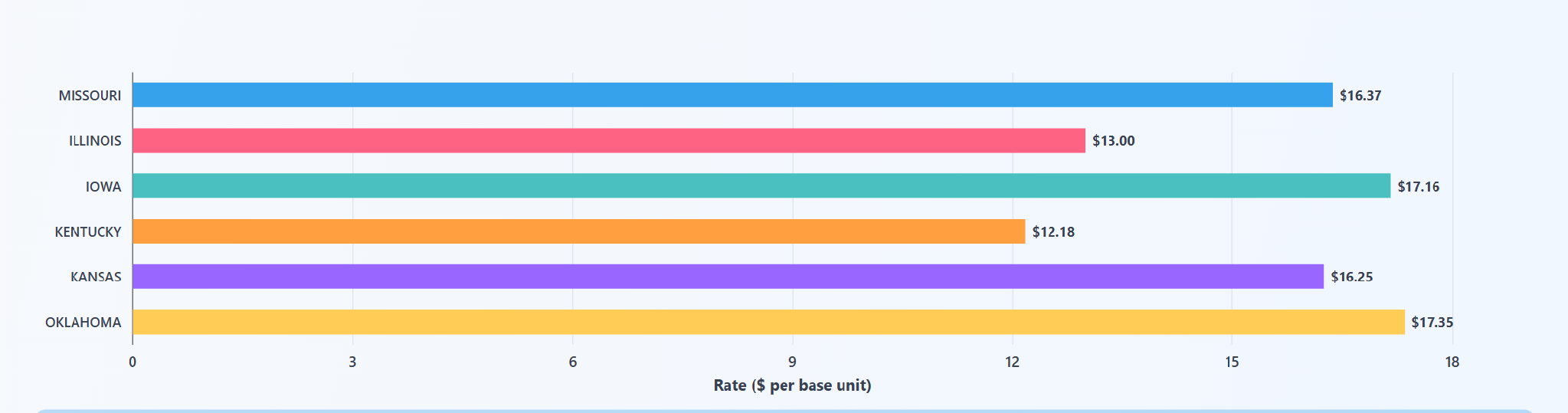
On 97153, Missouri’s $16.37 sits below Oklahoma at $17.35 and Iowa at $17.16, above Kansas at $16.25, and well above Illinois at $13.00 and Kentucky at $12.18. The spread across the six-state group runs from $12.18 to $17.35, and the unweighted average is $15.39, which places Missouri about a dollar above the regional midpoint. The gap that matters most is the one to the east and southeast: Missouri pays roughly 34 percent more than Kentucky for the same 15 minutes of the same service.
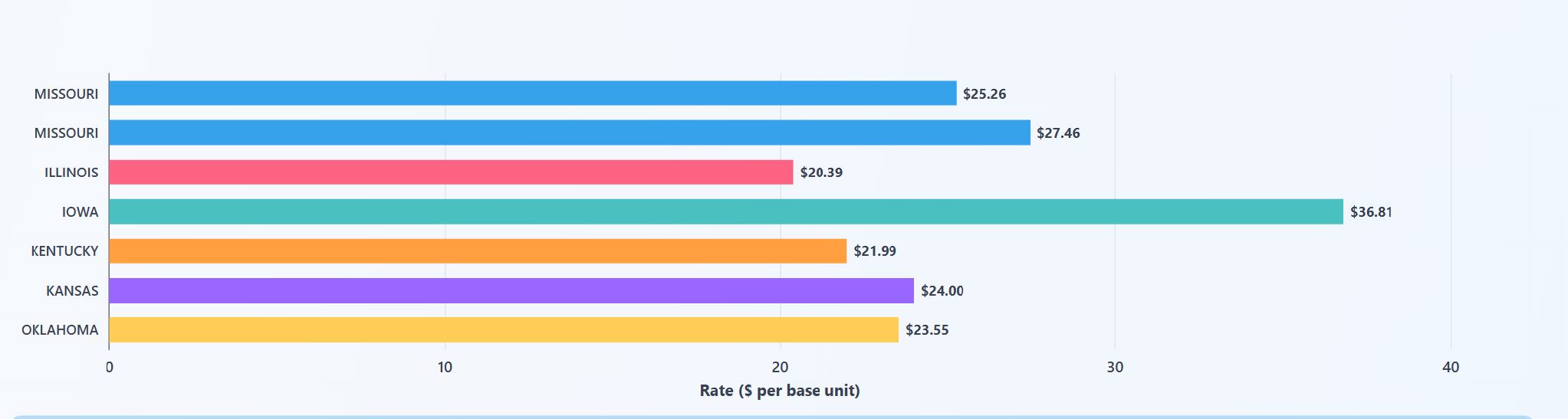
State Rate Comparison: Medicaid ABA Reimbursement, CPT 97155 (Adaptive Behavior Treatment with Protocol Modification), per 15-minute unit. Source: MediRate. Missouri appears twice because its analyst rate differs by setting: $25.26 in the clinic and $27.46 with the U8 home-setting modifier.
On 97155 Missouri moves up the order. Its $25.26 clears Kansas at $24.00, Oklahoma at $23.55, Kentucky at $21.99, and Illinois at $20.39, and the $27.46 home rate widens each margin. Only Iowa, at $36.81, pays meaningfully more, roughly 46 percent above Missouri’s clinic rate. Missouri also pays about 54 percent more for an analyst unit than a technician unit, a wider spread than Nebraska’s 21.5 percent and closer to the pattern in Colorado, which pegs its rates to 95 percent of a multi-state benchmark.
Together the charts describe a state paying competitively for analyst time and unremarkably for the technician hours that carry most of a program. Because 97153 holds the volume, it does more to determine whether a case can be staffed.
What Missouri ABA Providers Should Watch
The waiver renewals. Missouri published notice in February 2026 of renewal applications for the Comprehensive and Community Support waivers and amendment applications for Partnership for Hope and the Missouri Children with Developmental Disabilities waiver. Those applications are where waiver service definitions and rate methodology language are set, which makes them the document to read for any signal on the waiver side.
Whether the state plan follows the waivers, or the reverse. The four lines where the schedules disagree are all at the technician and assistant tiers. Aligning them upward would cost the state relatively little and would remove an anomaly that is difficult to justify on clinical grounds. Aligning them downward would be a cut.
The managed care question. MO HealthNet contracts with four managed care plans and carves certain services out to fee-for-service, naming pharmacy as one example. The Division does not say on its provider manuals page where ABA falls, and that determines whether the published schedule is the payment or merely a benchmark. Providers should confirm the current treatment with the Division rather than assume it.
The federal posture. In August 2026 the Centers for Medicare and Medicaid Services released its State Medicaid and CHIP Applied Behavior Analysis Toolkit, giving states a template for tighter utilization management, documentation standards, and program integrity review. It creates no new federal requirement, and Missouri is not among the seven states the toolkit names as having drawn ABA audit findings. It lands in a year when neighboring states have moved: Kansas reissued a schedule frozen since 2019, Nebraska held every code flat for lack of an appropriation, Louisiana entered a fifth year at its 2022 rates, and in Oklahoma a judge ordered SoonerCare payments restored to a provider whose funding had been suspended. Missouri’s stillness is the regional norm, not an exception to it.
Frequently Asked Questions
What does Missouri Medicaid pay for ABA in 2026?
On the fee schedule effective July 1, 2026, technician-delivered treatment under 97153 pays $16.37 per 15-minute unit and analyst-delivered treatment under 97155 pays $25.26, or $65.48 and $101.04 an hour. Assessment under 97151 pays $25.26 at the analyst tier and 97152 pays $15.00 at the technician tier. Several analyst-tier lines pay $27.46 with the U8 home-setting modifier.
When did Missouri last change its Medicaid ABA rates?
It depends on the code. The schedule’s rate effective date field shows July 1, 2024 for 97153, May 1, 2025 for 97154, and December 18, 2025 for 97157. Codes 97151, 97152, 97155, 97156, and 97158 all carry an effective date of July 1, 2022.
Do Missouri’s Developmental Disability waivers cover ABA?
Yes. The Comprehensive, Community Support, Partnership for Hope, and Missouri Children with Developmental Disabilities waivers each carry the adaptive behavior codes on their own fee schedules, delivered by Licensed Behavior Analysts, Licensed Assistant Behavior Analysts, and Registered Behavior Technicians.
Are the waiver ABA rates the same as the state plan rates?
Not on every line. At the analyst tier the two match at $25.26 for 97151, 97155, and 97156. At the Assistant Behavior Analyst tier the waivers pay $20.13 for 97155 against the state plan’s $17.73, and at the technician tier they pay $16.37 for 97152 against $15.00. The waiver schedules also list no prior authorization requirement on any adaptive behavior line, and set higher maximum units on 97155 and 97156.
Does Missouri Medicaid require prior authorization for ABA?
On the state plan, most adaptive behavior lines are marked as requiring prior authorization, with exceptions tied to specific modifier combinations. On the four Developmental Disability waiver schedules, every adaptive behavior line is marked as not requiring it.
Who can deliver ABA under Missouri Medicaid?
The state plan schedule tiers payment by modifier across three levels: Behavior Analyst or Psychologist, Assistant Behavior Analyst, and Registered Behavior Technician, plus a Rural Health Clinic line. For waiver services, the Department of Mental Health requires providers to be licensed in Missouri, typically as Licensed Behavior Analysts or Licensed Assistant Behavior Analysts, and also recognizes Licensed Professional Counselors, licensed psychologists, and licensed social workers with training and experience in applied behavior analysis.
Sources: MediRate; Missouri Department of Social Services, MO HealthNet Division Applied Behavioral Analysis fee schedule effective July 1, 2026; MO HealthNet Comprehensive, Community Support, Partnership for Hope, and Missouri Children with Developmental Disabilities waiver fee schedules effective July 1, 2026; MO HealthNet provider manuals; Missouri Department of Mental Health, Division of Developmental Disabilities Applied Behavior Analysis guidance; MO HealthNet public notice of waiver renewals and amendments, February 2026; Centers for Medicare and Medicaid Services State Medicaid and CHIP Applied Behavior Analysis Toolkit, August 4, 2026.