
Oklahoma’s SoonerCare schedule reissued its ABA rates unchanged in July 2026. OHCA says it strengthened medical necessity and utilization management first.
Key Takeaways
- The July 2026 schedule changed nothing on ABA: The SoonerCare Title XIX provider fee schedule effective July 1, 2026 prices 97153 at $17.35 per 15-minute unit and 97151, 97155, and 97156 at $23.55 each. Every one of those figures is identical to the schedule effective April 1, 2026.
- The agency has explained the decision in writing: On its program integrity page, the Oklahoma Health Care Authority describes strengthening medical necessity criteria, utilization management, and oversight before expanding rates or removing geographic limits. It states that proposals to widen out-of-state provider participation and raise reimbursement would further accelerate spending growth.
- The spending curve behind that choice is steep: OHCA reports ABA member counts rising from 820 per month in State Fiscal Year 2023 to more than 1,900 per month in SFY 2026, and expenditures climbing from $49.9 million to a projected $119.6 million across the same period.
- Rates and enforcement are one policy, not two: A payment suspension nearly closed a seven-clinic Oklahoma ABA provider this summer before a judge ordered payments resumed. Operators modeling Oklahoma should read the flat schedule alongside the state’s stated program integrity posture rather than in isolation.
What Oklahoma Medicaid Pays for ABA in 2026
Oklahoma reissued its Title XIX provider fee schedule effective July 1, 2026, and on applied behavior analysis it is the April schedule with a new date. Adaptive behavior treatment by protocol under 97153 pays $17.35 per 15-minute unit, or $69.40 an hour. Assessment under 97151, treatment with protocol modification under 97155, and family guidance under 97156 each pay $23.55, or $94.20 an hour. A line-by-line comparison against the April schedule returns no change on any of the four.
What is absent tells as much as what is on it. Oklahoma prices four adaptive behavior codes and no more. There is no 97152 for technician-delivered assessment support, no 97154 or 97158 for group treatment, no 97157 for multiple-family guidance, and neither Category III code for cases needing two or more technicians. Kansas prices seven codes and Colorado five. An Oklahoma provider treating at that acuity level has no distinct code to bill.
The omissions are consistent with the rules. Oklahoma Administrative Code 317:30-5-314 requires prior-authorized ABA treatment to be a one-on-one encounter between the member and the provider, with an explicit carve-out only for family adaptive treatment guidance. The reimbursement rule at 317:30-5-316 repeats it as a payment condition: services must be performed on an individualized basis and not in a group setting, with the same single exception. Both were revised September 1, 2025. A schedule that prices no group codes is the arithmetic expression of rules that do not permit group delivery.
Oklahoma also does not tier by credential. Every ABA line carries a single maximum fee with no modifier, so the published rate is the same whether a Board Certified Behavior Analyst or a Registered Behavior Technician delivers 97153. That differs from Missouri, which prices three credential tiers plus a home-setting modifier, and it means the schedule alone does not describe the staffing economics.
Why Oklahoma Held ABA Rates Flat
Most states leave a rate freeze unexplained. Oklahoma has published its reasoning: a section on combating rising ABA program costs, on the Health Care Authority’s program integrity page last modified August 18, 2026, sets out the sequence.
The account begins in 2025, when an OHCA employee started tracking the program’s costs. The agency states that Medicaid is the primary payer for ABA in Oklahoma, that member counts rose from 820 per month in State Fiscal Year 2023 to more than 1,900 in SFY 2026, and that expenditures went from $49.9 million to a projected $119.6 million, roughly 140 percent in three years.
Then comes the part bearing directly on the fee schedule. The agency writes that proposals to expand out-of-state provider participation and increase reimbursement rates would further accelerate that growth, and describes settling on stronger medical necessity criteria, utilization management, and oversight “before expanding rates or removing geographic limits.”
Read against the schedule, that is a state saying out loud that a rate increase was on the table and was deferred. The geographic limit is real: OAC 317:30-5-311 requires contracted providers to reside in Oklahoma or within 50 miles of its border. Both levers were held.
One claim on that page sits awkwardly against the rest of the record. Among the results, OHCA lists group-based treatment reducing the per-child cost. The July 2026 fee schedule prices no group ABA code, two rules bar group delivery, and on May 11, 2026 the SoonerSelect plan Oklahoma Complete Health issued an ABA Coverage Reminder telling providers that group ABA therapy is not a covered benefit under SoonerSelect and is not reimbursable, with payments for group services billed as individual care subject to recovery. What delivery model OHCA’s statement describes is not evident from the published materials.
Oklahoma is not benchmarking its way there. Colorado pegs its rates to 95 percent of a rolling multi-state comparison group, and Nebraska set its 2025 rates against a blended average of geographically proximate states, each becoming an input to the other. Oklahoma’s stated method is different in kind: it is sequencing, not indexing. Controls first, price later.
Who Can Bill Oklahoma ABA Codes, and Under What Limits
Oklahoma covers ABA under the Early and Periodic Screening, Diagnostic, and Treatment benefit for members age 21 and younger, and it credentials the workforce tightly. Under OAC 317:30-5-311, revised September 1, 2025, Board Certified Behavior Analysts must be licensed by Oklahoma Human Services, and every tier, including assistants and Registered Behavior Technicians, must be fully contracted with SoonerCare. The rule states plainly that all staff providing ABA services must be contracted with the agency, and technicians must receive supervision covering at least five percent of their service hours each month.
Contracting does not mean payment. Under OAC 317:30-5-316, payment is made only to contracted groups or qualified individual providers, never to practitioners working under supervision. The same rule confines reimbursement to direct service time: separate billing for treatment planning, documentation, and report writing is prohibited apart from what the assessment code allows.
The prior authorization rule is prescriptive. Authorizations are granted in units covering one to six months, and the number approved may differ from the number requested after review by an OHCA reviewer, a contracted Board Certified Behavior Analyst, or a physician. Functional behavior assessment is capped at 32 units, or eight hours.
Setting rules are explicit. ABA in a daycare or school setting requires OHCA approval and is limited to three months or less, with a plan showing titration of support to school staff. Telehealth is permitted where the modality is specified in the authorization, and the rule expects the child and guardian to attend at least 85 percent of treatment each review period.
The exclusion list makes the program integrity posture concrete. Non-covered services include ABA addressing academic goals, shadow or aide work in a school, treatment not expected to improve functioning, and services delivered by, or by a clinic owned by, the child’s own parent or guardian.
Oklahoma ABA Rates in Regional Context
Against its six bordering states, Oklahoma is near the top on technician-delivered treatment and in the lower half on analyst-delivered treatment. The usual caveat applies with force here: Oklahoma delivers coverage largely through SoonerSelect contracted entities, so a published fee-for-service maximum is a benchmark, not a payment.
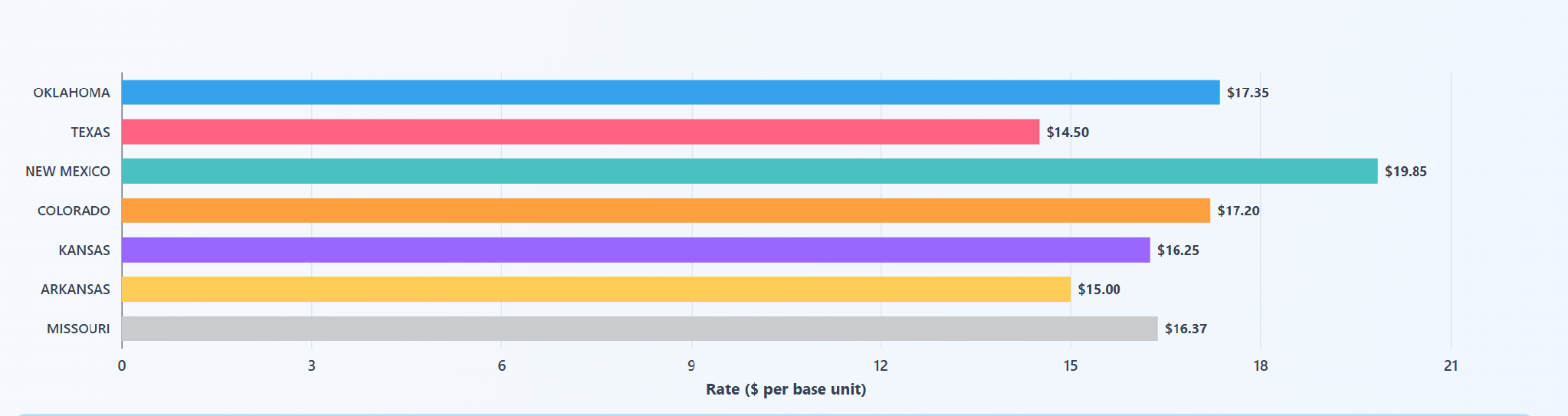
State Rate Comparison: Medicaid ABA Reimbursement, CPT 97153 (Adaptive Behavior Treatment by Protocol), per 15-minute unit. Source: MediRate. For granular state-by-state rate detail across the full ABA code set, MediRate maintains the underlying database.
On 97153, Oklahoma’s $17.35 trails only New Mexico at $19.85, sitting above Colorado at $17.20, Missouri at $16.37, Kansas at $16.25, Arkansas at $15.00, and Texas at $14.50. The unweighted seven-state average is $16.65, putting Oklahoma about 70 cents above the midpoint and roughly 20 percent above Texas at the floor
State Rate Comparison: Medicaid ABA Reimbursement, CPT 97153 (Adaptive Behavior Treatment by Protocol), per 15-minute unit. Source: MediRate. For granular state-by-state rate detail across the full ABA code set, MediRate maintains the underlying database.
On 97153, Oklahoma’s $17.35 trails only New Mexico at $19.85, sitting above Colorado at $17.20, Missouri at $16.37, Kansas at $16.25, Arkansas at $15.00, and Texas at $14.50. The unweighted seven-state average is $16.65, putting Oklahoma about 70 cents above the midpoint and roughly 20 percent above Texas at the floor.
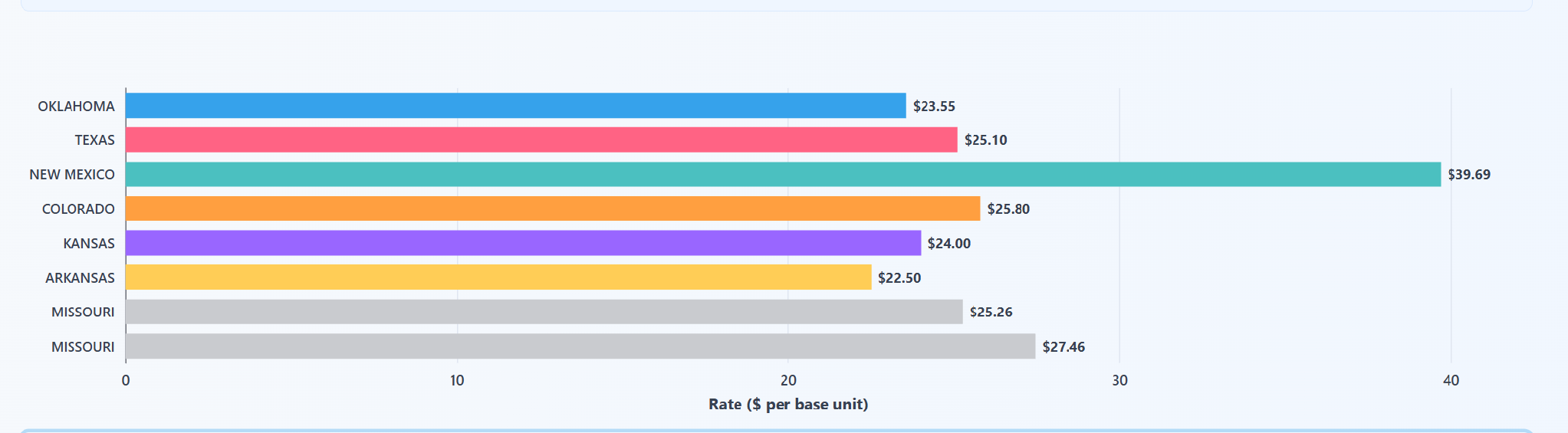
State Rate Comparison: Medicaid ABA Reimbursement, CPT 97155 (Adaptive Behavior Treatment with Protocol Modification), per 15-minute unit. Source: MediRate. Missouri appears twice because its analyst rate differs by setting: $25.26 in the clinic and $27.46 with the U8 home-setting modifier.
On 97155 the ordering reverses and Oklahoma falls to second from the bottom, above only Arkansas at $22.50, and below Kansas at $24.00, Texas at $25.10, Missouri at $25.26 and $27.46 in the home, Colorado at $25.80, and New Mexico at $39.69. New Mexico pays roughly 69 percent more for the same clinician time.
The internal ratio explains the shape. Oklahoma pays about 36 percent more for an analyst unit than a technician unit, a narrower spread than Missouri’s 54 percent and Colorado’s 50 percent. Because 97153 carries the bulk of billable hours, the first chart matters more to a revenue model, but the compression is what a Clinical Director will feel.
What Oklahoma ABA Providers Should Watch
The sequencing promise. OHCA said it wanted controls in place before expanding rates, and those controls are now in the rule as revised in September 2025. Whether the second half of that sentence arrives, and when, will be answered in a budget cycle rather than a fee schedule reissue.
The 50-mile border rule. Loosening it is the supply-side lever OHCA named and declined to pull. Any movement there would change the competitive picture for operators in Texas, Arkansas, Kansas, and Missouri before it changed anything about rates.
Payment suspension practice. OHCA suspended a provider’s SoonerCare payments effective November 10, 2025 over a fraud allegation, then issued written notice dated June 5, 2026, 207 days later, against the five days federal rules allow. On July 15 a judge ordered the payments resumed and the suspension lifted. The investigation remains active. Governor Kevin Stitt named Aaron Morris interim director the same day, after Clay Bullard said he would return to the private sector. How OHCA exercises its discretion under 42 C.F.R. 455.23 is now a material operating risk, distinct from the rate.
What the plans actually pay. With ABA inside SoonerSelect, the contracted entities determine the money that reaches a clinic, and their negotiated ABA rates are not published. The fee-for-service maximum is the only public number in Oklahoma, which is what every comparison in this piece rests on, including ours.
The federal backdrop. In August 2026 the Centers for Medicare and Medicaid Services released its State Medicaid and CHIP Applied Behavior Analysis Toolkit, reporting that national Medicaid and CHIP spending on ABA rose from roughly $1.94 billion in 2021 to $10.1 billion in 2025, an increase of 421 percent. It creates no new federal requirement, and Oklahoma is not among the seven states the toolkit names as having drawn ABA audit findings. It hands states a template for exactly the controls Oklahoma says it has chosen. Others are working the problem in public: Florida seated a task force in August with a December 31 reporting deadline, while Louisiana has left its ABA schedule at 2022 levels without saying why.
Frequently Asked Questions
What does Oklahoma Medicaid pay for ABA in 2026?
The SoonerCare Title XIX fee schedule effective July 1, 2026 pays $17.35 per 15-minute unit for 97153 and $23.55 for 97151, 97155, and 97156, or $69.40 and $94.20 an hour. The schedule prices no group, multiple-family, or Category III adaptive behavior codes.
Did Oklahoma change its Medicaid ABA rates on July 1, 2026?
No. All four adaptive behavior codes on the July 1, 2026 schedule carry the same amounts as the schedule effective April 1, 2026. Only the effective date changed.
Why has Oklahoma not raised its ABA rates?
The Health Care Authority has said publicly that it chose to strengthen medical necessity criteria, utilization management, and oversight before expanding rates or removing geographic limits, citing ABA utilization rising from 820 members per month in State Fiscal Year 2023 to more than 1,900 in SFY 2026 and expenditures rising from $49.9 million to a projected $119.6 million.
Does Oklahoma Medicaid cover group ABA therapy?
No. OAC 317:30-5-314 requires ABA treatment to be a one-on-one encounter between the member and the provider, and OAC 317:30-5-316 conditions payment on services being performed on an individualized basis and not in a group setting, both with an exception only for family adaptive treatment guidance. The fee schedule prices no group codes, and Oklahoma Complete Health advised SoonerSelect providers in May 2026 that group ABA is not a covered benefit and not reimbursable.
Who can bill ABA under SoonerCare?
Board Certified Behavior Analysts licensed by Oklahoma Human Services, licensed psychologists with professional experience in ABA, and certain licensed human services professionals certified by the national accrediting board. Under OAC 317:30-5-311 every tier, including Board Certified Assistant Behavior Analysts and Registered Behavior Technicians, must be fully contracted with SoonerCare. Payment, however, is made only to contracted groups or qualified individual providers and not to practitioners working under supervision.
How long do Oklahoma ABA prior authorizations last?
Prior authorization requests are granted by units covering one to six months of treatment as clinically indicated, and the units approved may differ from the units requested after review. A new prior authorization is required if the member’s condition necessitates a change in the treatment plan, and functional behavior assessment is capped at 32 units, or eight hours.
Sources: MediRate; Oklahoma Health Care Authority SoonerCare Title XIX provider fee schedules effective April 1, 2026 and July 1, 2026; Oklahoma Administrative Code 317:30-3-65.12 and 317:30-5-310 through 317:30-5-318; Oklahoma Health Care Authority program integrity page, last modified August 18, 2026; Oklahoma Complete Health provider notice on ABA under SoonerSelect; Centers for Medicare and Medicaid Services State Medicaid and CHIP Applied Behavior Analysis Toolkit, August 4, 2026; prior Acuity Media Network reporting.