
Arkansas refreshed its ABA fee schedule effective January 1, 2025, holding the technician rate at $15.00 and the analyst rate at $22.50 while a number of other states cut. Autism therapy reaches families through three separate pathways that shape access as much as the rate does.
Key Takeaways
- Arkansas holds a mid-band rate on a current schedule: The state’s January 1, 2025 ABA fee schedule sets the technician code (97153) at $15.00 and the analyst code (97155) at $22.50 per 15-minute unit. That places Arkansas near the middle of its regional band on technician pay and tied with Louisiana for the lowest analyst rate among neighbors, according to MediRate.
- Three pathways deliver ABA, and they do not overlap: ABA is an EPSDT benefit for beneficiaries 18 months to 21, but PASSE enrollees must route requests through a care coordinator, and children in the separate Autism Waiver receive their autism services through that waiver instead. The result is a fragmented map that shapes access as much as the rate.
- Arkansas has not cut, even as states across the country have: While states across the country reduced ABA rates in 2025 and 2026, Arkansas kept its schedule intact. Local providers and families have nonetheless flagged pressure from rising demand and long-term federal Medicaid funding changes.
- Oversight is the pressure point to watch: Federal auditors have made ABA a program-integrity focus, and a neighboring Oklahoma provider nearly closed this year after a Medicaid fraud suspension. How Arkansas balances stable rates against tightening oversight is the near-term question for operators.
Arkansas’s Applied Behavior Analysis fee schedule carries a run date of January 1, 2025, and by the standards of the moment, that recency is itself notable. Across the country, 2025 and 2026 have been years of ABA rate cuts, provider moratoriums, and court fights. Arkansas did none of that. It posted a refreshed schedule and did not cut its rates, keeping its autism benefit steady while a number of other states moved to cut theirs.
But steady is not the same as simple. The more revealing feature of ABA in Arkansas is not the rate, which sits comfortably in the middle of the regional pack, but the delivery system, which splits autism care across three separate tracks that rarely intersect.
What Arkansas Pays, and How It Compares
Arkansas reimburses technician-delivered therapy (CPT 97153) at $15.00 per 15-minute unit, or $60 an hour before managed care adjustments. That is squarely mid-band. Louisiana ($12.50) and Texas ($14.50) pay less; Mississippi ($15.08), Missouri ($16.37), and Oklahoma ($17.35) pay more. The unweighted average across the six-state group is about $15.13, placing Arkansas essentially at the regional midpoint.

State Rate Comparison: Medicaid ABA Reimbursement, CPT 97153 (Adaptive Behavior Treatment by Protocol), per 15-minute unit. Source: MediRate.
On the analyst code (CPT 97155), Arkansas pays $22.50 per 15-minute unit, tied with Louisiana for the lowest in the neighbor set. Every other state in the neighbor set pays more: Oklahoma ($23.55), Mississippi ($24.35), Texas ($25.10), and Missouri, which reimburses at $25.26 in clinic and $27.46 in the home. So while Arkansas holds a comfortable middle position on the technician code that accounts for most therapy hours, it anchors the low end on the analyst code that pays for assessment and protocol design. For code-by-code detail across the full ABA set, MediRate maintains the underlying datasets.
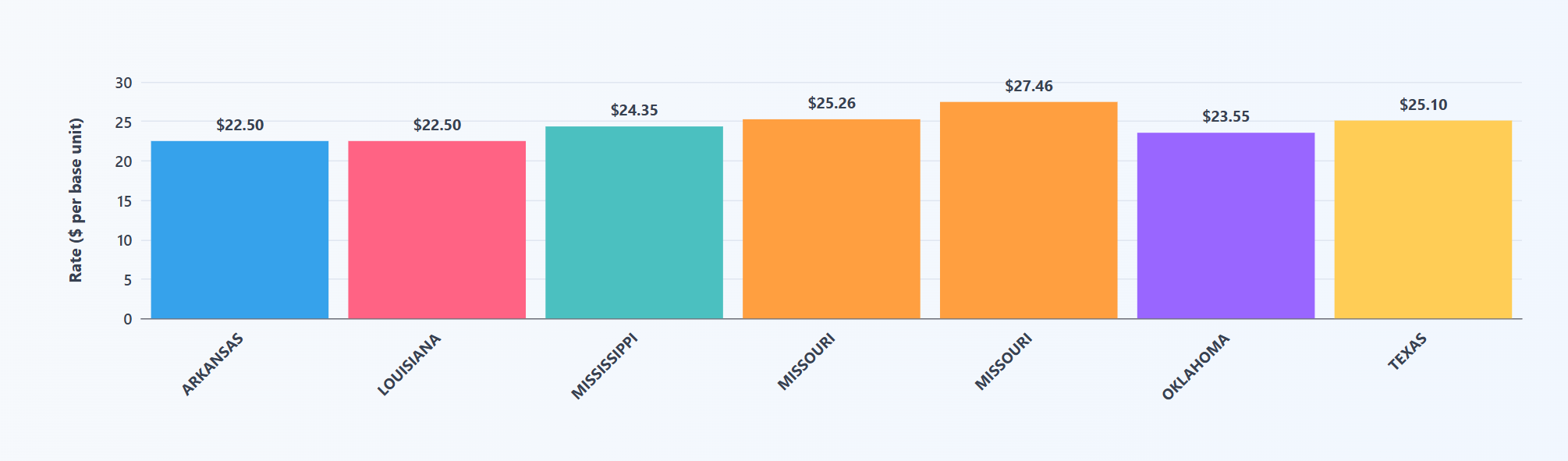
State Rate Comparison: Medicaid ABA Reimbursement, CPT 97155 (Adaptive Behavior Treatment with Protocol Modification), per 15-minute unit. Missouri appears twice because its analyst rate differs by setting: clinic ($25.26) and home ($27.46). Source: MediRate.
Who Qualifies, and How Providers Bill
Arkansas covers ABA as an Early and Periodic Screening, Diagnostic, and Treatment benefit for beneficiaries between 18 months and 21 years of age. Eligibility requires an autism spectrum disorder diagnosis established under Ark. Code Ann. § 20-77-124, an initial evaluation referral on form DMS-641 ER, and a treatment prescription on form DMS-641 TP that can run up to 12 months for older children. Services must be delivered by credentialed staff: a Board Certified Behavior Analyst, a Board Certified Assistant Behavior Analyst under supervision, or a Registered Behavior Technician under supervision, with claims billed by the BCBA. All treatment requires prior authorization and a demonstration of medical necessity, and providers must document referrals to the state’s First Connections early-intervention system for children under three.
Three Doors to the Same Therapy
The complication in Arkansas is structural. Most children reach ABA through the fee-for-service EPSDT benefit described above. But Arkansas also runs a managed care model for higher-need beneficiaries, the Provider-led Arkansas Shared Savings Entity, or PASSE, and a child enrolled in a PASSE must request ABA through an assigned care coordinator rather than going straight to a provider. A third group, children enrolled in the state’s Autism Waiver, receives autism services through that waiver and is not eligible for EPSDT ABA at the same time.
The Autism Waiver carve-out matters most for the youngest children, because it serves children from 18 months to age five as an early, intensive intervention track, while the EPSDT benefit is the broader entitlement that runs to age 21. A family placed on the waiver path can find that it forecloses the fee-for-service ABA benefit for as long as the child stays in it, a tradeoff that is easy to miss until services are already underway.
For a family, the door they enter can determine how quickly therapy starts and who manages the request. For a provider, it means the same clinical service can arrive through three different administrative front ends, each with its own paperwork and gatekeeper. The rate is uniform; the road to it is not. Whether Arkansas eventually simplifies that map is one of the quieter but more consequential questions hanging over its autism benefit.
Holding Steady in a Year of Cuts
Arkansas’s decision to leave its rates in place reads differently against the national backdrop. New York phased in a 25 percent cut to technician-delivered ABA; Indiana pushed through a multi-year rate phasedown with new caps and supervision limits; and in Georgia, CareSource cut Medicaid ABA rates by 20 percent. In the wider region, Alabama has held the Southeast’s rate floor for years. Arkansas did none of this, but the pressure is real: rising demand and anticipated long-term federal Medicaid funding changes that could leave states with fewer resources to meet growing need.
The other force bearing down on stable-rate states is oversight. The U.S. Department of Health and Human Services Office of Inspector General has made ABA a program-integrity priority, recommending more than $123 million in recoupments across multiple state Medicaid audits, with more states in the queue. The stakes of that scrutiny are visible next door: in Oklahoma, a provider was pushed to the brink after the state suspended its SoonerCare payments over a fraud allegation before a judge ordered them restored. For Arkansas operators, the near-term challenge is less about a rate cut that has not come and more about documentation, credentialing, and the PASSE and waiver rules that determine whether a claim holds up.
Frequently Asked Questions
Does Arkansas Medicaid cover ABA therapy?
Yes. Arkansas covers ABA as an EPSDT benefit for beneficiaries 18 months to 21 with an autism spectrum disorder diagnosis, subject to referral, treatment prescription, and prior authorization.
What are Arkansas’s current Medicaid ABA rates?
The state pays $15.00 per 15-minute unit for technician-delivered therapy (97153) and $22.50 for analyst-delivered protocol modification (97155), effective January 1, 2025.
How is ABA delivered in Arkansas?
Most children receive ABA fee-for-service through EPSDT. PASSE enrollees must request services through a care coordinator, and children in the Autism Waiver receive their autism services through that waiver instead of EPSDT ABA.
Has Arkansas cut its ABA rates?
No. Arkansas kept its schedule intact while several states, including New York, Indiana, and Georgia’s CareSource plan, reduced ABA reimbursement in 2025 and 2026.