Colorado’s PBT rates reset to 95 percent of an updated benchmark in October 2025 and held through July 2026, as a federal audit flagged $77.8 million in improper payments.
By Ethan Webb and Gregory Nersessian, MediRate
Key Takeaways
- Colorado does not set its ABA rates independently: Effective October 1, 2025, the Department of Health Care Policy and Financing repriced Pediatric Behavioral Therapy against a refreshed 10-state benchmark and set payment at 95 percent of it. The resulting schedule pays $17.20 per 15-minute unit for 97153 and $25.80 for 97155.
- Pediatric Behavioral Therapy sat out both of this year’s broad reductions: The benefit has no Medicare equivalent, which put it outside the April cut to 85 percent of Medicare, and the Department separately exempted it from the 2 percent across-the-board decrease in July. Behavioral services on the developmental disability waivers took the full 2 percent.
- A federal audit is now driving Colorado policy harder than the budget is: Every one of the 100 enrollee-months the Office of Inspector General sampled contained a defective claim line. Auditors estimated $77.8 million in improper payments, flagged $207.4 million more as potentially improper, and recommended Colorado refund $42.6 million.
- One code the auditors flagged is still missing from the schedule: Colorado does not permit facilities to bill 97156 for parent training, and federal auditors raised the omission as a separate matter. The July 2026 schedule has not added it, and 97152 and 97157 are absent too.
Colorado’s applied behavior analysis rates did not move on July 1, 2026, and that stillness is the most informative thing on the schedule. Nearly everything else moved. Fee-for-service rates were cut to 85 percent of 2025 Medicare rates in April, and a further 2 percent across-the-board reduction landed in July, applied across nine home and community based services waivers. Behavioral line staff on those waivers fell from $7.95 to $7.79 per 15-minute unit.
Pediatric Behavioral Therapy absorbed neither, and the Department explains only half of that. It gives a reason for the first exemption and none for the second. Either way, the rates in force date to October 2025, and they are not built from Colorado cost data. They are borrowed from other states.
What Colorado Medicaid Pays for ABA in FY 2026-27
The Health First Colorado fee schedule effective July 1, 2026 prices five adaptive behavior codes. Adaptive behavior treatment by protocol (97153) pays $17.20 per 15-minute unit, or $68.80 an hour. Treatment with protocol modification (97155) pays $25.80, or $103.20 an hour. Group treatment by a technician (97154) pays $8.81 and social skills group treatment (97158) pays $9.34. Every line requires prior authorization.
Behavior identification assessment is priced two ways, which is unusual. Billed without a modifier, 97151 pays $866.88 as a flat rate per encounter rather than a timed unit, and the Department limits it to once every 12 months. Billed with the TJ modifier for a reassessment, it pays $39.61 per unit and is limited to 2 units every 6 months. Federal auditors described that structure in those terms in their February 2026 report.
Three codes that neighboring states price do not appear: 97152, 97156, and 97157. The 97156 omission is the consequential one. Federal auditors stated flatly that Colorado does not permit ABA facilities to bill 97156, the parent training code, and raised it separately: most treatment plans they reviewed described parent training as important, some facilities provided it unbilled, others billed it improperly under 97155, and one said it provided none because it would not be reimbursed.
Colorado runs most behavioral health through Regional Accountable Entities, but federal auditors describe the benefit as an Early and Periodic Screening, Diagnostic and Treatment service primarily administered fee-for-service, with prior authorizations routed to the Department’s vendor, Acentra, and generally covering six months. The schedule therefore governs payment more directly here than in Kansas, where a published maximum sits behind managed care contracts. One further quirk: Colorado covers ABA for children with any diagnosis for which it is medically necessary, not only autism, a broader gateway than most states operate.
How the 95 Percent Benchmark Works, and Why Nebraska Matters
Colorado reviews provider rates under Section 25.5-4-401.5 of the Colorado Revised Statutes through the Medicaid Provider Rate Review Advisory Committee. Where Medicare offers no comparator, and it offers none for ABA, the Department benchmarks against other state Medicaid programs, choosing them on factors including program scope, data reliability, and geographic proximity, then adjusting their rates to Colorado’s cost of living.
In State Fiscal Year 2024-25, the Joint Budget Committee approved raising Pediatric Behavioral Therapy rates to 100 percent of that benchmark at a cost of $34.3 million total funds. Legislative staff later noted the group included Nebraska, considered a significant outlier at the time.
Nebraska then cut its own ABA rates effective August 1, 2025, by 28 to 79 percent depending on the code, on the state’s own published schedules. Because Nebraska remained in the comparison group, the benchmark itself fell. The Department’s R-9 request proposed rolling back the prior year’s increases, roughly $19.5 million total funds including $9.7 million General Fund, and the reset took effect October 1, 2025.
Nebraska sets its rates the same way. A state plan amendment Nebraska filed with federal regulators in July 2025 says its ABA rates were adjusted in alignment with Medicaid agencies in geographically proximate states and reflect a blended average of those states’ rates. Colorado benchmarks against a group that includes Nebraska, and Nebraska benchmarks against a group that includes Colorado. Neither state is anchored to its own cost of delivering the service.
Comparing published schedules shows the net effect, and it was not evenly distributed. Colorado’s January 1, 2025 schedule paid $17.88 for 97153 and $26.20 for 97155; the current schedule pays $17.20 and $25.80, reductions of roughly 3.8 and 1.5 percent. The group codes moved much further: 97154 fell from $11.33 to $8.81, and 97158 from $17.55 to $9.34, a cut of nearly half. A reset framed as a percentage adjustment took most of its value out of group services.
The Federal Audit and What It Set in Motion
The U.S. Department of Health and Human Services Office of Inspector General issued its audit of Colorado’s fee-for-service ABA payments on February 25, 2026 and posted it March 2. Those payments grew from $60.1 million in 2019 to $163.5 million in 2023, and reached $230.3 million in 2024. The audit covered $289.5 million across 1,057,164 claim lines grouped into 60,131 enrollee-months, from which auditors drew a random sample of 100. All 100 contained at least one improper or potentially improper claim line: 93 failed documentation requirements, 18 involved staff without appropriate credentials, and seven lacked a documented diagnostic evaluation or referral. Code 97153 accounted for 77 percent of the audited payments and 97155 for 23 percent.
It is the fourth and largest report in the OIG’s multi-state ABA audit series, following Indiana, Wisconsin, and Maine, each of which also returned a 100 percent sample error rate. Improper and potentially improper are not findings of fraud: the second category means documentation was insufficient for an auditor to verify the claim either way. A fifth recommendation asks Colorado to review the $112.5 million federal share of potentially improper payments and refund whatever proves improper. All five remain open and unimplemented, with a status update to the Centers for Medicare and Medicaid Services expected August 24, 2026.
The credentialing finding produced the sharpest disagreement, and Colorado won it. Auditors initially treated ABA delivered by noncredentialed behavior technicians as improper. The state objected that it has no such requirement and that the certification standard in state law applies to commercial insurance, not Medicaid. The auditors agreed, removed those amounts, and adjusted the estimate down: the draft report was titled $119.6 million, the final $77.8 million. Auditors noted state staff had told them throughout that the credential was required, and that it appears nowhere in agency guidance. The 18 enrollee-months remaining in that finding are a different problem, mostly 97155 services requiring a Board Certified Behavior Analyst that were delivered by assistants or technicians.
The Department has moved on the point since. It told providers in a December 2025 notice that Registered Behavior Technicians must hold active certification to bill, and pushed the compliance deadline back without setting a new one.
The audit also drove a rulemaking. From September 2025 the Department moved to pull the benefit out of Early and Periodic Screening, Diagnostic and Treatment and define it separately, with explicit enrollment, certification, training, and supervision standards. Department materials attributed the urgency to a federal review that found inconsistencies in how staff were trained and supervised, and warned Colorado could lose federal Medicaid funding if the issues went unaddressed.
Two operational changes landed alongside it. A July 2025 policy memo ended coverage of 40 hours of clinic-based service where the child has access to school hours, unless the district shows the child cannot be served in a classroom. And from July 1, 2026, ordering, prescribing, and referring rules extend to the benefit. The direction of travel matches Indiana’s post-audit rewrite of its ABA benefit and the concurrent billing restrictions spreading across states.
Colorado ABA Rates in Regional Context
Against its bordering states, Colorado sits mid-pack on the technician code and in the upper half on the analyst code, though two neighbors pay far more. The usual caveat applies: these figures come from published fee schedules and show what a state posts rather than what a plan pays.
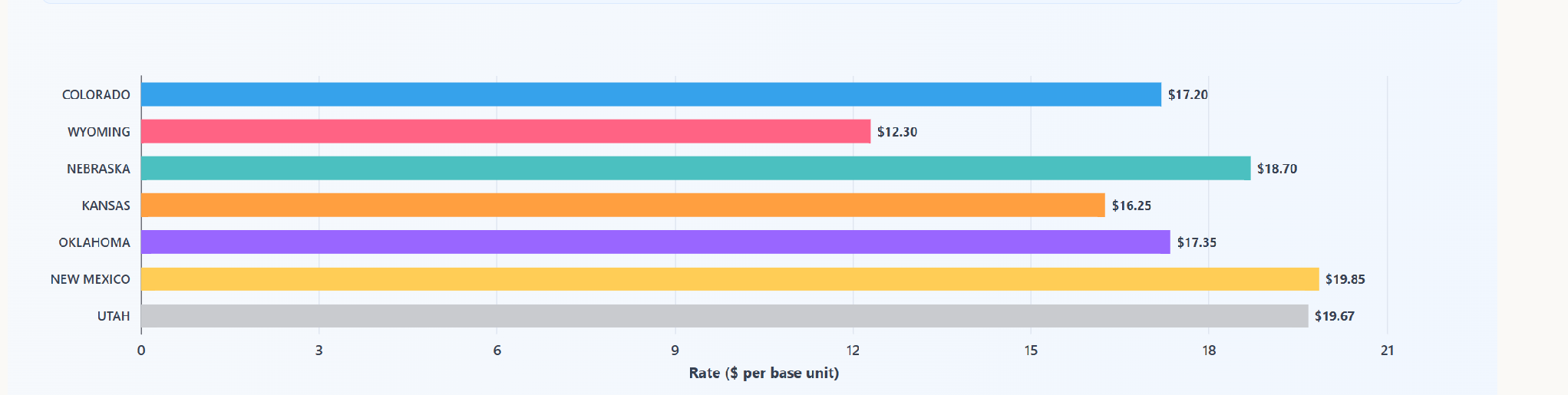
State Rate Comparison: Medicaid ABA Reimbursement, CPT 97153 (Adaptive Behavior Treatment by Protocol), per 15-minute unit. Source: MediRate. For granular state-by-state rate detail across the full ABA code set, MediRate maintains the underlying database.
On 97153, Colorado’s $17.20 sits in the middle of the seven-state group: below New Mexico at $19.85, Utah at $19.67, and Nebraska at $18.70, and above Oklahoma at $17.35, Kansas at $16.25, and Wyoming at $12.30. One caveat on the floor: Wyoming’s $12.30 is its state plan rate, and members enrolled in its developmental disability waivers draw $19.23 for the same code.
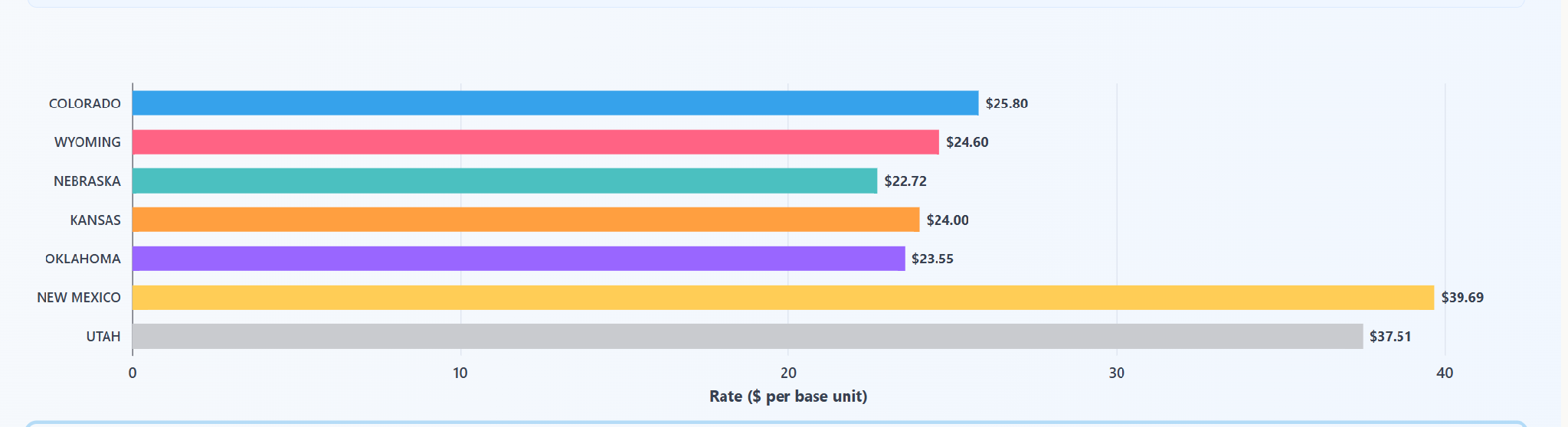
State Rate Comparison: Medicaid ABA Reimbursement, CPT 97155 (Adaptive Behavior Treatment with Protocol Modification), per 15-minute unit. Source: MediRate.
On 97155 the picture changes. Colorado’s $25.80 leads its Plains neighbors, above Wyoming at $24.60, Kansas at $24.00, Oklahoma at $23.55, and Nebraska at $22.72. But New Mexico pays $39.69 and Utah $37.51, each roughly 45 to 54 percent more for the same clinician time. Both border Colorado to the west and south, and Utah legislated a permanent rate-increase mechanism rather than benchmarking against a moving group.
The internal ratio is worth noting against Nebraska’s. Colorado pays 50 percent more for an analyst unit than a technician unit; Nebraska pays about 21.5 percent more.
What Colorado ABA Providers Should Watch
Whether 97156 gets priced
Adding the code would change the revenue mix for every comprehensive program in the state, and the auditors have put the omission on the record.
The defined-benefit rule and the RBT deadline
Moving the benefit out of EPSDT would set explicit credentialing and supervision standards, and the RBT enforcement date remains unannounced. Federal auditors found Colorado has no minimum qualification requirement for behavior technicians and that its Department of Regulatory Agencies does not license ABA providers at all, so any standard would be new.
The next benchmark refresh
Because rates are pegged to a comparison group rather than Colorado cost data, the question each cycle is which states are in the group and what they did. Several have reduced rates over the past year, including New York.
The refund and the corrective action plan
The recommended $42.6 million refund lands during a state budget shortfall. The corrective action plan Colorado files with federal regulators will determine how much of the audit’s pressure reaches providers as postpayment review.
Frequently Asked Questions
What does Colorado Medicaid pay for ABA in 2026?
The Health First Colorado fee schedule effective July 1, 2026 pays $17.20 per 15-minute unit for 97153 and $25.80 for 97155, or $68.80 and $103.20 an hour. Group codes pay $8.81 for 97154 and $9.34 for 97158. Behavior identification assessment pays $866.88 as a flat rate per encounter, limited to once every 12 months, or $39.61 per unit with the TJ modifier for a reassessment, limited to 2 units every 6 months.
Did Colorado cut ABA rates on July 1, 2026?
No. Pediatric Behavioral Therapy is exempt from the 2 percent across-the-board reduction effective July 1, 2026, and was also outside the April 1, 2026 reduction to 85 percent of Medicare rates because the benefit has no Medicare equivalent. The rates in force reflect the October 1, 2025 reset to 95 percent of an updated multi-state benchmark.
How does Colorado set its ABA rates?
Through benchmarking against other state Medicaid programs rather than against Medicare, under the rate review process in Section 25.5-4-401.5 of the Colorado Revised Statutes. The Department selects comparison states on factors including program scope, geographic proximity, and data reliability, adjusts their rates to Colorado’s cost of living, and currently pays 95 percent of the resulting benchmark.
What did the federal audit of Colorado’s ABA payments find?
The Office of Inspector General estimated at least $77.8 million in improper fee-for-service payments for 2022 and 2023, with a further $207.4 million identified as potentially improper, and recommended Colorado refund $42.6 million as the federal share. All 100 sampled enrollee-months contained at least one improper or potentially improper claim line. The findings concern documentation, credentialing, and eligibility rather than allegations of fraud, and auditors dropped the noncredentialed-technician amounts after Colorado showed it has no such requirement.
Is ABA in Colorado delivered through managed care?
Mostly not. While most Colorado behavioral health services run through Regional Accountable Entities, federal auditors describe Pediatric Behavioral Therapy as covered under Early and Periodic Screening, Diagnostic and Treatment and primarily administered through the fee-for-service delivery system. Providers enroll under Provider Type 84 and submit prior authorization requests to the Department’s utilization management vendor, Acentra.
Sources: MediRate; Colorado Department of Health Care Policy and Financing; Health First Colorado fee schedules effective January 1, 2025 and July 1, 2026; HCPF Medicaid Provider Rate Reductions fact sheet and Q&A; HCPF FY 2025-26 R-9 Provider Rate Adjustments request; Colorado Joint Budget Committee FY 2026-27 HCPF staff briefing; Nebraska State Plan Amendment NE 25-0020; HCPF Policy Memo 25-005; HCPF Registered Behavior Technician compliance notice, December 2025; HCPF June 2026 provider bulletin; U.S. Department of Health and Human Services Office of Inspector General report A-09-24-02004.