
Delaware’s ABA schedule pays master’s-level clinicians nearly double the base rate. See how its 97153 and 97155 rates compare with five neighboring states.
Key Takeaways
- Delaware’s ABA rates have held since November 2022: The January 2026 physician fee schedule lists 97153 at $15.68 and 97155 at $17.66 per 15-minute unit, the same base rates as the ABA schedule effective November 1, 2022.
- The state pays by education level, not a single rate: Bachelor’s, master’s and doctoral modifiers lift 97155 as high as $36.55, and the master’s tier pays $35.19, nearly double the base.
- Delaware sits mid-pack among its neighbors: Per MediRate data, its $15.68 base rate for 97153 trails only Maryland, and its $35.19 master’s-level 97155 rate ranks third behind Virginia and Maryland.
- Providers should confirm the managed care handoff: AmeriHealth Caritas Delaware describes the transfer after a child’s managed care allotment two ways, and the 2027 CPT code changes will force new rate decisions.
Delaware’s Medicaid fee schedule sets rates for applied behavior analysis that have not moved since at least November 2022. The state’s ABA fee schedule, effective November 1, 2022, lists technician-delivered treatment under CPT 97153 at a base rate of $15.68 per 15-minute unit and analyst-delivered treatment with protocol modification under 97155 at $17.66. The Delaware Physician Fee Schedule effective January 1, 2026 carries the same base figures for both codes, along with the same $31.25 for family guidance under 97156.
The base rates tell only part of the story. Delaware’s ABA schedule sets payment by the education level of the person delivering the service, and the higher tiers roughly double what the base rate pays. That structure, combined with a managed care benefit that one plan describes in two different ways, makes Delaware harder to model than a single number per code would suggest.
How Delaware’s ABA fee schedule pays by degree
The November 2022 schedule lists three modifiers for most ABA codes. Delaware’s children’s behavioral health fee schedule defines them as HN for bachelor’s level, HO for master’s level and HP for doctoral level. Under 97153, the $15.68 base rate rises to $21.34 at the bachelor’s tier, $31.25 at the master’s tier and $31.82 at the doctoral tier. Under 97155, the $17.66 base rate rises to $26.31, $35.19 and $36.55 across the same tiers. Family guidance under 97156 is the exception: every tier pays $31.25.
The practical effect is that the same 15 minutes of protocol modification pays $35.19 when billed at the master’s tier and $17.66 without a modifier, a difference of 99 percent. Assessment is flat by comparison. Behavior identification assessment under 97151 and supporting assessment under 97152 each pay $43.76 at all three tiers, the highest per-unit rate on the schedule.
The state plan explains how Delaware arrived at these numbers. State Plan Amendment 16-010, which CMS approved on January 12, 2017 with an effective date of October 1, 2016, directs the Division of Medicaid and Medical Assistance (DMMA) to build autism treatment rates on the Resource Based Relative Value Scale where relative value units exist. Where they do not, the agency examines CMS-approved fee schedules in states with comparable programs and may adopt another state’s fee. The amendment says the fee schedule and ‘any annual periodic adjustments’ to its rates are published on the state’s website.
Credential-tiered payment is not unique to Delaware. Acuity found a similar design in New Mexico, where the top tier earns nearly double the technician rate. Delaware’s tiers follow academic degree rather than certification, which means the rate attached to a claim depends on who renders the service as much as on what the service is.
Where Delaware’s ABA rates land among its neighbors
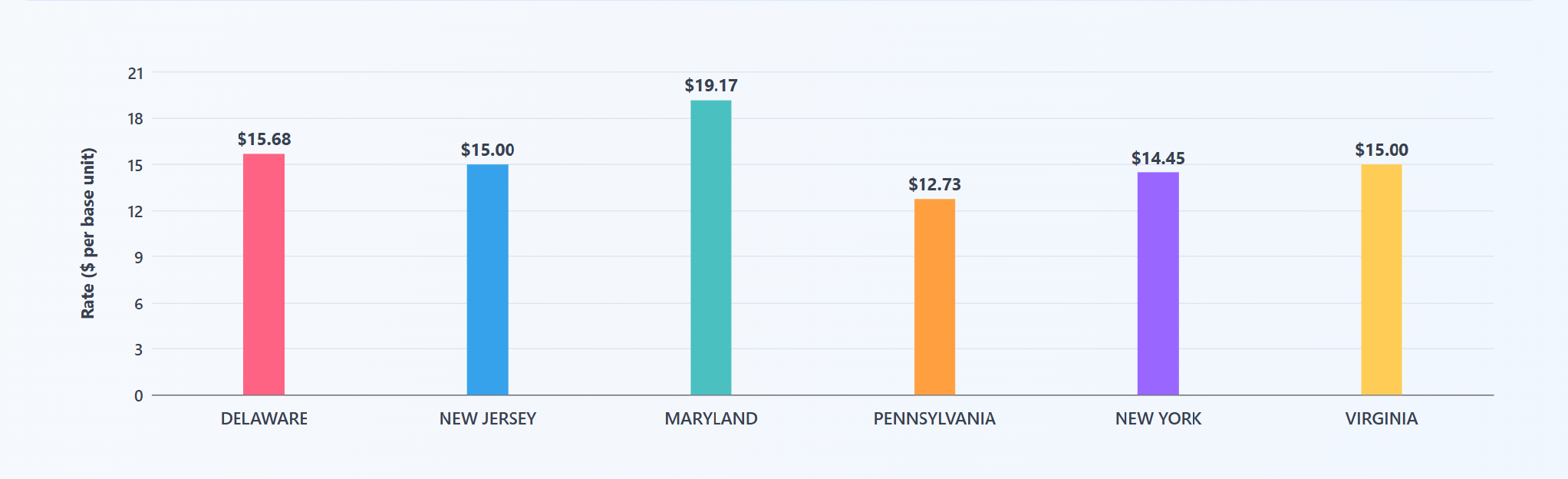
Figure 1: CPT 97153 (adaptive behavior treatment by protocol, technician-delivered) Medicaid rate per 15-minute unit, Delaware and neighboring states. Delaware reflects its base rate. New York reflects its fee-for-service rate through September 30, 2026; the rate for services on or after October 1 is $9.63. Source: MediRate.
On 97153, Delaware’s $15.68 base rate is the second highest in a six-state comparison built on MediRate data, behind only Maryland at $19.17. New Jersey and Virginia each pay $15.00 and Pennsylvania pays $12.73. Maryland’s rate is 22 percent higher than Delaware’s; Pennsylvania’s is 19 percent lower. New York paid $14.45 through September 30; its fee-for-service rate for services on or after October 1 is $9.63, per the state’s August 2026 Medicaid Update, the lowest published Medicaid rate for the code in the country, per MediRate, and below West Virginia’s $9.90, as Acuity has reported.
Figure 2: CPT 97155 (adaptive behavior treatment with protocol modification) Medicaid rate per 15-minute unit, Delaware and neighboring states. Delaware reflects its master’s-level (HO) rate. Source: MediRate.
On 97155, the comparison uses Delaware’s master’s-level rate of $35.19, the tier that matches the graduate degree a Board Certified Behavior Analyst holds. That places Delaware third, behind Virginia at $46.63 and Maryland at $38.34, and well ahead of Pennsylvania at $24.73, New Jersey at $21.25 and New York at $19.26. Measured by its $17.66 base rate instead, Delaware would rank last among the six.
Converted to hourly terms, Delaware’s base 97153 rate pays $62.72 an hour, while the same 97153 service billed at the master’s tier pays $125.00. That $15.57-per-unit gap between tiers is wider than the gap between the highest- and lowest-paying states in the 97153 comparison, which is why the modifier a claim carries can matter more to a Delaware provider’s revenue than the state’s regional ranking.
Which figure applies depends on the modifier the rendering clinician bills, which is why a single number per state cannot capture Delaware’s schedule. MediRate maintains the modifier-level rate detail for Delaware and other state Medicaid programs. MediRate tracks published fee-for-service rates; the Delaware documents reviewed for this article do not say whether Diamond State Health Plan managed care organizations must match them.
Who can deliver ABA under Delaware Medicaid
Delaware does not license behavior analysts. It does not appear on the Behavior Analyst Certification Board’s list of states with behavior analyst licensure or registration laws, and the state plan treats Board Certified Behavior Analysts as unlicensed professionals who may practice independently within the scope of their certification. Board Certified Assistant Behavior Analysts must work under a Board Certified Behavior Analyst, and Registered Behavior Technicians must work under either one. Behavior analysts also have no interstate licensure compact, as Acuity has reported.
The plan also lists Licensed Clinical Social Workers, Licensed Professional Counselors of Mental Health, Advanced Practice Nurses, physicians, Physician Assistants, psychiatrists and psychologists as qualified providers who need no additional certification. Services are covered for Medicaid members under 21. The amendment approved in 2017 says medically necessary services for children will be furnished without limitation, and treatment plans recommending more than 40 hours a week require prior authorization.
Commercial coverage runs on a separate track. A Delaware Health and Social Services regulation, 16 DE Admin. Code 2102, sets standards for certifying autism services providers under the state’s insurance mandate, and the Insurance Commissioner adjusts the mandate’s annual ABA benefit cap each spring for inflation. The 2026 notice sets the cap at $38,601.65 per person, effective April 1, 2026. That cap applies to commercial health plans, not Medicaid.
The 30-unit handoff, described two ways
Delaware delivers Medicaid through Diamond State Health Plan managed care organizations, with certain behavioral health services carved out. A 2017 DMMA parity report explains the split for children: managed care plans cover 30 units of outpatient mental health and substance use services for members under 18, and the Department of Services for Children, Youth and Their Families (DSCYF) is responsible for services beyond that.
How that split applies to ABA is less clear. AmeriHealth Caritas Delaware’s member benefits page, updated in May 2026, lists applied behavior analysis among its autism services and says the plan covers the first 30 outpatient hours per year, with hours above 30 provided through DSCYF. The plan’s provider behavioral health page, dated February 2026, describes the handoff differently: once a member under 18 reaches 30 units of behavioral health service in a calendar year, providers should obtain prior authorization and payment for further ABA from the Division of Developmental Disabilities Services (DDDS).
The two pages differ on the unit of measure and on the receiving agency. Thirty hours equals 120 billing units; 30 units equals seven and a half hours, less than half a week of treatment for a child authorized for 20 hours a week. The DSCYF fee schedule for its Division of Prevention and Behavioral Health Services, dated 2025, lists no adaptive behavior codes, while the January 2026 physician fee schedule includes a separate DDDS rate type. Providers serving Delaware Medicaid children should confirm with DMMA and with each plan which agency authorizes and pays for ABA once the managed care allotment is used.
What comes next for Delaware’s ABA rates
Federal pressure points toward closer scrutiny. CMS released its State Medicaid and CHIP ABA Toolkit on August 4, citing a 421 percent increase in Medicaid and CHIP ABA spending between 2021 and 2025, against 67 percent growth in the number of children with an autism diagnosis receiving services. CMS describes the toolkit as a resource to help states address rising expenditures, inconsistent clinical practices and fraud schemes, and says it is not a restriction on autism services. Acuity has examined its diagnosis guidance.
The code set is changing as well. As Acuity has reported, the 2027 CPT adaptive behavior code set splits 97155, which means Delaware, like other states that pay on the 9715x codes, will need to price new codes. For a schedule built on relative values where they exist and on other states’ fees where they do not, that repricing is the next natural point to revisit rates that have held since 2022. Delaware is not alone in holding ABA rates flat; Acuity has documented similar freezes in Missouri and Virginia.
Frequently Asked Questions
What does Delaware Medicaid pay for ABA in 2026?
Delaware’s January 2026 physician fee schedule lists 97153 at $15.68, 97155 at $17.66 and 97156 at $31.25 per 15-minute unit, matching the base rates on the ABA schedule effective November 1, 2022. Modifier tiers on the ABA schedule pay more; the master’s-level (HO) rate for 97155 is $35.19. MediRate maintains the full modifier-level detail.
Why does Delaware have multiple rates for the same ABA code?
Delaware’s ABA schedule pays by the education level of the rendering provider, using HN (bachelor’s), HO (master’s) and HP (doctoral) modifiers. Under 97153, those tiers pay $21.34, $31.25 and $31.82, compared with a $15.68 base rate.
Does Delaware license behavior analysts?
No. Delaware does not appear on the Behavior Analyst Certification Board’s list of states with behavior analyst licensure laws. The Medicaid state plan recognizes Board Certified Behavior Analysts as qualified providers who may practice independently, with Board Certified Assistant Behavior Analysts and Registered Behavior Technicians working under supervision.
How does ABA work for Delaware children in managed care?
Managed care plans cover a set number of outpatient behavioral health services for members under 18 before another state agency takes over. AmeriHealth Caritas Delaware describes that limit as 30 hours with DSCYF picking up on one page, and as 30 units with DDDS picking up on another. Providers should confirm the current process with DMMA and each plan.
How do Delaware’s ABA rates compare with neighboring states?
Per MediRate data, Delaware’s $15.68 rate for 97153 ranks second among six Mid-Atlantic states, behind Maryland’s $19.17. Its master’s-level 97155 rate of $35.19 ranks third, behind Virginia ($46.63) and Maryland ($38.34), and ahead of Pennsylvania, New Jersey and New York.