
Illinois held its Medicaid ABA rates flat from 2022 through the May 2026 reissue, choosing to expand the provider workforce instead of raising reimbursement.
Key Takeaways
- Illinois Medicaid pays among the lower ABA rates in the Midwest. The technician code 97153 reimburses at $13.00 per 15-minute unit and the analyst code 97155 at $20.39, both at or near the bottom of the state’s border group.
- The rates have not changed since January 2022, and the May 2026 fee schedule reissue left every unit price untouched. Instead of a rate increase, Illinois broadened who may deliver and bill for Adaptive Behavior Support services.
- The state’s access lever has been workforce expansion. A 2023 law removed the requirement that unlicensed staff work under a licensed practitioner and created new Developmental Clinician and Developmental Technician provider categories, and the May 2026 fee schedule reflects that broader pool while adding telehealth flexibility.
- A separate ownership deadline now looms over the provider network. Section 150 of the Behavior Analyst Licensing Act requires ABA businesses to be owned by licensed behavior analysts by January 2027, and repeal bills have been introduced to undo it.
Illinois runs one of the more stable Medicaid ABA programs in the country, though stability here cuts both ways. The rate a provider is paid for technician-delivered therapy has not changed in more than four years, and when the state reissued its Adaptive Behavior Support (ABS) fee schedule on May 14, 2026, it left every unit price exactly where it had been since January 2022. What changed instead was who is allowed to deliver and bill for the service.
That choice, expanding the workforce rather than raising the rate, is the throughline of Illinois ABA policy. It sits against a national backdrop in which many states are moving the other way, cutting reimbursement, adding prior authorization, or narrowing eligibility. Neighboring Indiana is phasing down its ABA rates through April 2027, and New York completed a 25 percent reduction to its technician rate this spring. Illinois, by contrast, has held its line on price while widening the door on labor.
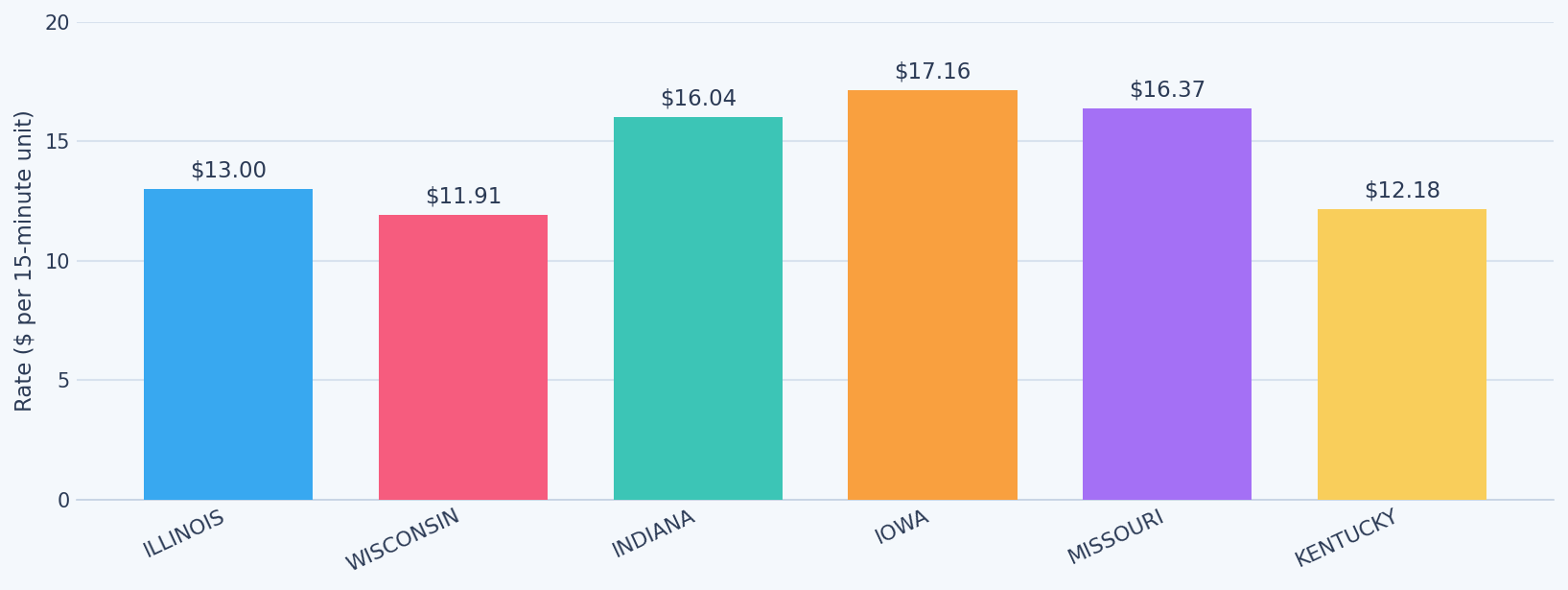
State Rate Comparison: Medicaid ABA Reimbursement, CPT 97153 (adaptive behavior treatment by protocol, technician-delivered), per 15-minute unit. Illinois and border states. Source: MediRate.
How Illinois Medicaid Pays for ABA: The Adaptive Behavior Support Fee Schedule
Illinois covers ABA through its Adaptive Behavior Support benefit, administered by the Department of Healthcare and Family Services (HFS). The benefit went live on November 1, 2020, and the current rate structure took effect on January 15, 2022. Under that schedule, the technician code 97153 (adaptive behavior treatment by protocol) pays $13.00 per 15-minute unit, or $52.00 an hour, when delivered by a Level 2 provider. The analyst code 97155 (adaptive behavior treatment with protocol modification) pays $20.39 per unit, or $81.56 an hour, when delivered by a Level 1 provider. Assessment, family guidance, and team-delivered codes round out the schedule.
The Level 1 and Level 2 labels are where recent policy has done its work. On the original 2022 schedule, Level 1 meant a Board Certified Behavior Analyst and Level 2 meant a Registered Behavior Technician. Those categories are broader now, but not because of the 2026 reissue. Illinois created two additional roles under a 2023 law, discussed below: the ABS Developmental Clinician and the ABS Developmental Technician. The current schedule reflects the wider pool. Level 1 covers BCBAs and ABS Developmental Clinicians, Level 2 covers RBTs and ABS Developmental Technicians, and the team-service codes accept either a BCBA with two RBTs or a Developmental Clinician with two Developmental Technicians. The May 2026 reissue folded these categories onto the rate table and expanded telehealth billing, adding the 93 modifier and place-of-service 10 to the single GT modifier the 2022 version allowed, without changing a single dollar figure.
Fee-for-Service, Managed Care, and the Workforce Expansion Strategy
Most Illinois Medicaid members receive care through managed care organizations, and ABA is no exception. Plans including Meridian, Blue Cross Blue Shield, and CountyCare administer their own prior authorization and negotiate their own contracted rates, which means the published fee schedule functions as a floor rather than a guaranteed payment. Prior authorization is required across the program, and plans apply their own utilization limits on weekly hours and daily units.
The more consequential story is on the supply side. Illinois has treated its provider pipeline, rather than its rate, as the variable to adjust. In August 2023, acting under Public Act 103-0102, HFS removed the requirement that unlicensed ABS clinicians and technicians work under the clinical supervision of a licensed practitioner of the healing arts, eliminated mandatory written collaborative agreements between enrolled providers, and expanded the pool eligible to enroll. That change created the two new categories now on the fee schedule: the ABS Developmental Clinician, open to licensed clinical psychologists, clinical social workers, clinical professional counselors, marriage and family therapists, occupational therapists, and speech-language pathologists who hold an approved developmental-intervention certification, and the ABS Developmental Technician. In January 2025, the Illinois Department of Financial and Professional Regulation began issuing behavior analyst licenses under the 2022 Behavior Analyst Licensing Act, a credentialing milestone that also underpins the ownership rules discussed below. Then, in a public notice dated September 30, 2025, HFS proposed a pathway for qualified individuals to enroll and bill as a technician while still completing full RBT certification, a change it described as budget neutral. The phrase captures the strategy in two words: widen access without adding cost.
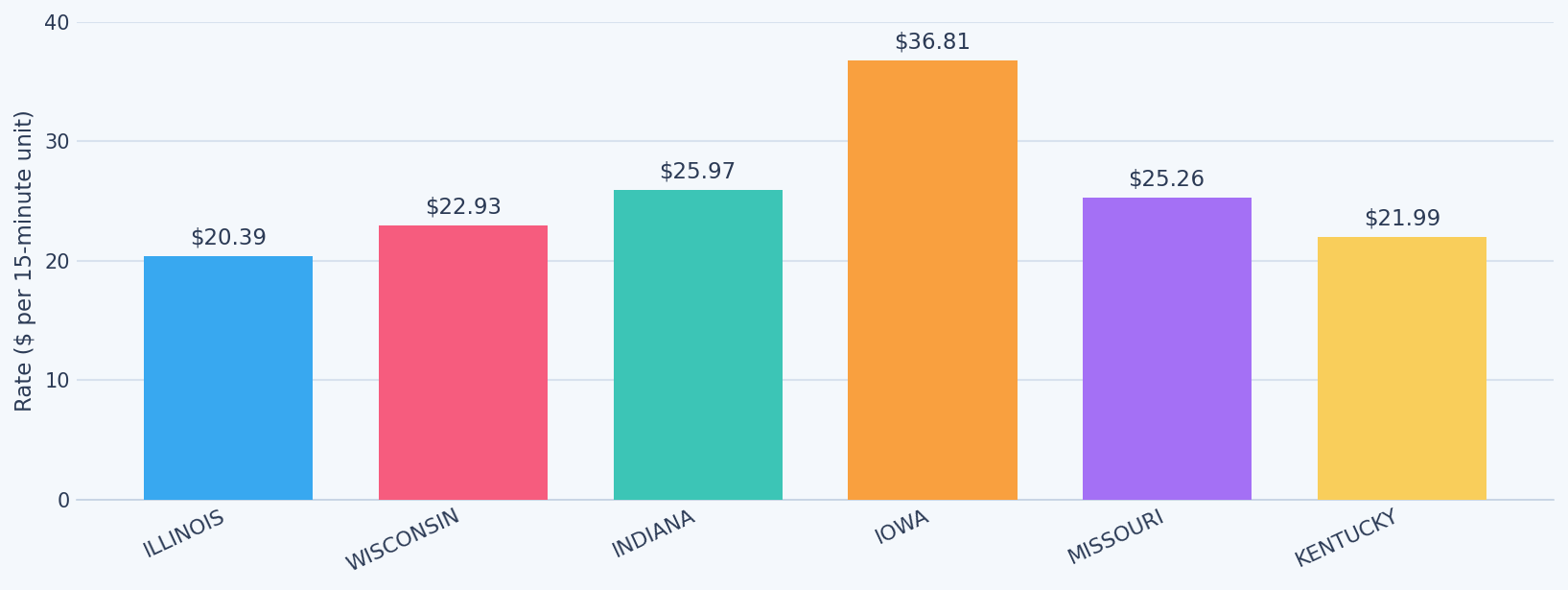
State Rate Comparison: Medicaid ABA Reimbursement, CPT 97155 (adaptive behavior treatment with protocol modification, analyst-delivered), per 15-minute unit. Illinois and border states. Indiana reflects the current rate effective April 1, 2026. Missouri reflects the state’s revised fee schedule, which distinguishes home-based delivery by modifier. Source: MediRate.
What Illinois ABA Providers Should Watch in 2026 and 2027
For all its rate stability, Illinois is not a quiet market. A separate provision of the Behavior Analyst Licensing Act, Section 150, requires that by January 2027, every owner and equity holder of an ABA business hold a valid Illinois behavior analyst license, or divest. Illinois and New York are the only two states with such an ownership mandate. Two repeal bills, SB 3807 and HB 5171, have been introduced to undo it, and the fight over Section 150’s ownership cliff has become a defining governance question for the state’s roughly 140 to 150 ABA companies.
The rate environment also cannot be read in isolation from federal policy. The 2025 federal reconciliation law, known as the One Big Beautiful Bill Act, carries Medicaid reductions that phase in over the next several years, and state budget writers will feel that pressure in the 2026-2027 fiscal year. When budgets tighten, managed care plans tend to reach first for utilization controls and approved-hour reductions rather than posted-rate cuts, which makes the authorization environment, not the fee schedule, the place to watch. Federal auditors have added to that pressure: neighboring Wisconsin was among the states where federal reviews flagged improper ABA payments, giving payers cover for tighter scrutiny.
The market context matters for who survives a flat-rate environment. Private equity-backed platforms can absorb stagnant reimbursement across a multi-state footprint in ways that independent, BCBA-owned practices often cannot, a dynamic that is reshaping the ABA M&A market nationally. In Illinois, a low but predictable rate, an expanding provider definition, and a looming ownership deadline together define the ground on which providers will compete over the next two years.
Frequently Asked Questions
What are Illinois Medicaid’s current ABA reimbursement rates?
Under the HFS Adaptive Behavior Support fee schedule, the technician code 97153 pays $13.00 per 15-minute unit and the analyst code 97155 pays $20.39 per unit. Those rates have been in effect since January 15, 2022.
Did Illinois change its ABA rates in 2026?
No. HFS reissued the Adaptive Behavior Support fee schedule on May 14, 2026, but every unit price and maximum stayed the same as the January 2022 version. The reissue expanded the provider categories that may bill at each level and broadened telehealth billing.
Who can deliver and bill for ABA under Illinois Medicaid?
Level 1 providers are Board Certified Behavior Analysts and ABS Developmental Clinicians (licensed clinical psychologists, clinical social workers, clinical professional counselors, marriage and family therapists, occupational therapists, and speech-language pathologists who hold an approved developmental-intervention certification). Level 2 providers are Registered Behavior Technicians and ABS Developmental Technicians. All must be enrolled in the state IMPACT system, and prior authorization is required.
How do Illinois rates compare to neighboring states?
On both the 97153 technician code and the 97155 analyst code, Illinois sits at or near the bottom of its border group, per MediRate. Several neighbors, including Indiana, are cutting their rates, while Illinois has held its rates flat rather than reducing them.
What is Illinois’s Section 150 ownership requirement?
Section 150 of the Behavior Analyst Licensing Act requires that by January 2027, every owner and equity holder of an ABA business hold a valid Illinois behavior analyst license, or divest. Repeal bills SB 3807 and HB 5171 have been introduced in the General Assembly that would undo the requirement.
Is ABA delivered through managed care in Illinois?
Yes. Most members receive ABA through managed care organizations such as Meridian, Blue Cross Blue Shield, and CountyCare, which set their own authorization rules and negotiate contracted rates. The published fee schedule functions as a floor.