TennCare publishes no ABA rates. BlueCare, UnitedHealthcare, and Wellpoint set their own while following a shared program description.
Key Takeaways
- No published rate. TennCare’s managed care organizations each keep their own fee schedules and contract with ABA providers directly, so TennCare publishes no ABA rate.
- One rulebook across plans. TennCare and its three plans share a single ABA program description covering credentials, treatment plans, and an annual quality attestation.
- Spending is visible even if rates are not. CMS data show Tennessee Medicaid paid $189.1 million for ABA in 2025 across 1,016 providers.
- Neighbors set the market. Six bordering states publish RBT-tier 97153 rates from $10.00 to $20.81, and Tennessee’s disability waivers pay behavior analysts $18.85 per 15 minutes.
Tennessee’s Medicaid program covers applied behavior analysis (ABA), but it does not publish what it pays for it. TennCare delivers services through managed care, and each of its three managed care organizations (MCOs), BlueCare Tennessee, UnitedHealthcare Community Plan, and Wellpoint, creates its own provider contracts and maintains its own fee schedules. TennCare sets no rate for 97153, 97155, or any other ABA code.
That makes Tennessee one of the hardest states in this series to price, and the last. Acuity’s Georgia installment left Tennessee off its charts for the same reason. This installment looks instead at what TennCare does standardize, what federal data show about Tennessee’s ABA spending, the behavior analysis rates the state does publish in other programs, and what neighboring Medicaid programs pay.
How TennCare Pays for ABA Through Managed Care
For children, the benefit rests on Early and Periodic Screening, Diagnostic, and Treatment (EPSDT), which TennCare’s rules define as a covered benefit for TennCare Medicaid enrollees under 21. TennCare’s MCOs authorize and pay for ABA under their own provider contracts. Each requires pre-certification built on a diagnosis from a qualified health professional and a treatment plan dated within 30 days of the start of services, according to the plans’ joint ABA program description. BlueCare Tennessee also operates TennCare Select, a second TennCare plan, according to its provider manual.
Because rates are set in private contracts, providers delivering the same service to children on different plans may be paid different amounts, and TennCare does not publish what any plan pays. Michigan, which also routes ABA through managed care, sets a legislated minimum of $16.50 for 97153. Tennessee sets none.
Plan-level discretion is drawing attention elsewhere in the region. Georgia’s plans are not contractually tied to the state fee schedule either, according to Autism Providers of Georgia, and lawmakers there pressed Amerigroup in October to reverse a 30 percent ABA cut for children in foster care.
One ABA Program Description for Three TennCare Plans
What TennCare has standardized is the clinical side. The Division of TennCare and its three MCOs share an ABA Provider Requirements and Program Description that every network provider must attest to follow; the version the plans post is dated June 13, 2024. Behavior analysts must hold Board Certified Behavior Analyst (BCBA) certification verified by the MCO, and Registered Behavior Technicians (RBTs) and their supervisors must meet all Behavior Analyst Certification Board requirements. BCBAs engaging in direct ABA therapy must also be licensed as Licensed Behavior Analysts (LBAs) by Tennessee’s Applied Behavior Analyst Licensing Committee, which the Legislature created in 2014. Unlicensed staff may deliver ABA only under the extended authority and direction of a Tennessee LBA, and may not represent themselves as behavior analysts.
The description sets the same treatment rules for all three plans. Treatment plans are due within 30 days of admission and reviewed every six months, standardized assessments must be updated at least every two years, and groups should run no larger than six to eight participants as a best practice. Assessments should include direct observation, ideally with at least one in-person contact, and the description asks providers to weigh the limitations of telehealth for each patient. Excluded services include provider travel time, services billed while a member is sleeping, and services that are part of a child’s individualized education program.
Oversight runs through an Annual ABA Provider Quality Assurance Attestation that TennCare and the MCOs developed with provider input, plus collaborative quality reviews of randomly sampled providers. Codes are listed on a Universal ABA Request for Authorization that each plan hosts. Wellpoint’s ABA request form, dated January 2026, asks providers to rate the severity of a member’s behavior deficits and maladaptive behaviors and to list the standardized assessments used to validate progress.
What Tennessee Medicaid Spends on ABA
Rates are private, but spending is not. The ABA heat map the Centers for Medicare & Medicaid Services (CMS) published in August, built from fee-for-service and managed care claims data, shows Tennessee Medicaid paid $189.1 million for ABA in calendar year 2025 across 1,016 providers. The median payment was $12,366 per beneficiary and $139,489 per provider.
Among the six neighbors charted below, North Carolina ($695.9 million), Georgia ($598.6 million), and Virginia ($332.2 million) paid more in total, while Kentucky ($77.3 million), Alabama ($51.9 million), and Mississippi ($8.8 million) paid less. Tennessee’s median payment per provider was the highest of the seven states, and its median per beneficiary sat just above Alabama’s $12,293, in a range that ran from $5,078 in Mississippi to $28,417 in North Carolina. CMS notes that geographic variation does not by itself indicate fraud, waste, abuse, or improper billing, and that state service definitions and hour limits differ.
The heat map is part of a broader federal push. CMS’s August ABA toolkit reported that Medicaid and CHIP spending on ABA rose 421 percent from 2021 to 2025, and CMS now spotlights ABA as a high-risk Medicaid service on its fraud-prevention page.
Tennessee Medicaid ABA Rates Compared With Neighboring States
With no Tennessee rate to chart, the comparison shows the market Tennessee providers and plans operate in. On RBT-delivered 97153, North Carolina pays the most at $20.81 per 15-minute unit, a rate that reflects the reversal of a 10 percent cut. Georgia pays $15.58 in the clinic and $18.69 outside it, followed by Mississippi at $15.08, Virginia at $15.00, Kentucky at $12.18, and Alabama at $10.00, which Acuity has described as the Southeast floor.
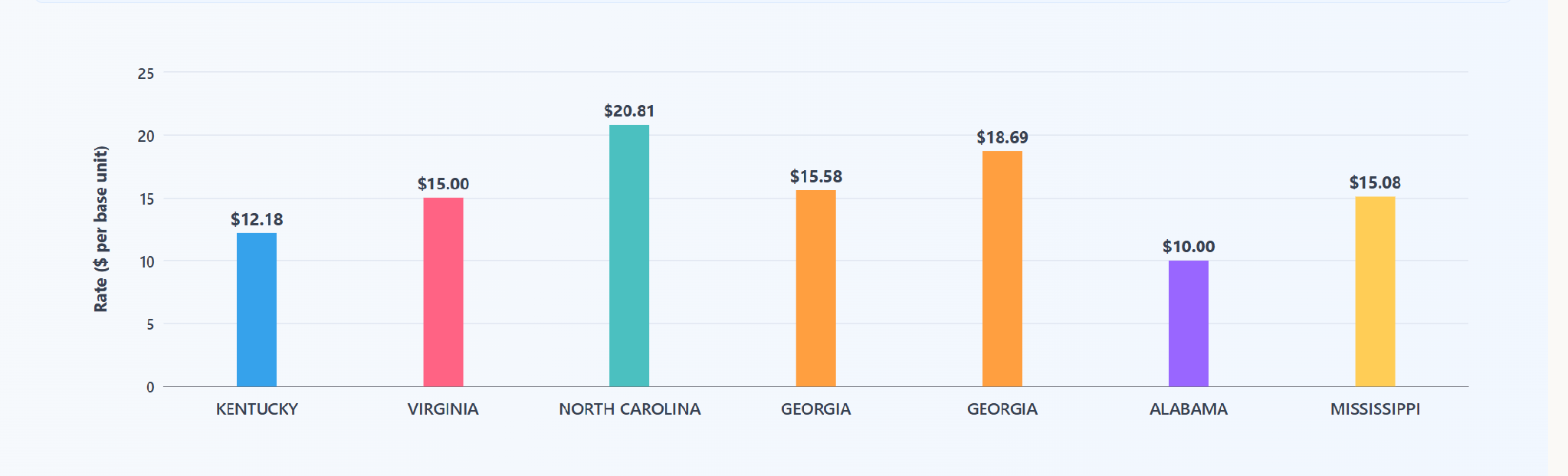
Figure 1. State Rate Comparison: Medicaid ABA Reimbursement, CPT 97153 (Adaptive Behavior Treatment by Protocol), RBT tier, per 15-minute unit, for states bordering Tennessee. Source: MediRate. Tennessee does not appear because TennCare’s managed care organizations set ABA rates privately. Georgia’s fee schedule differentiates by delivery setting; the first Georgia bar reflects in-clinic delivery ($15.58) and the second reflects out-of-clinic delivery ($18.69).
The analyst code spreads wider. Virginia pays $46.63 for BCBA-delivered 97155, followed by Georgia’s out-of-clinic rate of $37.78, North Carolina at $32.22, and Georgia’s in-clinic $30.91. Mississippi pays $24.35, Kentucky $21.99, and Alabama $15.00
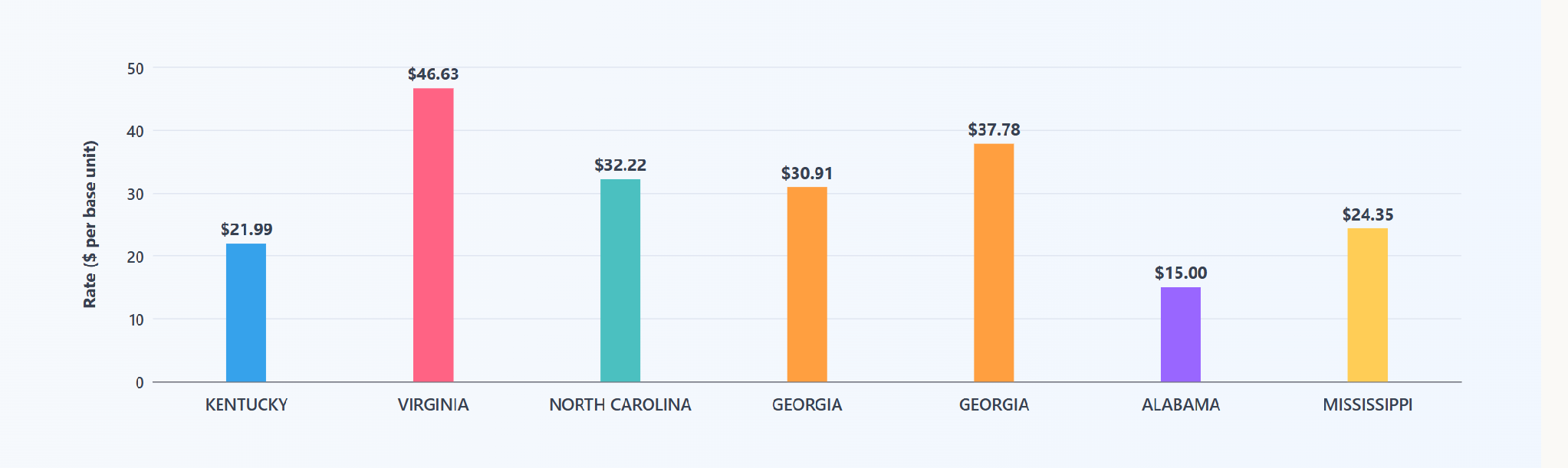
Figure 2. State Rate Comparison: Medicaid ABA Reimbursement, CPT 97155 (Adaptive Behavior Treatment with Protocol Modification), BCBA tier, per 15-minute unit, for states bordering Tennessee. Source: MediRate. Tennessee does not appear because TennCare’s managed care organizations set ABA rates privately. Georgia’s fee schedule differentiates by delivery setting; the first Georgia bar reflects in-clinic delivery ($30.91) and the second reflects out-of-clinic delivery ($37.78).
The Behavior Analysis Rates Tennessee Does Publish
Tennessee does set a public rate for behavior analytic work, in a different program. The Department of Disability and Aging (DDA) operates the state’s three Section 1915(c) waivers for people with intellectual and developmental disabilities: the Statewide, Comprehensive Aggregate Cap, and Self-Determination waivers. Under its rate schedule effective July 1, 2026, DDA pays $18.85 per 15 minutes, or $75.40 an hour, for Behavior Analyst services, including assessment and plan development and training. A Behavior Specialist, who needs no license but must work under a behavior analyst’s oversight according to DDA’s provider licensure requirements, is paid $6.75.
A second DDA program publishes credential-based rates. The Tennessee Early Intervention System (TEIS), which serves infants and toddlers under Part C of the Individuals with Disabilities Education Act, pays vendors $78 an hour for BCBA services, $59 for Board Certified Assistant Behavior Analysts, and $39 for RBTs under a rate sheet effective July 1, 2025, plus a $20 travel fee for home and community visits.
Neither program is the ABA benefit TennCare’s MCOs pay for, so neither rate is a stand-in for what the plans pay. They do show what the state itself pays for behavior analytic time. DDA’s $18.85 falls below every BCBA-tier 97155 rate in Figure 2 except Alabama’s, and TEIS’s RBT rate works out to $9.75 per 15 minutes, below every 97153 rate in Figure 1.
What Tennessee ABA Providers Should Watch
The 2027 CPT code set takes effect January 1, deleting 0362T and 0373T and splitting the treatment component of 97155 into a new code. Each TennCare plan will need to update the codes on its authorization forms.
Utilization rules are the other variable. CMS has said that weekly hour limits for children can work only as soft limits, while neighboring Virginia has proposed a 20-hour weekly cap. The shared program description sets no weekly hour limit, though it requires a schedule of treatment hours in each treatment plan, leaving intensity to each plan’s authorization review.
Acuity requested comment from TennCare on whether it sets or reviews the rates its MCOs pay ABA providers. For rate detail across the full ABA code set in neighboring states, MediRate maintains the underlying state datasets.
Frequently Asked Questions
Does TennCare publish ABA rates?
No. TennCare’s managed care organizations each maintain their own fee schedules and negotiate ABA rates privately with providers, so there is no public state rate for 97153, 97155, or other ABA codes.
Which plans pay for ABA under TennCare?
BlueCare Tennessee, UnitedHealthcare Community Plan, and Wellpoint. BlueCare Tennessee also operates TennCare Select.
Who can provide ABA under TennCare?
Behavior analysts must be BCBAs verified by the plan and, when providing direct therapy, licensed in Tennessee as LBAs. RBTs and unlicensed staff may deliver services under the direction of a licensed behavior analyst, under the plans’ shared program description. Licensed mental health clinicians who meet BACB and plan standards may provide direct ABA without an LBA when practicing within a provider group.
How much did Tennessee Medicaid spend on ABA in 2025?
About $189.1 million across 1,016 providers, according to CMS’s August 2026 heat map, with a median payment of $12,366 per beneficiary.