Michigan requires one Medicaid ABA rate, a 97153 minimum its PIHPs must pay. The state’s own benchmarks show how far it sits below rates modeled for degreed staff.
Key Takeaways
- Only one code has a state rate. Michigan’s ABA benefit runs through regional PIHPs, and only 97153 carries a state-set minimum: $16.50 per 15 minutes, or $66 an hour.
- The floor came from the Legislature. A fiscal 2025 budget mandate took effect November 1, 2024, as a state directed payment funded through PIHP capitation.
- State benchmarks run higher for degreed staff. Milliman’s SFY 2026 comparison rates put 97153 at $23.27 for bachelor’s-level and $28.00 for master’s-level staff, rates MDHHS has not adopted.
- Utilization is the next lever. The FY2027 budget books $21.6 million in autism utilization savings, and new ABA CPT codes take effect in January.
Michigan’s Medicaid program requires one applied behavior analysis (ABA) payment rate. Under a legislative mandate, the Prepaid Inpatient Health Plans (PIHPs) that run the state’s autism benefit must pay at least $16.50 per 15-minute unit, or $66 an hour, for CPT 97153, the code for technician-delivered treatment. Every other ABA code, including 97155 for protocol modification by an analyst, is paid at rates set in contracts between the PIHPs and providers.
That structure makes Michigan an outlier in this series. The state’s Non-Physician Behavioral Health fee schedule, revised August 27, 2026, lists no ABA codes at all. Michigan did commission benchmark rates for most ABA codes, though, and they show how the single floor compares with what the state’s actuarial consultant modeled for staff at each education level.
How Michigan Medicaid Pays for ABA Through PIHPs
Michigan added Medicaid coverage of Behavioral Health Treatment, including ABA, for young children with autism spectrum disorder in 2013, according to the state’s autism program, and extended it to beneficiaries under 21 in January 2016. The benefit is contracted through ten regional PIHPs and delivered locally through Community Mental Health Services Programs (CMHSPs), which handle assessment and eligibility, while PIHPs authorize services. MDHHS told Acuity that 10,330 Medicaid beneficiaries received Behavioral Health Treatment in fiscal year 2025, in responses to questions about Bulletin MMP 26-18, the October update that rewrote the benefit’s clinical rules.
The benefit covers beneficiaries under 21 with an autism diagnosis at any level of severity. The pathway runs from screening, by a primary care provider or the PIHP or CMHSP, to a comprehensive diagnostic evaluation, a behavioral assessment by a licensed provider, and prior authorization by the PIHP. Michigan’s rate documents distinguish ABA time by education level, using HM, HN, and HO modifiers.
Because the state pays PIHPs a capitation rate rather than paying providers claim by claim, what an ABA agency earns for most codes depends on its PIHP or CMHSP contract. Michigan publishes no state rate for any ABA code other than 97153. The FY2027 budget, signed July 21, adds a 5 percent actuarial soundness increase to autism capitation rates on a Medicaid autism services line that carried $530.3 million in fiscal 2026, according to the Senate Fiscal Agency. The same budget books $21.6 million in savings from policy changes meant to produce “utilization efficiencies” in Medicaid autism services.
Michigan’s $16.50 Minimum Rate for 97153
The 97153 floor came from the Legislature. Michigan’s fiscal 2025 budget, Public Act 121 of 2024, directed MDHHS to raise the ABA rate, and Bulletin MMP 24-51 set the minimum at $16.50 per unit effective November 1, 2024. MDHHS structured it as a state directed payment under federal managed care rules, funded through higher PIHP capitation payments, and CMS approved the state plan amendment on December 17, 2024, effective November 1. In its public notice, MDHHS estimated the gross cost at $17.2 million a year.
The rate document MDHHS used for SFY 2026 capitation development, obtained through MediRate’s state document library, applies the $16.50 minimum to 97153 at both the less-than-bachelor’s (HM) and bachelor’s (HN) modifier levels. It lists the eligible provider types as Board Certified Behavior Analysts, Board Certified Assistant Behavior Analysts, Qualified Behavioral Health Professionals, Licensed and Limited Licensed Psychologists, and Behavior Technicians. Because the minimum is a directed payment, PIHPs cannot contract below $16.50 for 97153 at those levels, though nothing stops them from paying more.
Budget language has steered technician pay for years. FY2023 budget boilerplate, attached to the minutes of a February 2023 Autism Council meeting set behavioral technician rates at not less than $52.35 and not more than $57.35 per hour, a band the $66 floor now clears. Lawmakers have also tried to enforce it: the FY2026 budget directed MDHHS to seek CMS approval to condition PIHP performance incentives on compliance with the autism provider rates, according to the House Fiscal Agency.
Michigan ABA Rates Compared With Neighboring States
Against its neighbors, Michigan’s 97153 floor sits at the top. In MediRate data, Minnesota pays $16.14, Indiana $16.04, Illinois $13.00, and Wisconsin $11.91, a rate that has held since February 2023. Acuity’s Iowa installment compared many of the same states.
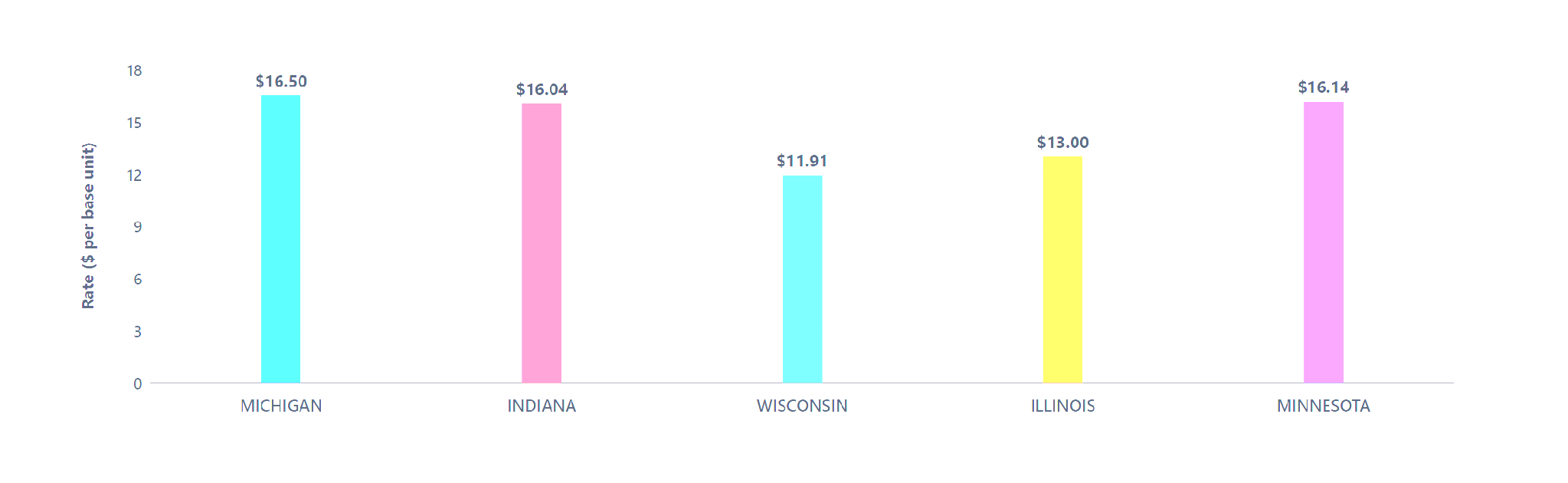
Figure 1. Medicaid 97153 (adaptive behavior treatment by protocol, technician-delivered), rate per 15-minute unit: Michigan and neighboring states. Michigan’s figure is the minimum PIHPs must pay under a state directed payment. Ohio has no adopted 97153 rate and is not charted. Source: MediRate.
Indiana’s $16.04 reflects a 6 percent cut to nongroup ABA rates that took effect April 1 under Bulletin BT202627, which schedules another 4 percent cut for April 1, 2027. Michigan’s figure works differently from its neighbors’ fee schedules: it is a minimum, not a measure of what PIHPs actually pay, and plans may contract above it.
The comparison also stops at 97153. Michigan sets no state rate for 97155, so there is no Michigan figure to set against neighbors’ analyst rates, and this installment omits the series’ standard 97155 chart. Ohio, Michigan’s other neighbor, has no adopted ABA fee schedule.
What Michigan’s Benchmark Rates Show
The best public guide to the codes Michigan does not price is a comparison rate report Milliman prepared for MDHHS for SFY 2026, dated July 2025. Milliman built independent rate models from provider wage surveys and other cost inputs, producing benchmark rates for most ABA codes, including 97153 and 97155, by provider education level.
For 97153, the statewide benchmarks are $15.33 per 15 minutes for staff with less than a bachelor’s degree, $23.27 for bachelor’s-level staff, and $28.00 at the master’s level. For 97155, they are $24.47 and $29.77 at the bachelor’s and master’s levels. Benchmarks run higher in frontier counties: $18.45 for less-than-bachelor’s 97153, against $15.14 in urban areas.
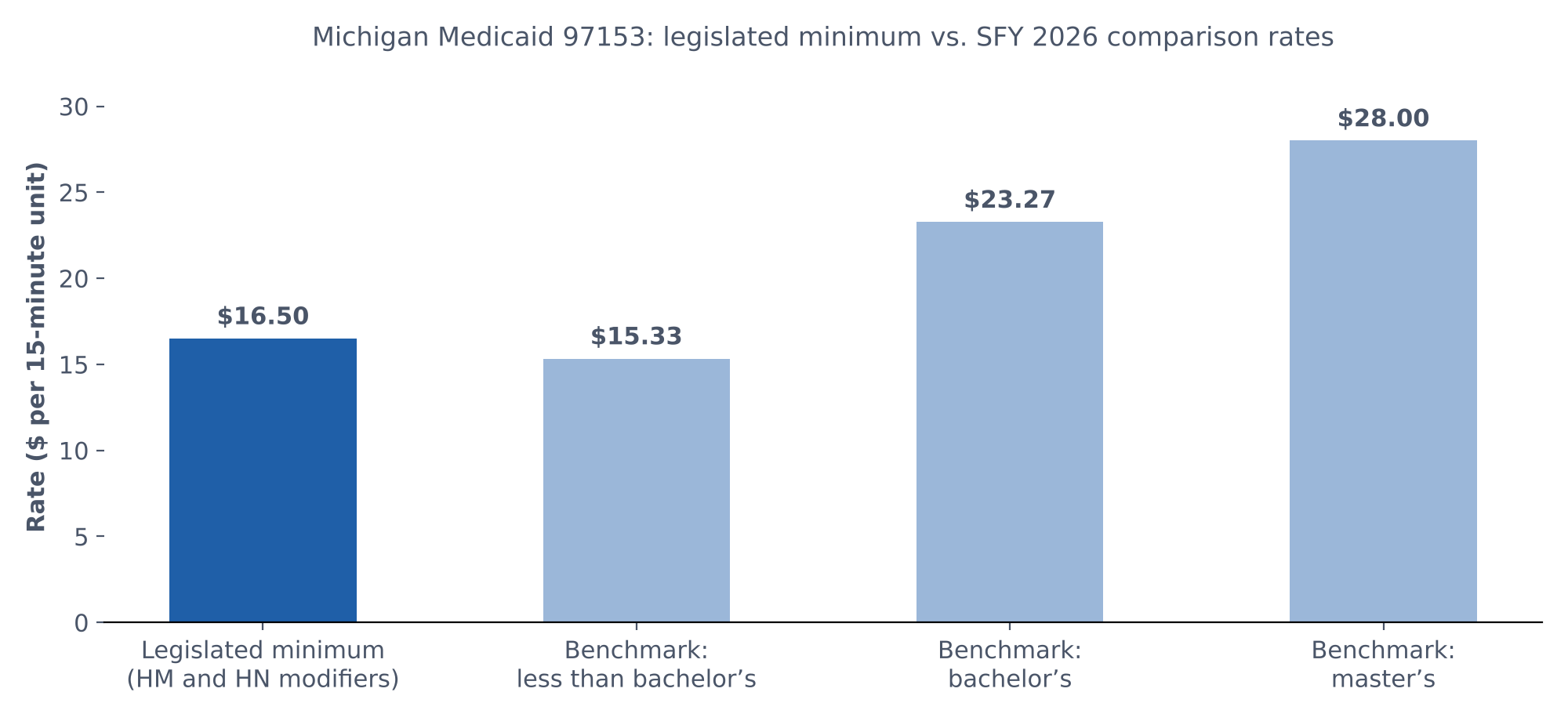
Figure 2. Michigan’s legislated 97153 minimum compared with SFY 2026 statewide comparison rates by provider education level, per 15-minute unit. This series’ standard comparison charts, built on the MediRate platform, track 97153 and 97155 across neighboring states. Michigan sets no state rate for 97155 and only a minimum for 97153, so Acuity compiled this chart from MDHHS’s SFY 2026 ABA rate document for PIHP rate development and Milliman’s SFY 2026 Behavioral Health Comparison Rate Development report, both obtained through MediRate’s state document library. Comparison rates are benchmarks that MDHHS has not adopted as payment rates. Source: MDHHS and Milliman, via MediRate.
Read together, the floor sits $1.17 above the benchmark for staff with less than a bachelor’s degree and $6.77 below it for bachelor’s-level staff. The report is explicit that it does not set payment. It says MDHHS is not currently considering broad adoption of the comparison rates as a fee schedule or directed payment and will not use them to reprice PIHP capitation. The one service MDHHS does reprice for capitation is 97153, and it uses the $16.50 budget rate, not the comparison rate, to do so. MDHHS will use the rates to identify outliers in reported costs, according to the report.
The gap matters most where agencies staff 97153 with degreed technicians. Because the floor applies equally at the HM and HN levels, a PIHP can satisfy the mandate by paying $16.50 for bachelor’s-level time that Milliman’s model prices at $23.27. Whether plans pay more is a contract question the public record does not answer.
What Comes Next for Michigan ABA Providers
The PIHP system itself will stay in place for now. MDHHS withdrew its request for proposals to rebid the PIHP contracts after a January 8 Court of Claims ruling found parts of it conflicted with the Mental Health Code, the Michigan Health and Hospital Association reported.
MMP 26-18, issued October 1, requires services to be delivered under the direction of a Licensed Behavior Analyst and interim progress assessments at least every six months. MDHHS told Acuity its requirements took effect June 1, 2026. Billing changes next: the 2027 ABA CPT code set, including 97180, takes effect in January and will require billing updates in state Medicaid programs.
Federal scrutiny frames all of it. CMS’s August 4 ABA toolkit reported that Medicaid and CHIP spending on ABA rose 421 percent from 2021 to 2025, and enforcement is active in the region: Minnesota investigators searched two autism centers on October 29. Other states have turned to utilization controls to slow ABA spending, and Michigan’s FY2027 budget assumes savings of its own.
MDHHS has not yet published an SFY 2027 version of its ABA rate document or a new Milliman comparison report on its behavioral health billing page. Michigan’s SFY 2027 began October 1, and Acuity requested comment from MDHHS on whether the $16.50 minimum carries into them. MediRate maintains the underlying rate detail for Michigan and other state Medicaid programs.
Frequently Asked Questions
What does Michigan Medicaid pay for ABA in 2026?
For CPT 97153, PIHPs must pay at least $16.50 per 15-minute unit, or $66 an hour, under a state directed payment in effect since November 1, 2024. Rates for other ABA codes are set in PIHP and CMHSP contracts with providers, and the state does not publish them.
Does Michigan Medicaid have a rate for 97155?
Michigan publishes no state rate for 97155. A Milliman benchmark report for MDHHS puts 97155 at $24.47 for bachelor’s-level and $29.77 for master’s-level providers, but MDHHS has not adopted those figures.
How do families access ABA through Michigan Medicaid?
Families start with their local CMHSP or PIHP, which handles assessment, eligibility, and prior authorization for Behavioral Health Treatment.
Who can provide ABA under Michigan Medicaid?
Services must be delivered under the direction of a Licensed Behavior Analyst. Licensed Assistant Behavior Analysts, qualified psychologists, and Registered Behavior Technicians or Behavior Technicians supervised by an LBA or LABA can also deliver services, under Bulletin MMP 26-18.