
South Carolina’s new ASD Services Provider Manual will make Adaptive Behavior Treatment with Protocol Modification (97155) and Family Adaptive Behavior Treatment Guidance (97156) permanently telehealth-eligible, eliminate Behavior Identification Assessment (97151) from telehealth, and tighten medical necessity, non-covered services, and high-risk provider screening. Provider feedback is due to SCDHHS by June 1, 2026, with the updated fee schedule to follow on July 1.
Key Takeaways
- Manual rewrite advances on July 1. SCDHHS will replace the September 2025 ASD Services Provider Manual with a draft that streamlines service definitions, strengthens medical necessity criteria, and expands the list of non-covered services. The updated Adaptive Behavior Services fee schedule will follow.
- Telehealth recalibrates, not contracts. 97156 will be permanently telehealth-eligible and 97155 will be permanently telehealth-eligible with prior authorization, while 97151 will no longer be allowable via telehealth. The assessment-versus-treatment split lines up with where direct, in-person observation drives clinical quality.
- South Carolina’s rates sit at the lower end of the Southeast. The current ASD fee schedule reimburses 97153 at $14.88 per 15-minute unit and 97155 at $21.25, both below the corresponding North Carolina, Virginia, and Georgia out-of-clinic benchmarks on the analyst code. The 160-unit-per-week 97153 cap and the 64-unit-per-month 97155 cap remain in force.
- A new state law puts private ABA providers in public schools. Governor Henry McMaster signed H.3974 on May 18, 2026, requiring districts to consider parent requests for BCBA, BCaBA, BCBA-D, and RBT services in schools as medically necessary, with a State Board of Education model policy due by January 6, 2027.
South Carolina’s Medicaid autism program is moving into its second tightening cycle in less than a year. In a May 2026 Medicaid bulletin, the South Carolina Department of Health and Human Services (SCDHHS) told Autism Spectrum Disorder (ASD) providers that it will replace its current ASD Services Provider Manual with an updated version effective for dates of service on or after July 1, 2026. A draft is posted, public comment is due by June 1, and the updated fee schedule will follow on the same date the manual takes effect.
The rewrite is not a wholesale restructuring of the benefit. It is a layered update on top of the September 1, 2025 manual, which itself reorganized how medical necessity for ABA is established in South Carolina. Read together, the two updates show SCDHHS narrowing the documentation and screening perimeter around the program while keeping the existing rate structure in place.
What the July 1 Manual Will Change
The May 2026 bulletin identifies six categories of update in the manual: telehealth guidance; medical necessity criteria; the list of non-covered services; provider qualifications and enrollment; plan of care and documentation requirements; and procedure code standards. The telehealth changes are the most operationally significant for ABA providers because they cut against the post-pandemic baseline that has shaped scheduling and staffing for several years.
Under the draft, Family Adaptive Behavior Treatment Guidance (97156) will be permanently incorporated into the ASD Services Provider Manual as a telehealth-eligible service, and Direct Adaptive Behavior Treatment with Protocol Modification (97155) will also be permanently incorporated with prior authorization. Behavior Identification Assessment (97151), however, will no longer be allowable via telehealth. The split lines up with how the clinical literature distinguishes structured behavioral observation, which benefits from in-person delivery, from caregiver guidance and BCBA protocol direction, which can be effective remotely.
On enrollment, SCDHHS is aligning the manual with federal Medicaid provider screening rules and the September 2025 CMS strengthening of “high risk” provider screening categories. Additional language clarifies which ASD providers fall into that category and what documentation they must submit at enrollment.
The September 2025 Restructuring Sits Underneath the July Update
The September 2025 manual update, which is the operative document going into the July rewrite, already changed the diagnostic gateway. SCDHHS replaced the previous Comprehensive Psychological Evaluation with a Comprehensive Diagnostic Assessment (CDA) that must be administered directly by a licensed physician (MD or DO), licensed psychologist (PhD or PsyD), or Licensed Psychoeducational Specialist (LPES). Autism diagnoses conferred by telehealth are not considered valid for ASD medical necessity, and the structured behavioral observations supporting the CDA must use one of three validated tools (ADI-R, ADOS, or CARS).
To avoid bottlenecking access, SCDHHS opened two alternative pathways alongside the CDA. A Medical Care Home Autism Assessment lets a child’s primary physician confirm medical necessity for a member with a prior ASD diagnosis or, for medically uncomplicated children ages 18 to 36 months, make an initial diagnosis using a two-tiered screening process. A Presumptive Eligibility Assessment allows ABA services for at-risk 18- to 36-month-olds until the 6th birthday while a CDA is in process. Both alternatives funnel back to the CDA on a defined timeline.
Where South Carolina Sits on Rates
South Carolina’s Adaptive Behavior Services fee schedule, effective July 1, 2024 and still in force, pays $14.88 per 15-minute unit for 97153 (Adaptive Behavior Treatment by Protocol, delivered by an RBT under a BCBA-D, BCBA, or BCaBA) and $21.25 per 15-minute unit for 97155 (Adaptive Behavior Treatment with Protocol Modification, delivered by a BCBA-D, BCBA, or BCaBA). 97155 may be rendered at up to 10 percent of weekly therapy hours, capped at 64 units per month. 97153 is capped at 160 units per week, the equivalent of 40 hours of direct treatment.
Among Southeast neighbors, South Carolina’s 97153 rate sits in the lower middle of the regional pack, ahead of Florida but below North Carolina, Georgia, and Virginia on at least one published comparison.
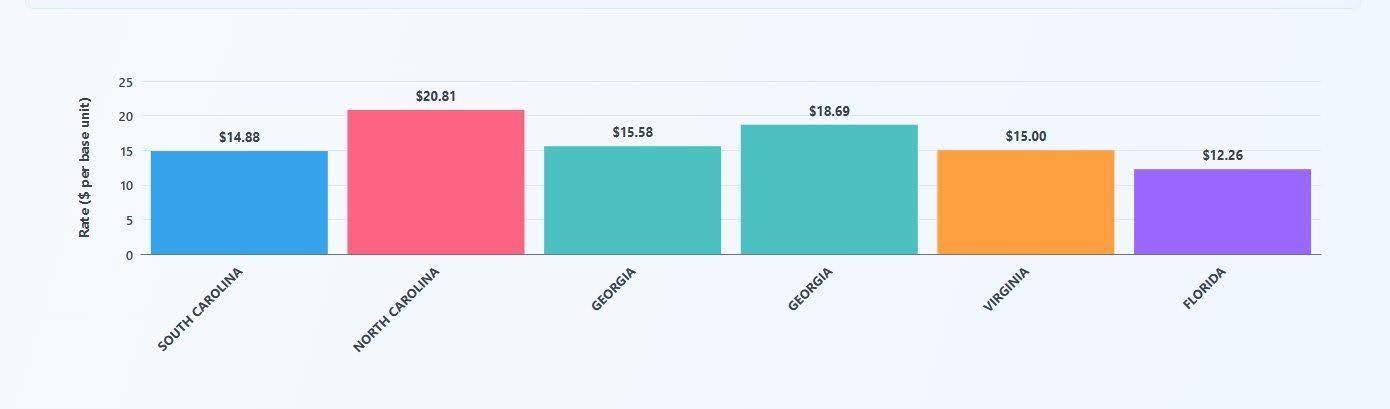
State Rate Comparison: Medicaid ABA Reimbursement, CPT 97153 (Adaptive Behavior Treatment by Protocol), per 15-minute unit. Source: MediRate. Georgia’s fee schedule differentiates by delivery setting; the first Georgia bar reflects in-clinic delivery ($15.58) and the second reflects out-of-clinic delivery ($18.69).
The 97155 picture is sharper. South Carolina’s $21.25 per 15-minute unit is the second-lowest in the neighbor set, ahead of only Florida ($15.37). It sits roughly 34 percent below North Carolina ($32.22), 31 percent below Georgia’s in-clinic rate ($30.91), and roughly 46 percent below Virginia ($39.40).
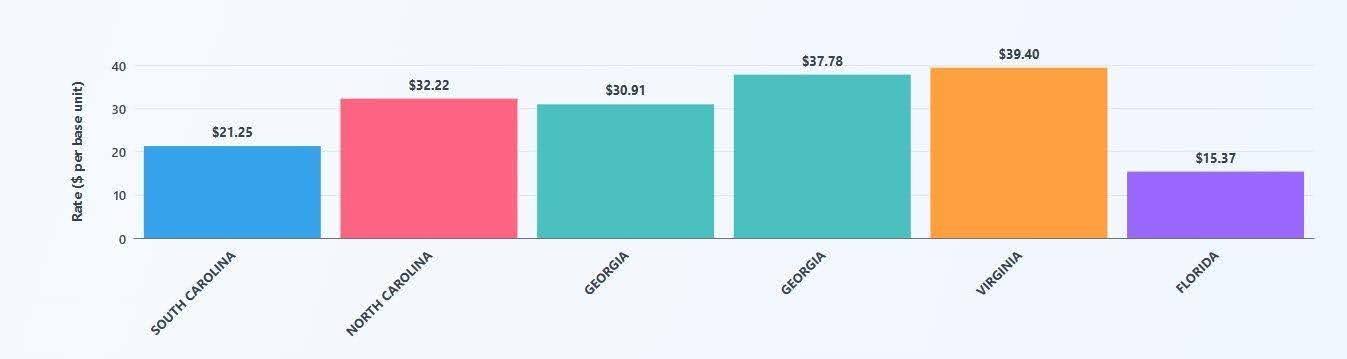
State Rate Comparison: Medicaid ABA Reimbursement, CPT 97155 (Adaptive Behavior Treatment with Protocol Modification), per 15-minute unit. Source: MediRate. Georgia’s fee schedule differentiates by delivery setting; the first Georgia bar reflects in-clinic delivery ($30.91) and the second reflects out-of-clinic delivery ($37.78). For state-by-state rate detail across the full Adaptive Behavior Services code set, MediRate maintains the underlying datasets.
Program Structure: Caseloads, Supervision, and Prior Authorization
South Carolina’s ASD program runs through fee-for-service and through five Healthy Connections Medicaid managed care organizations (Absolute Total Care, Healthy Blue (formerly BlueChoice HealthPlan Medicaid), First Choice by Select Health, Humana Healthy Horizons in SC, and Molina Healthcare of SC). Most members are enrolled in an MCO, and SCDHHS explicitly defers authorization, coverage, and reimbursement for those members to plan policy. The fee schedule is the FFS reference point.
Inside the program, the September 2025 manual sets caseload ratios that are unusually specific for a state Medicaid ABA benefit. BCBA-Ds and BCBAs may carry a maximum of 12 cases without a BCaBA, or 16 with one; BCaBAs are capped at 16. Cases are weighted by therapy intensity: 30 to 40 hours per week counts as one case, 10 to 25 hours counts as a half case, and under 10 hours counts as a quarter case. RBTs must be supervised for a minimum of 5 percent of the hours they deliver, with at least two face-to-face supervisor contacts per month and at least one direct observation of an RBT session.
Authorization runs through Acentra (the state’s quality improvement organization), with all prior authorizations valid for six months and reauthorization requests due 10 to 30 days before expiration. SCDHHS uses InterQual’s Applied Behavior Analysis Treatment Criteria for medical necessity determinations. Members enrolled in an MCO follow their plan’s authorization process.
H.3974 Brings Private ABA Providers Into South Carolina Schools
On May 18, 2026, the same day Alabama Medicaid issued a new ABA diagnostic restriction, Governor Henry McMaster signed H.3974 into law. The act, ratified May 14, 2026 and passed unanimously in both chambers on its final votes, requires South Carolina public school districts to consider parent or guardian requests for medically necessary ABA services from licensed BCBAs, BCaBAs, BCBA-Ds, and RBTs to be delivered in schools during the school day.
Under the statute, a district must review each request on a case-by-case basis using an Americans with Disabilities Act framework rather than an Individuals with Disabilities Education Act framework alone. Districts cannot use a child’s IEP determination to deny access to medically necessary services from a private provider unless doing so would impose an undue burden or fundamental alteration on the school’s operations. The State Board of Education must develop a model policy by January 6, 2027, and districts must adopt the model or their own equivalent by July 1, 2027.
For ABA providers operating in South Carolina, H.3974 is a structural access expansion that does not change Medicaid reimbursement directly, but does open a delivery setting that has historically been gated by school district policy. Providers must satisfy background check, liability insurance, and written-agreement requirements before billing third-party payers (including Medicaid) for in-school services. Acuity has previously covered the broader regional context in which Medicaid ABA programs are tightening across the Southeast alongside expanded coverage in school and home settings.
Regional and Federal Context
South Carolina’s tightening sits within a regional pattern. In Georgia, Governor Brian Kemp vetoed $15.86 million in autism rate parity funding on May 9, 2026, and CareSource Georgia’s 20 percent ABA rate cut took effect May 11. In North Carolina, the state Medicaid program restored a 10 percent ABA rate cut in late 2025 after litigation, and on April 30, 2026, Governor Josh Stein signed House Bill 696, a $319 million Medicaid funding bill that requires monthly eligibility checks and funds a performance audit of the program.
Nationally, the U.S. Department of Health and Human Services Office of Inspector General has recommended more than $123 million in federal recoupments across four state ABA audits (Indiana, Wisconsin, Maine, and Colorado), and on April 23, 2026, CMS directed all 50 state Medicaid programs to submit provider revalidation plans within 30 days. South Carolina is not among the four published audits, but its September 2025 high-risk provider screening alignment and the July 2026 documentation tightening reflect the same federal pressure that has pushed other states to act.
What Providers Should Watch
Three near-term items shape ABA operations in South Carolina through the second half of 2026. First, the June 1 comment window: SCDHHS is accepting feedback on the draft manual at MedicaidStatePlan@scdhhs.gov, and providers concerned about the 97151 telehealth change or the new documentation requirements have a short window to put concerns on the record. Second, the July 1 fee schedule update: SCDHHS has not previewed rate adjustments alongside the manual rewrite, but the bulletin’s reference to updated procedure code standards suggests at minimum some structural changes to how codes are billed. Third, the H.3974 model policy: the State Board of Education’s January 6, 2027 deadline will determine how quickly private ABA providers can begin serving children in school settings, and how districts handle the case-by-case review process.
The combined effect of the September 2025 restructuring and the July 2026 manual rewrite is a more tightly defined ASD benefit, but one that has not, as of this writing, moved on rates. For providers operating at the lower end of the Southeast rate band, that is a meaningful baseline. For providers that have leaned heavily on telehealth-delivered 97151 assessments, the July change requires a near-term operational pivot. The fee schedule update, when it lands, will determine how much further the program tightens.