
New Hampshire pays $17.79 for 97153 but $16.43 for 97155, the lowest analyst rate in its regional comparison. See how its ABA rules changed in 2026.
Key Takeaways
- Analyst pay sits below technician pay: New Hampshire’s fee schedule pays $16.43 per unit for analyst-delivered 97155 and $17.79 for technician-delivered 97153, and both rates have been in effect since July 1, 2023.
- Rates held through two 2025 fights: Budget negotiators rejected a 3 percent cut to all Medicaid provider rates, and DHHS retracted a plan to stop covering 97155 weeks before it would have taken effect.
- The regional gap is widest for analysts: Per MediRate, New Hampshire pays the most for 97153 among six Northeast states and the least for 97155 among five, a third of Vermont’s $49.35 fee-for-service rate.
- Oversight is tightening first: April 2026 notices set authorization documentation rules and require Board Certified Behavior Analysts to enroll as rendering providers, with denials beginning August 1, 2026 for group claims that lack one.
New Hampshire Medicaid pays less for an hour of a Board Certified Behavior Analyst’s time than for an hour of technician-delivered applied behavior analysis (ABA). The state’s 2026 fee schedule, revised July 24, lists CPT 97153, treatment by protocol delivered by a technician, at $17.79 per 15-minute unit. It lists 97155, treatment with protocol modification delivered by an analyst, at $16.43. Both rates have been in effect since July 1, 2023.
Those rates survived a 2025 budget fight over Medicaid provider pay, and the Department of Health and Human Services (DHHS) has since moved on other fronts. In April 2026, DHHS issued two notices to ABA providers: one setting documentation expectations for service authorization, and another requiring analysts to enroll in Medicaid and appear on claims as rendering providers.
What New Hampshire Medicaid Pays for ABA
The July 2026 schedule lists six ABA codes. Behavior identification assessment under 97151, analyst treatment under 97155 and family guidance under 97156 each pay $16.43 per unit, or $65.72 an hour. Technician treatment under 97153 pays $17.79, or $71.16 an hour. Group treatment by a technician under 97154, added September 1, 2025, pays $6.50, and 0373T, used for severe destructive behavior, pays $35.58. The schedule lists no rates for 97152, 97157 or 97158.
The schedule requires service authorization for assessment, technician treatment, analyst treatment and family guidance. It lists maximum unit amounts of 32 for 97153, or eight hours, and 24 for 97155. Assessment and technician treatment also appear with the TM modifier, which marks services billed through schools; those lines carry the same rates, an eight-unit maximum and no service authorization requirement.
New Hampshire’s analyst rate equals 92 percent of its technician rate. In the four other states in MediRate’s comparison that pay 97155, the analyst rate runs from 42 percent above the technician rate in New Jersey to more than three times it under Vermont’s fee-for-service schedule.
New Hampshire Nearly Stopped Paying for 97155 in 2025
The analyst code survived a closer call than the rate table shows. In a July 1, 2025 notice, DHHS told providers that under a proposed state plan amendment, 97155 would become a non-covered service on September 1, 2025, because New Hampshire Medicaid does not pay solely for supervision, and that qualified providers should bill direct treatment under 97153. On August 5, the department formally retracted that guidance, saying 97155 would remain covered, including when appropriately billed for supervision, and citing the need to align with national standards. The same notice set the 97154 group rate at $6.50.
How the 2025 Budget Left New Hampshire ABA Rates in Place
The House budget passed in April 2025 would have cut reimbursement rates for all Medicaid providers by 3 percent, lowering planned spending by $52.5 million in state general funds over two years, according to the New Hampshire Fiscal Policy Institute. The Senate Finance Committee voted in May to reverse the cut, and the final Committee of Conference agreement rejected it, setting Medicaid rates at the levels Gov. Kelly Ayotte had proposed. The House cut would have followed a 3 percent across-the-board Medicaid rate increase enacted for the 2024 and 2025 fiscal years, which the institute put at $134.2 million in general funds.
The ABA lines on the July 2026 schedule show what that outcome meant for providers: no cut and no increase. The only change to the ABA code set since 2023 is the addition of 97154.
How ABA Reaches New Hampshire Children
New Hampshire covers ABA through the Early and Periodic Screening, Diagnostic and Treatment (EPSDT) benefit. DHHS’s April 14, 2026 guidance told providers that any Medicaid member who meets the state’s EPSDT rule, He-W 546, is eligible for medically necessary ABA. Providers must submit a service authorization request with supporting documentation, and a qualified health professional must confirm a diagnosis of autism or another developmental disability. Coverage of ABA beyond autism is a question the federal government has also taken up, as Acuity has reported. The guidance also told providers not to duplicate ABA a child already receives at school under an individualized education program billed through Medicaid to Schools.
New Hampshire delivers Medicaid benefits through managed care, apart from carve-outs such as children’s dental care and waiver services. Its Medicaid Care Management program contracts with three plans, AmeriHealth Caritas New Hampshire, NH Healthy Families and WellSense Health Plan, which DHHS says cover the same services but may have different networks and rules, including prior authorization. The current contracts run through August 31, 2029. The rates above are fee-for-service rates, and the plans’ contracted ABA rates are not published. New Hampshire does use CMS-approved directed payments to require minimum fee schedules in managed care for specific services, such as durable medical equipment, but none of the New Hampshire arrangements Acuity reviewed covers ABA. NH Healthy Families’ ABA payment policy describes its move from a bundled H2019 rate to separate codes for direct treatment, supervision and parent training.
Schools are a separate pathway. The state’s March 2024 Medicaid to Schools manual, available on the New Hampshire Medicaid provider portal, says ABA is covered through EPSDT and lists Board Certified Behavior Analysts among the performing-only providers in that program, who deliver services under an enrolled school provider. Services billed by a school provider need no service authorization. School-funded ABA is a large share of the field that coverage debates tend to overlook, as Melmark’s Chief Executive Rita Gardner told Acuity.
New Enrollment Rules for New Hampshire ABA Analysts
DHHS’s April 29, 2026 notice said a Bureau of Program Integrity review of ABA claims found that many Medicaid-enrolled groups did not consistently list rendering providers on claims, and that those providers might not be enrolled in Medicaid or credentialed with the health plans. The notice requires Board Certified Behavior Analysts to enroll in New Hampshire Medicaid, hold an active National Provider Identifier and be listed on claims as rendering providers. Technicians do not have to enroll, but the supervising analyst must be listed as the rendering provider on every claim for services delivered under that analyst’s supervision. Beginning August 1, 2026, the notice said, claims an ABA group submits without an enrolled rendering provider will be denied.
The notice laid out the sequence for groups that have not finished: a National Provider Identifier first, then New Hampshire Medicaid enrollment, then credentialing with each health plan the group bills. For groups that have billed without listing their analysts, each analyst on staff needs those steps completed.
The notice arrived as neighboring states scrutinize ABA billing. Vermont barred concurrent billing of 97153 and 97155 on January 1, 2026, and a LEARN Behavioral unit is suing MassHealth over a recoupment in Massachusetts.
Where New Hampshire’s ABA Rates Land Among Its Neighbors
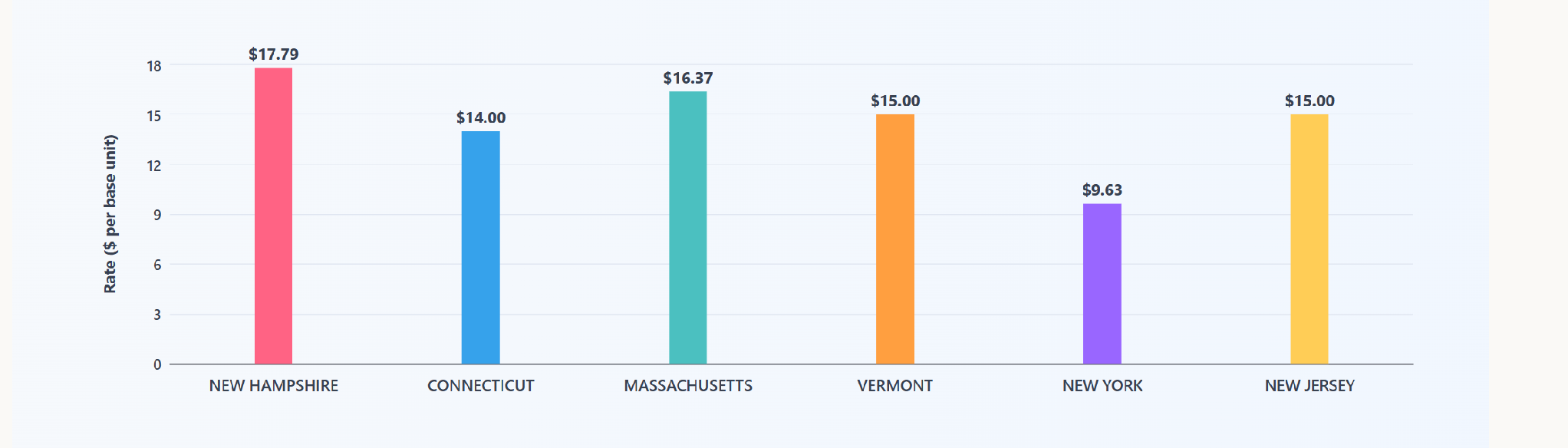
Figure 1: CPT 97153 (adaptive behavior treatment by protocol, technician-delivered) Medicaid rate per 15-minute unit, New Hampshire and neighboring states. New York reflects its rate for services on or after October 1, 2026. Source: MediRate.
On 97153, New Hampshire’s $17.79 is the highest of six Northeast states, ahead of Massachusetts at $16.37, Vermont and New Jersey at $15.00, Connecticut at $14.00 and New York at $9.63
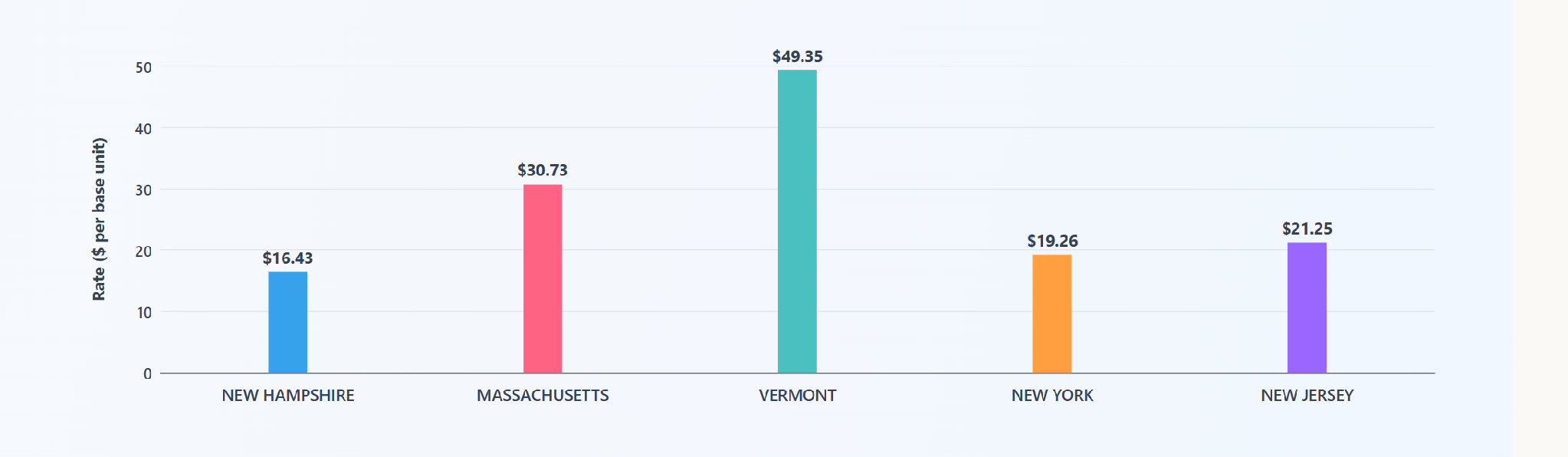
Figure 2: CPT 97155 (adaptive behavior treatment with protocol modification, analyst-delivered) Medicaid rate per 15-minute unit, New Hampshire and neighboring states. Connecticut is not shown because it pays analyst services under HCPCS codes rather than 97155. Source: MediRate.
On 97155, the order reverses. New Hampshire’s $16.43 is the lowest of five, behind New York at $19.26, New Jersey at $21.25, Massachusetts at $30.73 and Vermont at $49.35. Massachusetts pays 87 percent more for the same unit of analyst time. Vermont’s rate is three times New Hampshire’s, though it is a fee-for-service figure; Vermont children whose only coverage is Medicaid receive ABA through a monthly case rate, as Acuity has reported. MediRate maintains the underlying rate detail, including codes not shown here, for state Medicaid programs across the country.
What Comes Next for New Hampshire ABA Providers
Code changes will force the first rate decision. As Acuity has reported, the 2027 CPT adaptive behavior code set, which takes effect in January, splits 97155 and deletes both Category III codes for severe behavior, including 0373T. New Hampshire will need to price the analyst codes that replace 97155, starting from a rate below what it pays technicians.
Enforcement is the second test. The open question is how many claims the August 1 denial rule has affected, and how many groups are still enrolling their analysts. Federal attention adds pressure: CMS released a State Medicaid and CHIP ABA Toolkit on August 4, 2026, citing a 421 percent increase in Medicaid and CHIP ABA spending from 2021 to 2025, and CMS says the toolkit is meant to help states ensure ABA providers are qualified and properly supervised, the same ground New Hampshire’s April notices cover.
Frequently Asked Questions
What does New Hampshire Medicaid pay for ABA in 2026?
The 2026 fee schedule pays $17.79 per 15-minute unit for 97153; $16.43 for 97151, 97155 and 97156; $6.50 for 97154; and $35.58 for 0373T. Every rate except 97154 has been in effect since July 1, 2023. Code 97154 was added September 1, 2025.
Does New Hampshire pay analysts more than technicians?
Not per unit. Analyst-delivered 97155 pays $16.43 and technician-delivered 97153 pays $17.79. Among the five states in MediRate’s comparison that pay 97155, New Hampshire is the only one where the analyst rate is below the technician rate.
Do New Hampshire’s Medicaid health plans pay the state fee schedule rates?
The published rates are fee-for-service rates. DHHS says its three health plans cover the same services but may have different networks and plan rules, including prior authorization. The plans’ contracted ABA rates are not published, and none of the state’s CMS-approved minimum fee schedule arrangements that Acuity reviewed covers ABA.
Do Board Certified Behavior Analysts have to enroll in New Hampshire Medicaid?
Yes. An April 29, 2026 DHHS notice requires Board Certified Behavior Analysts to enroll and be listed as rendering providers on ABA claims. Technicians do not have to enroll, but their supervising analyst must be listed on the claim. Beginning August 1, 2026, group claims without an enrolled rendering provider are subject to denial, per the notice.
Does New Hampshire Medicaid cover ABA in schools?
Yes, through the Medicaid to Schools program under the EPSDT benefit. School claims carry the TM modifier and do not require service authorization, and Board Certified Behavior Analysts work as performing-only providers under an enrolled school.
Sources: MediRate; New Hampshire Department of Health and Human Services, 2026 Fee Schedule Covered Procedures Report with Service Authorization Requirements (July 1, 2026, revised July 24, 2026), Guidance on Authorization of Applied Behavioral Analysis Services (April 14, 2026), Applied Behavioral Analysis Rendering Provider Requirements (April 29, 2026), provider notices dated July 1, 2025 and August 5, 2025, EPSDT Provider Manual (August 2026) and Medicaid to Schools Provider Manual (March 2024); DHHS Medicaid Care Management program and managed care contract award pages; CMS approved state directed payment preprints for New Hampshire; NH Healthy Families Payment Policy NH.PP.07; New Hampshire Fiscal Policy Institute; New Hampshire Bulletin; Department of Vermont Health Access, Global Commitment Register 25-042 (December 30, 2025); Centers for Medicare and Medicaid Services (August 4, 2026); prior Acuity Media Network reporting.