
Key Takeaways
- ABA rates went up April 1, 2026. Kentucky’s revised behavioral health fee schedule raised every ABA code by roughly 8 percent, with 97153 moving from the prior rate of $11.25 to $12.18 per 15 minutes for RBT-delivered services in Column 6.
- Access runs through MCOs and licensure. Kentucky Medicaid delivers ABA through five contracted managed care organizations and requires behavior analysts to hold a Kentucky Licensed Behavior Analyst license in addition to BCBA certification.
- Waivers add a second coverage pathway. The Michelle P. Waiver and Supports for Community Living Waiver cover behavior support services for eligible individuals with intellectual and developmental disabilities, supplementing standard Medicaid ABA coverage but carrying long waiting lists.
- HB 2 is now law and changes the cost-sharing landscape. House Bill 2, which passed the Kentucky House February 27, 2026 and was enacted after the General Assembly overrode Governor Beshear’s veto on April 14-15, 2026, introduces Medicaid copays (reduced by the Senate from $35 to $5 for health care services and to $1 for drugs in the enacted version) and community engagement requirements, with indirect but real implications for ABA provider revenue cycles.
Kentucky’s Medicaid ABA market is having a quieter year than several of its neighbors. Where North Carolina spent the fall of 2025 in court over rate cuts and Indiana issued a 60-page bulletin restructuring the entire service category, Kentucky’s Department for Medicaid Services quietly raised its behavioral health fee schedule for 2026, with modest but real increases across every ABA procedure code. The state’s service architecture, anchored by managed care organizations and a standalone behavior analyst licensure framework, has remained stable for the better part of three years.
That stability is part of what makes Kentucky worth studying. Providers and investors tracking the 50-state Medicaid ABA landscape often overlook states that are not in active policy turbulence. But for operators evaluating expansion, Kentucky’s combination of MCO-based administration, a clear credentialing path, and two active 1915(c) waivers covering behavior supports offers a relatively predictable reimbursement environment. House Bill 2, a Medicaid reform package enacted in mid-April over the Governor’s veto, adds new cost-sharing and eligibility rules to that picture without directly touching ABA rates.
What Kentucky Medicaid pays for ABA in 2026
Kentucky’s Fee for Service Behavioral Health Fee Schedule effective April 1, 2026 pays ABA services in 15-minute increments, with rates tiered by provider credential and billing column. Codes colored red on the published schedule denote rate increases from the prior edition. Column 1 rates (Psychiatrist with the AF modifier, or MD/DO with AM, under Provider Type 64) are the highest: $27.50 for 97151 (behavior identification assessment), $27.50 for 97155 (adaptive behavior treatment with protocol modification), $21.35 for 97156 (family adaptive behavior treatment guidance), and $10.81 for 97157 and 97158 (multiple-family and group protocol services).
For Licensed Behavior Analysts (LBAs), who bill under Provider Type 63 with the HO modifier in Column 3, the revised rates are lower: $21.99 for 97151, $21.99 for 97155, $17.09 for 97156, and $8.65 for 97157 and 97158. Services delivered by Registered Behavior Technicians fall in Column 6 at a uniform $12.18 per 15-minute unit, covering 97152 (behavior identification supporting assessment), 97153 (adaptive behavior treatment by protocol), and 97154 (group adaptive behavior treatment by protocol). That $12.18 figure represents an approximately 8 percent increase from the prior RBT rate of $11.25. The same proportional increase appears across the other provider columns.
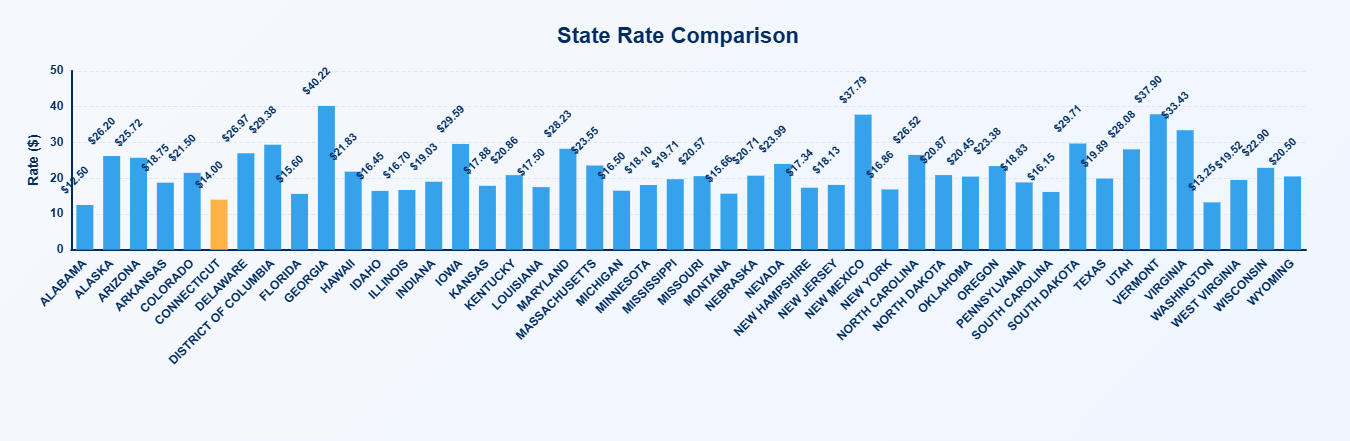
State Rate Comparison: Medicaid ABA Reimbursement (unweighted average of 97153 and 97155 rates across Kentucky’s credential tiers, per 15-minute unit). Source: MediRate.
On an unweighted average that incorporates the 97153 technician rate alongside 97155 rates across Kentucky’s four credential tiers, MediRate data places the state at $20.86 per 15-minute unit, up from roughly $19.27 under the pre-April 2026 fee schedule. That approximately 8 percent lift in the comparison figure tracks the across-the-board fee schedule increase DMS implemented April 1, and it moves Kentucky modestly upward within the national Medicaid ABA rate range.
MediRate maintains a granular, up-to-date Medicaid ABA rate database that captures state-level detail, which providers and investors can use to benchmark Kentucky against regional peers. Kentucky’s fee schedule is published by the Department for Medicaid Services and serves as the payment floor below which the contracted MCOs may not pay. Individual MCOs negotiate their own contracted rates, which can match or exceed the state floor.
How ABA delivery is structured in Kentucky
Kentucky Medicaid is a managed care program. Roughly 90 percent of beneficiaries receive services through one of five contracted MCOs: Aetna Better Health of Kentucky, Humana Healthy Horizons in Kentucky, Passport Health Plan by Molina Healthcare, UnitedHealthcare Community Plan, and WellCare of Kentucky. Anthem exited Kentucky Medicaid managed care effective January 1, 2025. ABA services are typically delivered through two provider type frameworks defined in Kentucky regulation. The first is the individual provider pathway under 907 KAR 15:010, which covers services delivered by Licensed Behavior Analysts (Provider Type 63) and, by extension, by Registered Behavior Technicians working under LBA supervision. The second is the Behavioral Health Services Organization pathway under 907 KAR 15:020, which governs organizations that deliver ABA alongside other behavioral health services.
Kentucky requires behavior analysts to hold a state license, not just a BCBA certification. The Applied Behavior Analyst Licensing Board issues LBA licenses and, separately, Licensed Assistant Behavior Analyst (LABA) credentials. Services delivered by a LABA carry the U4 modifier on claims, billed in Column 4 of the fee schedule. Supervising practitioners, typically MDs, DOs, licensed psychologists, or LBAs, oversee services provided by technicians and LABAs. The state does not operate a standalone autism waiver or a dedicated pediatric ABA benefit separate from the fee-for-service behavioral health schedule; ABA is covered as a medically necessary behavioral health service when prior authorization criteria are met.
The waiver pathway for children with IDD
Beyond the fee-for-service behavioral health benefit, Kentucky operates two 1915(c) Home and Community Based Services waivers that cover behavior support services for individuals with intellectual or developmental disabilities. The Michelle P. Waiver (MPW), named for the plaintiff in the early-2000s Kentucky IDD access lawsuit whose settlement created the waiver, provides services to adults and children who would otherwise require an intermediate care facility level of care. Services include positive behavior supports, consultative clinical and therapeutic services, and community living supports.
The Supports for Community Living (SCL) waiver covers adults with intellectual or developmental disabilities. Both waivers operate with extensive waitlists, which is a persistent access issue independent of ABA. That waitlist dynamic means most children with autism who receive ABA in Kentucky are served through the standard Medicaid behavioral health benefit rather than through the MPW, though families pursuing both pathways in parallel is a common practice.
What House Bill 2 changes
The most significant policy development in Kentucky’s 2026 Medicaid environment has already happened in the legislature. House Bill 2 passed the Kentucky House on February 27, 2026 by a 77 to 21 vote. The Senate substantially revised the bill, reducing the House’s $35 inpatient hospital copay to a $5 per-service copay and an $8 prescription-eyewear copay to a $1 prescription drug copay, and removing several of the House’s stricter documentation and self-attestation provisions. The full legislature passed the revised bill April 3, 2026. Governor Andy Beshear vetoed it; the General Assembly overrode the veto on April 14-15, 2026, and HB 2 is now enacted law.
The enacted bill applies primarily to the Medicaid expansion population. It implements community engagement (work or volunteering) requirements for certain able-bodied adults, establishes cost-sharing through the reduced copays, and requires more frequent eligibility redeterminations, broadly in line with the federal direction established by Public Law 119-21 (the Reconciliation Act of 2025, also known as the One Big Beautiful Bill Act).
For ABA providers, HB 2 does not propose rate changes or service limitations specific to behavioral health treatment. The operational implications are second-order. Copays introduce a new collection and reconciliation step for provider billing teams, even at the reduced $5 level and even if ABA services are exempt from copays in final rulemaking. Community engagement requirements and more frequent eligibility redeterminations could reduce continuous enrollment among parents and caregivers of Medicaid-covered children, with consequences for family ABA participation and the parent training codes (97156 and 97157) that depend on caregiver engagement. The implementation timeline embedded in the final bill will determine how much of this translates into near-term operational adjustment for Kentucky ABA clinics.
Where Kentucky fits in the national picture
Kentucky’s 2026 Medicaid ABA profile looks, in aggregate, like a stable mid-market state. Rates moved up modestly rather than being cut. The delivery framework is settled, with licensed behavior analysts, supervised RBTs, and MCO-based administration that providers have been operating under for years. The regulatory environment is not generating the kind of enforcement activity that neighboring states and peer markets are producing.
That relative calm is a useful comparison point. Acuity’s state-by-state reporting has documented North Carolina’s court-forced rate reversal, Indiana’s credential-tiered phasedown, New York’s 25 percent rate reduction, and Arizona’s credential-tiered reform in motion. Against those, Kentucky’s 2026 adjustments are modest.
The broader national context Kentucky providers should track includes the accountability era that has arrived for autism care, the federal audits exposing widespread ABA billing failures, and the ABA concurrent billing restrictions spreading across states. For operators weighing expansion or M&A activity in the Southeast, the top 10 providers reshaping autism care includes multiple companies with a Kentucky footprint.
Frequently Asked Questions
What are the Kentucky Medicaid rates for ABA services in 2026?
Kentucky’s April 1, 2026 behavioral health fee schedule rates depend on provider credential and billing column. The Column 1 rates (Psychiatrist AF or MD/DO AM, Provider Type 64) are $27.50 for 97151, $27.50 for 97155, $21.35 for 97156, and $10.81 for 97157 and 97158. Licensed Behavior Analysts bill in Column 3 under the HO modifier at $21.99 for 97151, $21.99 for 97155, $17.09 for 97156, and $8.65 for 97157 and 97158. Registered Behavior Technicians bill in Column 6 at $12.18 for 97152, 97153, and 97154. All are billed in 15-minute units.
Did Kentucky Medicaid raise ABA rates for 2026?
Yes. The revised fee schedule effective April 1, 2026 raised every ABA code by approximately 8 percent relative to the prior edition. The RBT rate for direct therapy codes (97152, 97153, 97154) moved from $11.25 to $12.18. The same proportional increase appears in Columns 1 through 3 for the assessment, protocol modification, and parent training codes.
Who can bill Medicaid for ABA services in Kentucky?
Kentucky requires a state license for independent ABA practice. BCBAs must obtain a Kentucky Licensed Behavior Analyst (LBA) license from the Applied Behavior Analyst Licensing Board. LABAs (Licensed Assistant Behavior Analysts) operate under supervision and bill with the U4 modifier in Column 4. Registered Behavior Technicians deliver services under LBA supervision and bill in Column 6 of the fee schedule with the UC modifier. Services may also be delivered through Behavioral Health Services Organizations that meet the requirements of 907 KAR 15:020.
Which MCOs deliver Medicaid ABA in Kentucky?
Kentucky Medicaid contracts with five MCOs that serve the vast majority of beneficiaries: Aetna Better Health of Kentucky, Humana Healthy Horizons in Kentucky, Passport Health Plan by Molina Healthcare, UnitedHealthcare Community Plan, and WellCare of Kentucky. Anthem exited Kentucky Medicaid managed care effective January 1, 2025. Each MCO sets its own contracted rates, which must meet or exceed the state Medicaid fee-for-service schedule. ABA providers typically contract with multiple MCOs to serve the full Medicaid population.
Does Kentucky have an autism Medicaid waiver?
Kentucky does not operate a standalone autism waiver. Two 1915(c) waivers cover behavior support services for individuals with intellectual or developmental disabilities, including autism: the Michelle P. Waiver (MPW) for individuals who would otherwise require an ICF level of care, and the Supports for Community Living (SCL) Waiver for adults. Both have long waitlists. Most children with autism who receive ABA in Kentucky are served through the standard Medicaid behavioral health benefit.
What is House Bill 2 and how does it affect ABA providers?
HB 2 is the 2026 Kentucky Medicaid Reform Act. It passed the House February 27, 2026, was substantially revised by the Senate (lowering the inpatient hospital copay from $35 to a $5 per-service copay and cutting drug copays to $1), cleared both chambers April 3, 2026, and became law after the General Assembly overrode Governor Beshear’s veto on April 14-15, 2026. The bill implements federal community engagement (work) requirements and cost-sharing for certain adult Medicaid expansion enrollees, aligned with Public Law 119-21. It does not propose ABA-specific rate changes. Indirect effects on ABA providers include potential changes to eligibility redeterminations, continuous enrollment, and family-level billing processes.
How do Kentucky’s ABA rates compare to other states?
On an unweighted average that incorporates the 97153 technician rate alongside 97155 rates across Kentucky’s four credential tiers, MediRate places Kentucky at $20.86 per 15-minute unit, up from roughly $19.27 before the April 1, 2026 fee schedule update. That positions the state in the middle of the national Medicaid ABA rate range, above lower-paying states but below the top tier. For granular, code-by-code state comparison, MediRate maintains a national Medicaid ABA rate database that providers and investors can use to benchmark Kentucky against regional and peer markets.
Can ABA services be delivered via telehealth in Kentucky Medicaid?
Kentucky’s Medicaid regulations permit telehealth delivery for services that meet the requirements of 907 KAR 3:170. Individual MCOs may set additional telehealth policies within that framework. Kentucky has not proposed restrictions on paraprofessional ABA telehealth of the kind being advanced in North Carolina’s HB 696, though providers should verify coverage with each contracted MCO before delivering services remotely.