Kansas Medicaid ABA rates date to 2019 on every code except 97153, repriced in July 2024. The state’s Autism Waiver covers ages 0 to 5 and funds no ABA.
Key Takeaways
- Kansas has repriced exactly one ABA code in seven years. Code 97153 moved to $16.35 per 15-minute unit effective July 1, 2024. The other six adaptive behavior codes on the July 2026 KMAP fee schedule date to January or April 2019, including 97155 at $24.00 and 97151 at $43.75.
- The state routes technician-delivered treatment through a separate billing specialty and a weekly hour limit. The KMAP Mental Health provider manual assigns the adaptive behavior codes to provider type 11 and specialty 403, then specifies that 97153 and 97154 are billed under specialty 404. It also sets an initial soft limit of 25 hours a week on technician-delivered treatment, with additional hours available on a showing of medical necessity.
- The Kansas Autism Waiver covers ages 0 through 5 and funds no ABA. Waiver 0476 pays for respite care, family adjustment counseling, and parent support and training for children who enter between birth and their fifth year. ABA is a separate state plan benefit delivered through KanCare, and K.S.A. 65-7503 expressly exempts autism waiver service providers from ABA licensure.
- Kansas licenses analysts and assistants but does not credential technicians. The Behavioral Sciences Regulatory Board issues Licensed Behavior Analyst and Licensed Assistant Behavior Analyst credentials under a 2014 act effective July 1, 2016, with no state credential for Registered Behavior Technicians. The tier the state declines to license is the same one it singles out in billing policy.
Kansas reissued its Medicaid fee schedule effective July 1, 2026, and for applied behavior analysis almost nothing in it is new. Six of the seven adaptive behavior codes the state covers carry effective dates from the first four months of 2019. The seventh, 97153, was repriced on July 1, 2024. Nothing has moved since. That is not a rate cut, and not the kind of moment that generates hearings or litigation. The consequential facts sit in structure: what the schedule covers and omits, who the state permits to bill each code, and which of its two autism-related pathways actually pays for treatment.
What Kansas Medicaid Pays for ABA in 2026
Converted to hours, 97153 pays $65.40 and 97155 pays $96.00. Three codes that neighboring states price do not appear at all: 97157, plus 0362T and 0373T, the Category III codes for cases requiring two or more technicians. Mississippi prices those two at $56.64 and $41.49, and Alabama added them in February 2026. Kansas providers serving that acuity level have no distinct code to bill.
The internal relationships are unusual in a second respect. Code 97156, family guidance, pays $37.50, or 56 percent more than 97155 at $24.00, though both are analyst-delivered. The schedule pays comparatively well for assessment and family guidance and poorly for the direct treatment hours that make up the bulk of a comprehensive program. Every ABA line carries one benefit plan and one maximum fee with no modifiers, so Kansas does not differentiate by delivery setting the way Georgia, Louisiana, and Missouri do.
Who Can Bill Kansas ABA Codes
Kansas licenses behavior analysts under the Applied Behavior Analysis Licensure Act, K.S.A. 65-7501 through 65-7505, passed in 2014. Since July 1, 2016, no person may practice applied behavior analysis in the state unless licensed, with enumerated exceptions. The Behavioral Sciences Regulatory Board administers the act, and its rules sit in Article 8 of Agency 102 of the Kansas Administrative Regulations. The statute creates two credentials, Licensed Behavior Analyst and Licensed Assistant Behavior Analyst, both keyed to national certification, and it also contemplates individuals accruing supervised field experience toward licensure.
What Kansas does not have is any state credential for the technician tier. There is no Kansas license and no registration for Registered Behavior Technicians, a meaningful contrast with Mississippi, where the Mississippi Autism Board registers every technician and puts the filing duty on the supervising analyst.
Billing policy fills part of that gap. The KMAP Mental Health provider manual assigns the adaptive behavior codes to provider type 11 and specialty 403, then specifies separately that 97153 and 97154, the two technician-delivered codes, are billed under specialty 404. Coverage requires a recommendation from a physician or other licensed practitioner and is subject to prior authorization, and community mental health center providers may deliver the services. The manual also sets an initial soft limit of 25 hours a week on technician-delivered treatment, with additional hours available on a demonstration that medical necessity criteria are met.
The result is a state that draws its sharpest line around the technician tier in billing policy while declining to draw one in licensure. Kansas has repriced only 97153 since 2019, singles it out with its own billing specialty, and caps it with a weekly soft limit, yet the people delivering that service hold no Kansas credential. Their qualifications rest on national certification and on the terms each managed care organization writes into its provider agreements.
The Kansas Autism Waiver Does Not Fund ABA
Kansas operates a dedicated 1915(c) Autism Waiver under control number 0476. It is one of the more misunderstood programs in the state, partly because provider-facing marketing routinely describes it as an autism therapy benefit or an extension of KanCare ABA coverage. It is neither.
The waiver serves children who enter between birth and their fifth year and who meet a hospital level of care. Covered services are respite care, family adjustment counseling, and parent support and training on a peer-to-peer basis. Applied behavior analysis is not among them. Children who age out at five may transition toward the Intellectual and Developmental Disability waiver, control number 0224, which serves ages five and older.
ABA sits elsewhere. It is a state plan benefit for members under 21, delivered through KanCare and priced on the KMAP fee schedule. The separation is not merely administrative: K.S.A. 65-7503(b)(5) exempts from ABA licensure anyone qualified to provide services under the autism waiver administered by the Kansas Department for Aging and Disability Services. The waiver workforce and the licensed ABA workforce are legally distinct groups operating under different rules.
Delivery Runs Through KanCare, Not Fee-for-Service
Three managed care organizations hold KanCare contracts running January 1, 2025 through December 31, 2027: Sunflower Health Plan, UnitedHealthcare Community Plan of Kansas, and Healthy Blue. The Kansas Department of Health and Environment announced the awards in 2024, and incumbent Aetna Better Health of Kansas was not renewed. Effective January 1, 2024, mandatory managed care authority shifted from the Section 1115 demonstration to the State Plan combined with a 1915(b) waiver.
A published fee-for-service maximum in a state where nearly all members are in managed care is a benchmark rather than a payment. Kansas offers unusually direct evidence on the point: UnitedHealthcare’s onboarding materials for KanCare autism providers state that it reimburses according to Kansas Medicaid rates for autism services, drawn from KMAP reference codes. For that plan, the 2019 numbers are the operative numbers.
Kansas ABA Rates in Regional Context
Against its Plains and Mountain West neighbors, Kansas presents a split profile: at the floor on technician-delivered treatment, mid-pack on analyst-delivered treatment. One caveat applies throughout. MediRate builds these comparisons from published state fee schedules only, so they show what a state posts rather than what a managed care plan pays, which matters more in Kansas than in most states.
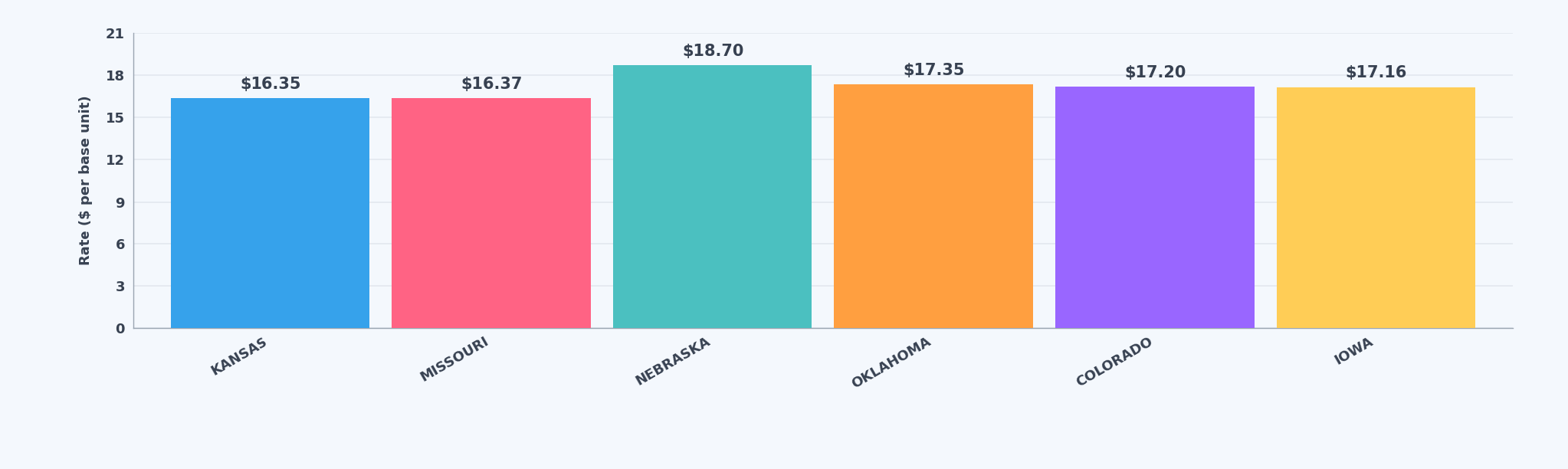
State Rate Comparison: Medicaid ABA Reimbursement, CPT 97153 (Adaptive Behavior Treatment by Protocol), per 15-minute unit. Source: MediRate. For granular state-by-state rate detail across the full ABA code set, MediRate maintains the underlying database.
On 97153, Kansas sits below every neighbor in the comparison set, though the margin against Missouri is two cents. Missouri is at $16.37, Iowa at $17.16, Colorado at $17.20, Oklahoma at $17.35, and Nebraska at $18.70. The spread is modest by regional standards: roughly 14 percent from Kansas to Nebraska, against about 87 percent between floor and ceiling of the Southeastern band on the same code.
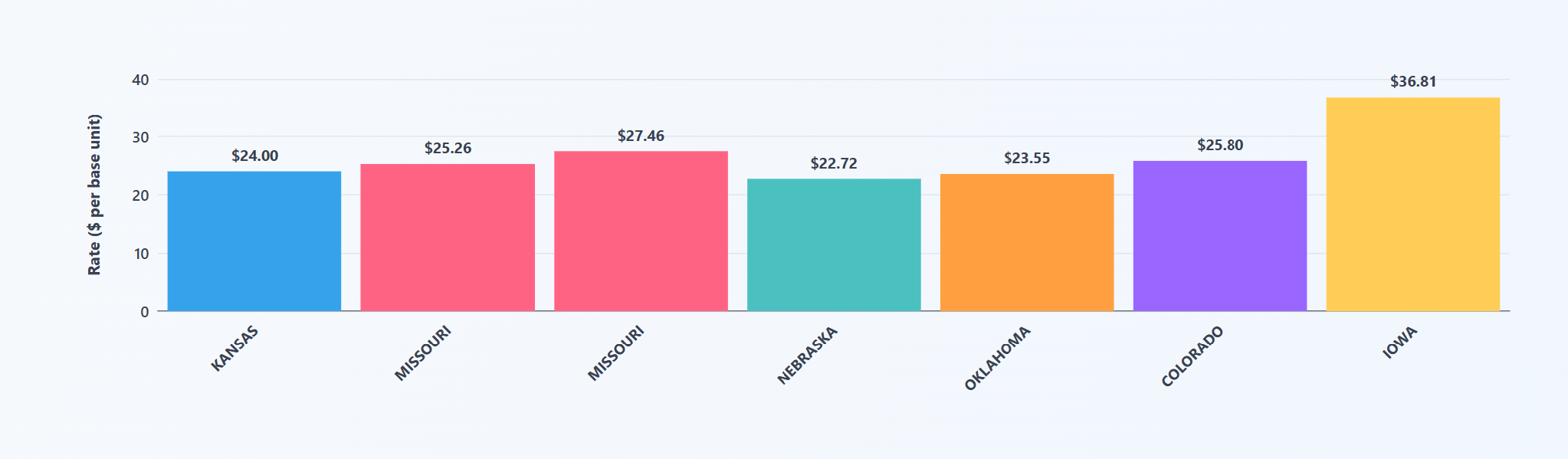
State Rate Comparison: Medicaid ABA Reimbursement, CPT 97155 (Adaptive Behavior Treatment with Protocol Modification), per 15-minute unit. Source: MediRate. Missouri publishes two rates: $27.46 carries the U8 modifier, which designates the home setting.
On 97155 the ordering changes. Kansas at $24.00 sits above Nebraska at $22.72 and Oklahoma at $23.55, below Missouri at $25.26 and $27.46 with the home modifier, below Colorado at $25.80, and well below Iowa at $36.81. Iowa is the outlier, paying roughly 53 percent more than Kansas on this code while paying only about 5 percent more on 97153.
The Kansas asymmetry runs opposite to the pattern elsewhere. In Washington, technician pay tracks the regional range while analyst pay lags, with 97153 at $12.40 and 97155 at $14.09. Kansas is the mirror image. Because 97153 covers the direct one-to-one therapy hours in a comprehensive plan and 97155 covers the analyst’s protocol modification time, the Kansas configuration bears on staffing economics differently than a comparison of analyst rates alone would suggest. Kansas is also not alone in holding still: Illinois has not moved its ABA rates since 2022 while reissuing its fee schedule. What distinguishes Kansas is that its freeze is nearly total and its one exception is the direct treatment code.
A review of public records for this period surfaced no ABA audit or rate litigation involving Kansas, while two of the states on these charts have both. Colorado is among the states in the federal ABA audit wave, and in Oklahoma a court ordered SoonerCare to resume ABA payments after a fraud-related suspension.
What Kansas ABA Providers Should Watch
Any move toward a rate study. Alaska’s roughly 41 percent July 2026 increase followed a Guidehouse study, and Utah legislated a permanent rate-increase mechanism. Kansas has neither.
Whether the missing codes get priced. Adding 97157, 0362T, and 0373T would give providers a billing pathway for two-technician cases they now lack.
How the 25-hour soft limit is administered. A soft limit with a medical necessity exception is only as permissive as the authorization process behind it, and the KanCare plans apply it.
Rate floor language in the KanCare contracts. The executed contracts are public. Whether they tie a floor to the KMAP schedule determines how much the published numbers govern.
Frequently Asked Questions
What does Kansas Medicaid pay for ABA in 2026?
The KMAP fee schedule effective July 1, 2026 pays $16.35 per 15-minute unit for 97153 and $24.00 for 97155, or $65.40 and $96.00 an hour. Assessment pays $43.75 for 97151 and $31.25 for 97152.
When did Kansas Medicaid ABA rates last change?
Code 97153 was repriced effective July 1, 2024. The other six adaptive behavior codes on the schedule date to January or April 2019.
Is there a limit on ABA hours in Kansas?
The KMAP Mental Health provider manual sets an initial soft limit of 25 hours a week for technician-delivered treatment. Additional hours can be authorized on a demonstration that medical necessity criteria are met, and coverage requires a recommendation from a physician or other licensed practitioner along with prior authorization.
Does the Kansas Autism Waiver cover ABA therapy?
No. The waiver covers respite care, family adjustment counseling, and parent support and training for children entering between birth and their fifth year. ABA is a separate state plan benefit for members under 21, delivered through KanCare.
Who can deliver ABA under Kansas Medicaid?
Licensed Behavior Analysts and Licensed Assistant Behavior Analysts licensed by the Behavioral Sciences Regulatory Board, along with individuals accruing supervised field experience toward licensure. Kansas has no state license or registration for Registered Behavior Technicians, so technician qualifications rest on national certification and payer contract terms.