
Hawaii raised Medicaid ABA rates in 2025 with one-year funding. Its June 2026 fee schedule still lists 97153 at $17.66 and 97155 at $35.94.
Key Takeaways
- Lawmakers questioned whether rates were adequate. Three 2023 legislative resolutions asked Med-QUEST to ensure adequate ABA rates, and providers told the resulting rate study that Registered Behavior Technicians were hard to recruit and keep.
- Lawmakers funded a one-year increase. The Legislature approved non-recurring money for calendar year 2025, raising 97153 by 41.3 percent at the technician tier and 97155 by 20.6 percent at the analyst tier under the study’s “Scenario 1.”
- The higher rates remain on the books. Med-QUEST’s fee schedule dated June 1, 2026 lists 97153 at $17.66 and 97155 at $35.94, third among six Western states on both codes.
- Funding durability and a school-day lawsuit are the open questions. Med-QUEST said later years would need new appropriations, and a federal case over ABA during school hours returned to district court.
Hawaii Medicaid pays for applied behavior analysis at rates that climbed sharply at the start of 2025, and the money behind that increase came with an expiration date. The Med-QUEST Division implemented new rates on January 1, 2025, drawn from a Milliman rate study, after the Legislature approved what the division described as non-recurring funding for calendar year 2025 only. Med-QUEST told providers in October 2024 that it intended to request additional appropriations to carry the rates into 2026 and beyond, subject to legislative approval.
The higher rates are still on Hawaii’s published fee schedule. The Medicaid fee-for-service schedule dated June 1, 2026 lists CPT code 97153 at $17.66 per 15-minute unit and 97155 at $35.94, the same figures in the division’s December 2024 ABA memo. That places Hawaii in the middle of a Western peer group where Alaska raised its core autism codes roughly 41 percent in July 2026 and several other states pay less.
How Hawaii Medicaid Covers ABA Through QUEST Integration
Hawaii covers ABA for Medicaid members under 21 through the Early and Periodic Screening, Diagnostic, and Treatment (EPSDT) benefit. Most members receive it through QUEST Integration, the state’s managed care program, run by five health plans: AlohaCare, Hawaii Medical Service Association, Kaiser Permanente, Ohana Health Plan, and UnitedHealthcare Community Plan.
Memo QI-2431/FFS 24-13, dated December 31, 2024, sets the pathway. A primary care provider screens the child, a diagnosing provider such as a developmental pediatrician, psychiatrist, or psychologist confirms autism spectrum disorder, and a Licensed Behavior Analyst (or one of the diagnosing providers) completes the assessment and treatment plan. Screening and diagnostic evaluation need no prior authorization; treatment does. Providers request hours per week for up to 26 weeks at a time, and interim progress assessments using a standardized tool such as the VB-MAPP or ABLLS-R are due at least every 26 weeks. That cadence puts authorization timing at the center of operations, as recent prior authorization delays in Wisconsin have shown.
Two other features stand out. A diagnosing provider who suspects autism but needs more time can ask the health plan to approve a trial of ABA lasting up to 26 weeks before a formal diagnosis. And ABA runs alongside other state systems: the Department of Health’s Early Intervention Program serves children from birth to age three under Part C of the Individuals with Disabilities Education Act (IDEA), and the Department of Education provides educationally necessary ABA in school, with health plans expected to coordinate the rest.
The memo also sets workforce rules. Rendering providers must be licensed in Hawaii, actively enrolled in Medicaid, and, for analysts, assistant analysts, and technicians, certified through the Behavior Analyst Certification Board. Board Certified Assistant Behavior Analysts and Registered Behavior Technicians must work under a Licensed Behavior Analyst, whose case supervision generally runs one to two hours for every 10 hours of technician service, with direct supervision covering at least 5 percent of assistant and technician hours. The memo excludes care that is primarily custodial, services delivered by family or household members, and services provided as long-term services and supports, home and community-based services, or respite.
Hawaii ABA Fee Schedule: Three Modifiers and One Technician Rate
Hawaii bills ABA with three credential modifiers: HM for Registered Behavior Technicians, HN for Board Certified Assistant Behavior Analysts, and HO for Licensed Behavior Analysts. The 2025 update folded Board Certified Behavior Analysts and doctoral-level analysts into the single HO modifier, a change Med-QUEST attributed to stakeholder feedback, other states’ practices, and a goal of simpler billing.
At the technician level, the structure is flat. Under Attachment C of the memo, 97153 pays $17.66 whether a Registered Behavior Technician, an assistant analyst, or a Licensed Behavior Analyst delivers it. On 97155, a Licensed Behavior Analyst is paid $35.94 and an assistant analyst $20.24. Group codes step down by the number of members served, and the memo states that health plans may pay above the fee-for-service rates.
Hawaii also allows 97153 and 97155 to be billed for the same time when both codes’ criteria are met and they carry different modifiers, an exception to its one-provider-per-session rule and a contrast with the concurrent billing restrictions spreading to other states. During the rate study, providers told Med-QUEST that one health plan allowed the practice and others did not. The code set shifts again in January, when the 2027 CPT revisions split 97155, add six adaptive behavior codes, and delete Category III codes 0362T and 0373T. Hawaii prices both of those Category III codes today and will need to map its rates and modifiers onto the new set.
What the Hawaii ABA Rate Study Changed
The increase traces to 2023, when House Resolution 207 and two Senate resolutions asked Med-QUEST to ensure adequate ABA provider rates. The division hired Milliman, which surveyed provider wages and costs and published its report on December 21, 2023.
In spring 2024 the Legislature funded the study’s “Scenario 1,” which carried an estimated payment impact of $6.5 million, or 34 percent, over calendar year 2022 spending. According to Med-QUEST’s October 2024 stakeholder presentation, the largest changes were a 41.3 percent increase on 97153 at the technician tier, up from a prior rate of $12.50, along with 20.6 percent on 97155 and 39.0 percent on 97156 at the analyst tier. Some rates fell. Group codes were repriced by the number of members served, and assessment rates dropped as the state began allowing billing for non-face-to-face time.
Providers told the study team that technicians are difficult to recruit and retain, citing wage competition from larger agencies and other industries, burnout, and companies offering larger hiring bonuses. They also reported that analysts are often developed from within the technician workforce, and that Hawaii paid the same rate whether services were delivered in a clinic or in the community.
How Hawaii ABA Rates Compare to Western States
Against a Pacific and West Coast peer group, Hawaii ranks third on both core codes.
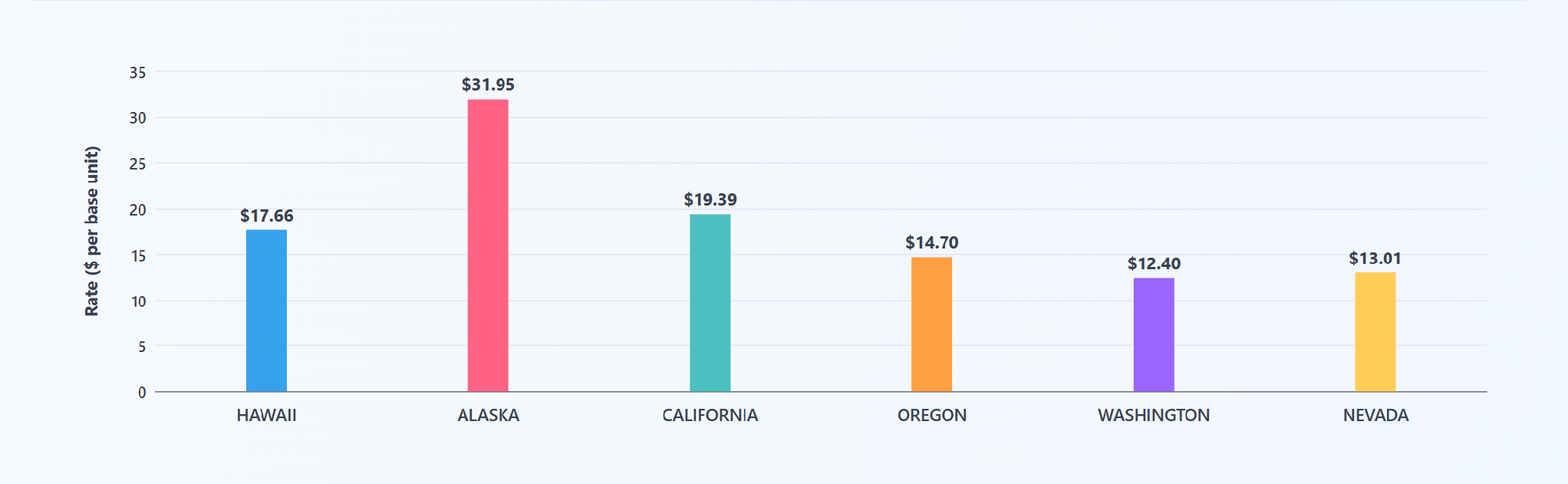
Medicaid 97153 (adaptive behavior treatment by protocol, technician-delivered), rate per 15-minute unit: Hawaii and selected Western states. California rates are proposed and pending CMS approval. Source: MediRate.
On 97153, Hawaii’s $17.66 trails Alaska at $31.95 and California at $19.39, and sits above Oregon at $14.70, Nevada at $13.01, and Washington at $12.40.
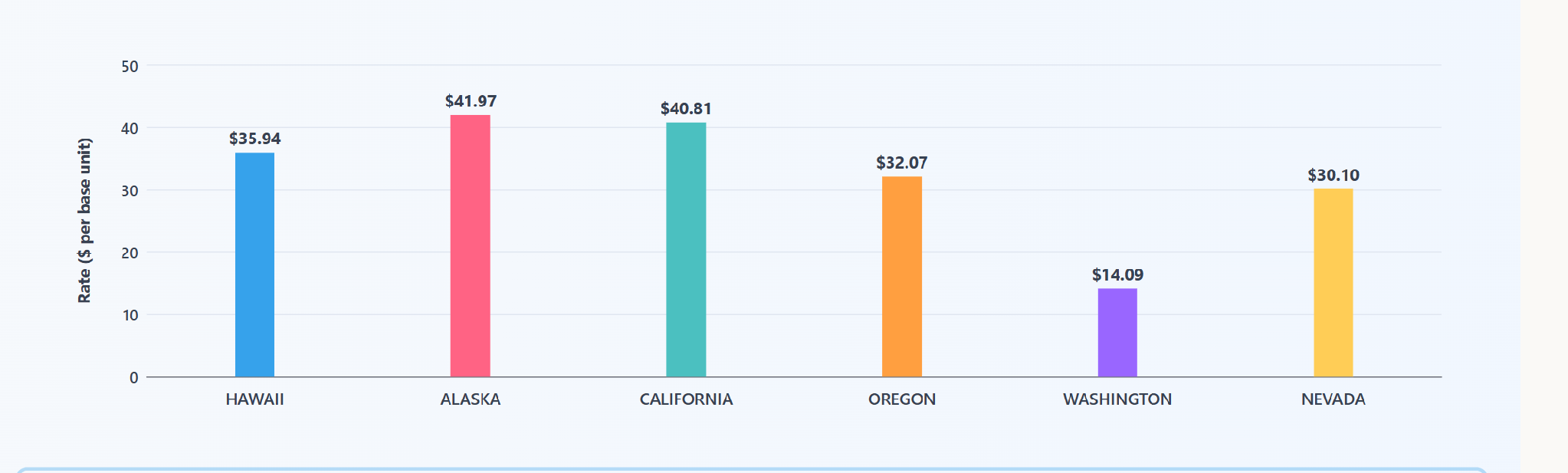
Medicaid 97155 (adaptive behavior treatment with protocol modification, analyst-delivered), rate per 15-minute unit: Hawaii and selected Western states. California rates are proposed and pending CMS approval. Source: MediRate.
On 97155, Hawaii’s $35.94 again trails Alaska ($41.97) and California ($40.81), and leads Oregon ($32.07), Nevada ($30.10), and Washington ($14.09). California’s figures are proposed: they come from State Plan Amendment 25-0028, which the California Department of Health Care Services submitted to CMS in September 2025 to set Medi-Cal fee-for-service rates effective July 1, 2025, and which is still awaiting federal approval. Because Hawaii delivers most ABA through managed care, fee-for-service figures are a benchmark rather than a measure of what each plan pays. For granular rate detail across the full ABA code set, MediRate maintains the underlying data.
What Hawaii ABA Providers Should Watch
The first issue is whether the funding lasts. The 2025 increase was built on a one-year appropriation, and Med-QUEST said further legislative action would be needed to sustain it. The June 2026 schedule shows the rates have held so far, but MediRate’s legislative tracking shows no ABA measure passing in the 2025 or 2026 sessions, and Acuity found no public explanation of how the rates were carried into 2026. The next budget cycle will test them, as Nebraska’s flat rates after no appropriation was made illustrate.
The second is litigation. In Hawaii Disability Rights Center v. Kishimoto, filed in 2018, the state’s protection and advocacy organization alleges that the Departments of Education and Human Services deny medically necessary ABA to students during the school day. The state won summary judgment in 2022, but in November 2024 the Ninth Circuit partly reversed, holding that the organization’s Medicaid Act and disability rights claims did not require exhaustion under the IDEA, and it sent the case back to the federal district court in Honolulu for further proceedings.
The third is federal oversight. On August 4, 2026, CMS released its State Medicaid and CHIP ABA Toolkit, reporting that ABA spending in the two programs rose 421 percent from 2021 to 2025. The agency said the toolkit creates no new federal requirements. It covers clinical standards, benefit design, payment methodology, provider enrollment, credentialing, utilization management, and program integrity, and it arrives as federal auditors have flagged improper ABA payments in several states.
Frequently Asked Questions
What does Hawaii Medicaid pay for ABA in 2026?
Med-QUEST’s fee-for-service schedule dated June 1, 2026 lists 97153 at $17.66 and 97155 at $35.94 per 15-minute unit. Under the December 2024 ABA memo, 97153 pays the same rate at every credential tier, while 97155 pays $20.24 when a Board Certified Assistant Behavior Analyst delivers it. QUEST Integration plans may pay more than the fee-for-service rates.
Who is eligible for ABA under Hawaii Medicaid?
Members under 21 with an autism spectrum disorder diagnosis are eligible through EPSDT when services are medically necessary. If a diagnosing provider suspects autism but needs more time to confirm it, the health plan may approve a trial of up to 26 weeks.
Does Hawaii Medicaid require prior authorization for ABA?
Not for screening or diagnostic evaluation, although plans may require a primary care referral. Treatment requires authorization, requested in hours per week for up to 26 weeks, with interim progress assessments at least every 26 weeks.
Can providers bill 97153 and 97155 at the same time in Hawaii?
Yes. The ABA memo allows it when a Registered Behavior Technician delivers 97153 under a Licensed Behavior Analyst’s supervision and an analyst, or an assistant analyst under supervision, delivers 97155, as long as the criteria for both codes are met.
Why did Hawaii’s ABA rates increase in 2025?
The Legislature funded “Scenario 1” of a 2023 Milliman rate study that Med-QUEST commissioned after House Resolution 207 and related resolutions. Med-QUEST described the funding as non-recurring and scheduled for calendar year 2025.
Sources: MediRate; Hawaii Department of Human Services, Med-QUEST Division, Memo QI-2431/FFS 24-13 (December 31, 2024) and Attachments A through C; Med-QUEST Medicaid Fee-for-Service Fee Schedule as of June 1, 2026; Med-QUEST ABA Rate Study materials and October 30, 2024 stakeholder presentation; Hawaii QUEST Integration Quarterly Monitoring Report to CMS, FFY 2025 Q1; U.S. Court of Appeals for the Ninth Circuit, Hawaii Disability Rights Center v. Kishimoto, No. 20-17521 (November 26, 2024); Centers for Medicare and Medicaid Services (August 4, 2026); California Department of Health Care Services, SPA 25-0028 public notices (June 24 and August 28, 2025) and submittal letter (September 30, 2025); prior Acuity Media Network reporting.