
Ohio drafted ABA rates, then paused to rework them. Until a rule is final, there is no uniform ABA pay, and some ABA has been billed under codes that can pay more.
Key Takeaways
- No adopted rate yet. Ohio has no adopted Medicaid fee schedule for ABA, and its May 2025 draft rule, which priced 97153 at $16.04, has not been filed.
- ODM paused to rework the rule. At July 30 office hours, ODM cited budget pressure and audits in other states; its data shows ABA spending up 358 percent since 2020.
- Behavioral health codes pay more for technician time. ODM says ABA has been billed under TBS, CPST, and PSR codes; bachelor’s-level TBS pays $22.50 to $28.71 per 15 minutes, against a draft $16.04 for 97153.
- Two tracks to watch. The revised rule adds accreditation and diagnosis requirements, while House Bill 453 would tie managed care ABA rates to a fee schedule Ohio has not adopted.
Ohio Medicaid covers applied behavior analysis (ABA) for children with autism, but the state has no ABA fee schedule in its Administrative Code. The Ohio Department of Medicaid (ODM) drafted ABA rates, most recently in a May 2025 revision, then paused the rule to rework it. Until a rule is final, Ohio has no uniform Medicaid payment policy for ABA; advocates told lawmakers in 2024 that the state’s seven managed care plans were operating seven different medical and reimbursement policies. ODM says some ABA has been billed under community behavioral health codes that can pay more than its draft technician rate would.
Ohio’s gap is long-standing. A July 2014 CMS bulletin clarified that states must cover medically necessary autism treatment for Medicaid-eligible children under 21 through the Early and Periodic Screening, Diagnostic, and Treatment benefit, and the same 2024 advocacy materials said Ohio had still not codified ABA coverage in its Administrative Code or state plan. That leaves Ohio without the numbers this series usually compares. This installment looks instead at what Ohio proposed, why it stopped, and how the codes some providers have used in the meantime are priced.
Why Ohio Medicaid Has No ABA Fee Schedule
ODM has drafted rules for a new Administrative Code chapter, 5160-34, to cover ABA. A revised draft circulated for clearance review in May 2025 was marked as not yet filed. Among its changes from an earlier version, it would have let exam-eligible technicians work for 90 days before earning Registered Behavior Technician (RBT) certification, and it removed a list of specific qualifying diagnostic conditions.
Then ODM stopped. At provider office hours on July 30, 2026, the department said it had paused the rule in 2025 to reevaluate it. It cited projected budget shortfalls tied to the federal One Big Beautiful Bill Act and Ohio House Bill 453, national attention on ABA spending growth, audits in other states that found inadequate oversight, and concern that service volume was not proportionate to outcomes. ODM presented a revised direction and asked providers to submit comments by August 5.
ODM has not publicly announced when it will file the rule. Acuity requested comment from ODM on its timing and on whether the 2025 draft rates still stand.
Ohio’s Draft ABA Rates for 97153 and 97155
Appendix A to the May 2025 draft, obtained through MediRate’s state document library, priced 97153 delivered by an RBT at $16.04 per 15 minutes, or $64.16 an hour. For 97155, it set $27.28 for an independent practitioner, meaning a Board Certified Behavior Analyst or Certified Ohio Behavior Analyst, and $20.63 for a Board Certified Assistant Behavior Analyst. Assessment under 97151 was priced at $30.49 and $22.67, and family guidance under 97156 at $30.09 for independent practitioners. Group treatment by protocol under 97154 was $7.61, and the exposure codes 0362T and 0373T were $33.54.
Whether those figures survive the rewrite is open. ODM’s July presentation also listed pending changes to incorporate new CPT codes, which matters because the 2027 ABA code set takes effect in January.
For context, the draft 97153 rate equals the $16.04 MediRate lists for Indiana after that state’s April 2026 rate cut and sits just below Michigan’s legislated $16.50 minimum, which Michigan’s PIHPs must pay. Because Ohio has no adopted rate for either code, this installment does not include the series’ standard cross-state comparison charts.
ABA Billed Under Ohio Behavioral Health Codes
ODM’s presentation laid out the problem the rule is meant to fix. It said ABA services have been submitted under several billing codes, including Therapeutic Behavioral Services (TBS) and Community Psychiatric Supportive Treatment (CPST), which were not designed to capture ABA’s clinical components and limit the department’s view of what is delivered. Among its observations, ODM listed “selective use of TBS service code for higher reimbursement rate.”
The rates show why that matters. Under ODM’s Behavioral Health State Plan Services manual (version 1.28, August 2025), TBS under H2019 pays a bachelor’s-level Qualified Mental Health Specialist (QMHS) $22.50 per 15 minutes in the office and $28.71 in the community. Master’s-level practitioners receive $25.33 and $32.24. Community Psychiatric Supportive Treatment under H0036 pays $22.03, and Psychosocial Rehabilitation (PSR) under H2017 pays a high-school-level QMHS $17.86 and $22.91. Each of those technician-level rates exceeds the draft 97153 rate. The comparison has limits: units beyond six in a day from the same agency are paid at 50 percent (for TBS, only in the office), and the draft 97155 rate is higher than every office rate shown, trailing only the TBS community rates.
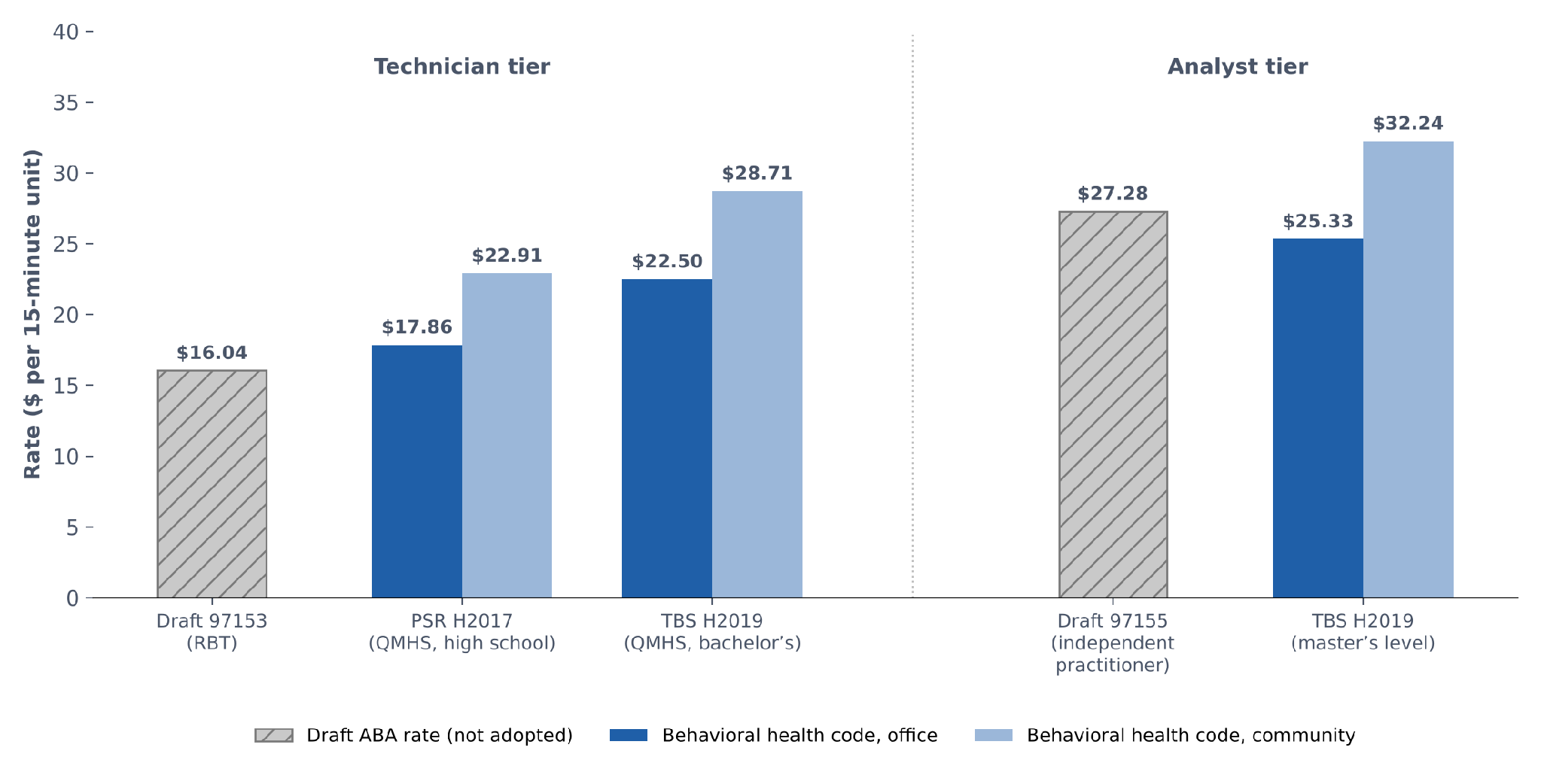
Figure 1. Ohio’s draft ABA rates compared with community behavioral health rates, per 15-minute unit. This series’ standard comparison charts, built on the MediRate platform, track 97153 and 97155 across neighboring states. Ohio has no adopted rate for either code, so Acuity compiled this chart from the May 2025 draft Appendix A to proposed rule 5160-34-03, which ODM has not filed and is revising, and ODM’s Behavioral Health State Plan Services manual (version 1.28), both obtained through MediRate’s state document library. Credential requirements differ across codes: draft 97153 would be delivered by Registered Behavior Technicians, while the TBS and PSR rates shown apply to the practitioner levels listed. Behavioral health rates shown are per-unit maximums; units beyond six in a day from the same agency are paid at 50 percent (for TBS, only in the office). Source: ODM, via MediRate.
The revised rule would close that route by prohibiting the use of community behavioral health codes to bill ABA.
What Ohio’s Revised ABA Rule Would Change
ODM’s July presentation described a tighter benefit than the 2025 draft. RBT certification would be required, with the exam-eligible option removed, and organizational providers would need CARF or Joint Commission accreditation under a new ABA-specific provider type. Services would require an autism spectrum disorder diagnosis from a practitioner independent of the ABA provider, and parents would have to participate four hours a month. Kansas has also tightened its diagnosis rule, limiting which clinicians’ diagnoses qualify for ABA.
ODM’s revisions would also narrow what Medicaid pays for. Meals, snack breaks, naps, and educational activities would not be covered; school-based ABA could not overlap with Ohio’s Autism or Jon Peterson scholarships; services duplicating developmental disabilities waiver services would not be reimbursed; and group sessions would require a Board Certified Behavior Analyst on site.
The rule would also define two levels of care. Comprehensive ABA would typically run 10 to 25 hours a week for one to three years, and focused ABA 1 to 20 hours a week for one to four years. Those ranges land in a live debate over weekly hour limits, which CMS says can work only as soft limits for children, and sit near Virginia’s proposed 20-hour cap.
ODM’s data shows why it is moving. Members with ABA claims rose from 1,341 in 2020 to 4,569 in 2025, and ABA spending for them rose from $21.8 million to $99.6 million, a 358 percent increase. Over the same period, total spending on members with an autism diagnosis, for all services, rose 206 percent, while the number of those members doubled, a gap ODM read as services being billed for longer durations. ODM also cited federal audit recoveries in other states, including $18.5 million in Wisconsin, and listed supervision, documentation, and billing failures found in those audits.
Ohio House Bill 453 and What Comes Next
A legislative track runs alongside the rule. House Bill 453, introduced September 15, 2025, would set FY2027 managed care ABA rates at 100 percent of the fee-for-service rate for 97151 through 97158, require commercial payers to pay at least the Medicaid fee schedule, and create a temporary exam-eligible technician credential, according to the Legislative Service Commission’s analysis. Both rate provisions point to a Medicaid fee schedule Ohio has not adopted.
The bill has had three hearings in the House Insurance Committee, most recently on June 2, 2026. Every witness listed for its first two hearings testified as a proponent, including the Ohio Association for Behavior Analysis, Hopebridge, the Ohio Autism Insurance Coalition, and the Ohio Children’s Alliance.
Providers have pushed back on parts of ODM’s approach before. Commenting on the 2025 draft, the Ohio Council of Behavioral Health and Family Services Providers warned that requiring behavior analyst certification would shut out licensed psychologists, counselors, and social workers already practicing ABA within their scope, raise costs, and deter entry-level workers. It also objected that community behavioral health centers were left off the list of eligible organizational providers and asked ODM to drop prior authorization for starting treatment. Acuity did not find published comments on the 2026 revisions.
Federal pressure points the same way as ODM’s revisions. CMS’s August 4 ABA toolkit reported that Medicaid and CHIP spending on ABA rose 421 percent from 2021 to 2025 and urged states to strengthen oversight. For Ohio providers, the next marker is a filed rule with rates attached; neighboring Michigan issued a rewrite of its ABA policy on October 1. MediRate maintains the underlying rate detail for state Medicaid programs nationwide.
Frequently Asked Questions
Does Ohio Medicaid have an ABA fee schedule in 2026?
No. ODM drafted ABA rates, most recently in May 2025, but has not filed the rule, and it paused the rule to revise it. Ohio has no uniform Medicaid payment policy for ABA in the meantime.
What rates did Ohio’s draft ABA rule propose?
The May 2025 draft priced 97153 delivered by an RBT at $16.04 per 15 minutes, 97155 by an independent practitioner at $27.28, and 97155 by a Board Certified Assistant Behavior Analyst at $20.63. ODM has not said whether those rates will change.
Why did ODM pause its ABA rule?
ODM cited projected budget shortfalls, national attention on ABA spending growth, state audits that found weak oversight, and concerns that service volume outpaced outcomes.
What would Ohio House Bill 453 do?
It would set FY2027 managed care ABA rates at 100 percent of the fee-for-service rate, require commercial payers to pay at least the Medicaid fee schedule, and create a temporary exam-eligible technician credential. As of November 4, its House Insurance Committee page lists no action since a June 2 hearing.