
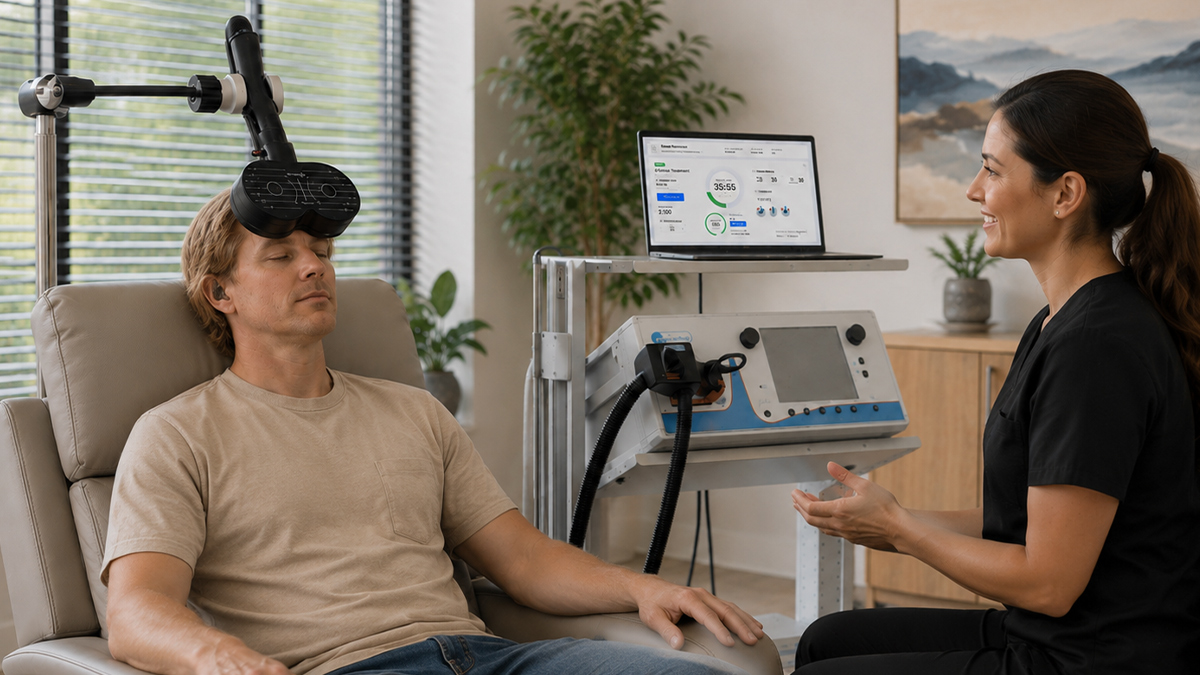
Wave Neuroscience’s MeRT System is FDA cleared as an adjunct for adult PTSD. Inside the trial results, the safety profile, and the reimbursement path ahead.
Key Takeaways
- A real evidentiary first, on a broad indication: FDA cleared the MeRT System on June 3, 2026 as an adjunct for adult PTSD, an indication that covers the full adult population rather than a defined subgroup. Wave’s submission notes that no previously cleared PTSD device had been supported by a double-blind, randomized, sham-controlled trial; the category’s prior clearance, in 2023, rested on an open-label study with no sham comparator.
- The efficacy and safety numbers are strong: Active-arm patients improved 27 points on the PCL-5 against a VA threshold of 8.5 to 12.5 for clinically meaningful change, 68.2 percent met remission at follow-up, and improvement continued through a two- to four-month window rather than decaying. There were no serious adverse events.
- The trial tested a different lever than the rest of the field is pulling. Fixed-frequency TMS has repeatedly fallen short in PTSD, and the industry’s response has been accelerated protocols that add multiple sessions per day. MRT-005 instead tested EEG-guided frequency selection: each patient’s stimulation frequency was set from their own EEG. Exploratory results favor that lever: brain-function changes appeared only in the active group, and a dose analysis found no benefit from more pulses.
- Reimbursement is the next gate, and a code now exists: A Category III CPT code covering the EEG and ECG acquisition and the algorithmic analysis behind MeRT was released on July 1, 2026 and will be effective with the 2027 CPT code set. The timeline for insurance reimbursement of the code is currently pending, and state appropriations remain the payer for Wave’s largest programs.
In 2018, Fred Walke was being courted to join a small neurotechnology company in Newport Beach, and he was not persuaded. He had spent his career as a chief executive for venture and private equity backers, largely in medical technology, and he had looked at the business three years earlier and concluded it was not ready. What changed his mind was not a data room. It was a ten-minute electroencephalogram (EEG) performed on his youngest daughter.
She had been, by his account, an extroverted student and a competitive soccer player who over roughly eighteen months became withdrawn, tearful, and academically adrift. Pediatricians and psychiatrists had offered no mechanism, only reassurance that she should “grow out of it.”
A scientist at the company watched her trace and asked whether she had ever had a head injury. There had been a concussion two years earlier, on the field. “I can see network slowing in her frontal cortex,” Walke recalled being told. “She’s processing the world at about eight times per second. The back of her brain is receiving information a little over ten times per second. There’s a communication mismatch. She can’t process the world.”
What he was being shown, in plainer terms, was a rhythm reading. An EEG records the brain’s electrical activity as cycles per second, or hertz, and the scientist’s interpretation was that the front of her brain had slowed relative to the back by enough to matter. The proposed remedy was transcranial magnetic stimulation, a non-invasive treatment in which a magnetic coil held against the scalp induces electrical activity in a targeted region, tuned in her case to her own brainwave data. The neurons were not damaged, he was assured. “They’re just on the wrong radio station.”
Three weeks of treatment later, Walke says, his daughter stopped in the kitchen to talk with him unprompted, something she had not done in a year and a half. A teacher told him she had become a pleasure to have in class. That August, Walke told the company he would come in on one condition: that it be rebuilt around clinical evidence before anyone tried to sell it. He raised money, moved the assets into a new entity, and incorporated Wave Neuroscience in June 2019.
Walke told this story during an interview with Acuity Media Network in mid-August of 2026. Eight years and, by his account, roughly $30 million in trial spending later, the Food and Drug Administration has cleared the company’s MeRT System. The clearance came on June 3, 2026, and Wave announced it on June 11. It is a big milestone in a category that has waited a long time for one. The 510(k) summary now posted in the agency’s premarket notification database lays out the trial design, the endpoints, the safety data, and the supporting analyses in considerably more detail than the press release that followed it, and it is the better document for understanding what MeRT is cleared to do and what the agency reviewed to get there.
What the FDA Cleared in the MeRT 510(k)
As one might expect, the Indications for Use are specific: the MeRT System is cleared as an adjunct for the treatment of adult patients suffering from post-traumatic stress disorder, for prescription use in a clinical setting. It is the first personalized, biomarker-guided treatment for PTSD to carry an FDA clearance.
Adjunct is the operative word, and it works in patients’ favor. MeRT is cleared to be added to a patient’s existing PTSD care rather than substituted for it, which means patients do not need to discontinue, wash out, or retitrate medications, or pause psychotherapy, in order to begin treatment. Wave sought that language deliberately. Adjunctive means MeRT can be used alongside other treatments; it does not mean it has to be. In the pivotal trial, it was delivered on its own.
That distinction matters because PTSD patients rarely arrive treatment-naive. Many are already on medication, are dissatisfied with the result, and are looking for something to add rather than something to swap in. An adjunct clearance matches how care is delivered in practice, preserves continuity, and lets a referring clinician keep the treatment plan intact while adding MeRT to it. MagVenture, whose hardware is part of the cleared configuration, has used the adjunct language consistently in its own materials.
How the Personalization Actually Works
The device itself is two things. The first is MRT-005, a machine-learning-derived algorithm that reads resting-state, eyes-closed EEG and ECG data and returns an individualized pulse rate between 8 and 13 hertz. The second is a compatible, legally marketed TMS stimulator that delivers the treatment. MRT-005 generates no magnetic field. It hands parameters to hardware that does, and it runs in the cloud rather than on the device.
The distinction that matters commercially is what happens before the coil ever touches a patient. Conventional TMS has long tailored one variable to the individual, the intensity of the pulse, but delivers those pulses at a frequency fixed by protocol. Wave reads the patient’s resting brain rhythm and heart rate first and derives an optimal pulse rate from them, on the theory that a brain responds to stimulation delivered at the right rate for its own network dynamics rather than at a rate chosen for the average patient. Those rhythms vary from person to person, which is the premise the product rests on. Everything else about the session, the coil, the machine, the chair, is standard TMS.
One methodological point separates this from other EEG-informed stimulation. The frequency MeRT delivers is not the individual alpha frequency, or IAF, as that term is conventionally used. In the EEG literature, IAF generally denotes the single highest-power spectral peak within the 8 to 13 hertz band, which is a descriptive measurement. What Wave’s algorithm produces is a therapeutic determination: the rate that produces the best clinical response in that individual.
In healthy brains the two commonly coincide, which is why the terms are often conflated. In the clinical populations MeRT treats, they frequently diverge. The dominant peak can sit at a suboptimal, sometimes counterproductive, point within the alpha range, so that stimulating at the loudest observed rhythm would reinforce the disordered state rather than resolve it. The algorithm therefore treats the observed spectrum as an input to the determination rather than as the target itself, a distinction Wave regards as central to the innovation.
The dose is deliberately gentle, because the goal is to entrain brain networks rather than overwhelm them. Stimulation is delivered to the midline dorsomedial prefrontal cortex at 60 to 80 percent of motor threshold, across 20 to 25 sessions of about 30 minutes each. Motor threshold is the power level at which a single pulse makes the patient’s thumb twitch, and it is how clinicians calibrate dose to the individual. Conventional TMS protocols typically run at 120 percent of that threshold. MeRT runs at 60 to 80 percent, delivering fewer pulses at lower intensity to the same anatomical neighborhood. A course that runs gentler and still separates from sham is part of the clinical argument, not a footnote to it.
Where MeRT Sits Among Cleared PTSD Devices
Wave calls MeRT the first-ever FDA-cleared personalized clinical treatment system for PTSD. Set against the rest of the cleared field, that claim is worth spelling out, because it determines what a clinician can tell a patient.
Two other devices carry PTSD authorizations. GrayMatters Health cleared Prism in March 2023 (K222101), EEG neurofeedback software in which patients train themselves to move their own signal rather than receiving stimulation, on an open-label study of 79 patients with no sham comparator. Eight days before Wave’s clearance, Neurovalens announced De Novo authorization for Modius Spero, an at-home wearable delivering vestibular nerve stimulation, which does stimulate but is not tailored to individual brain data.
Against that field, Wave’s claim holds in a specific and consequential way: MeRT is the first cleared device that uses an individual patient’s own EEG to set the parameters of applied stimulation for PTSD. Its evidentiary footing is also the strongest of the three. The 510(k) summary notes that no FDA-cleared device for PTSD had previously been supported by a double-blind, randomized, sham-controlled trial, and against Prism’s open-label study that holds cleanly. Neurovalens, for its part, has not published the results of its pivotal trial and has posted no results to ClinicalTrials.gov, so there is no public data set against which its outcomes can be read. Acuity has previously covered how much commercial weight an FDA clearance carries in this sector.
What the PTSD Trial Data Actually Shows
The multisite trial was run with investigators at the Texas A&M Health Institute of Biosciences and Technology, with Dr. Kenneth S. Ramos as Principal Investigator, and led scientifically by Dr. Leslie Prichep, Wave’s Chief Scientific Officer and the contact of record on the submission. Prichep spent decades directing the Brain Research Laboratories at NYU School of Medicine and is among the most published figures in quantitative EEG. Walke calls hiring her the move that made the trial possible.
Two instruments do the measuring, and the difference between them deserves mention. The PCL-5 is a twenty-item checklist patients complete themselves. The CAPS-5 is a structured interview conducted by a trained clinician who probes the answers, which is why researchers generally treat it as the more rigorous of the two.
Patients were also randomized against a sham arm, meaning a matched group went through the identical course of sessions without receiving an effective dose. That design is how a trial separates the treatment itself from everything else that comes with being treated, from the clinic visits to the attention to the expectation of getting better.
The intention-to-treat population was 158 adults, 77 assigned to active treatment and 81 to sham, all with a CAPS-5 diagnosis and a PCL-5 severity score of at least 30. Eighty-four percent completed treatment. The PCL-5 was the primary outcome and reached significance at p < 0.046. The clinician-administered CAPS-5, a prespecified secondary measure, performed considerably better at p < 0.0006.
On safety, there were no serious adverse events at all, and treatment-emergent adverse events were comparable between the active and sham arms. For a population in which medication side effects drive a good deal of the discontinuation, that profile is part of the commercial argument.
The within-group numbers are also strong. Active-arm patients improved by 27 points on the PCL-5, against a Department of Veterans Affairs estimate of 8.5 to 12.5 points for a minimal clinically important difference, meaning the smallest change considered clinically meaningful rather than merely measurable. Using established criteria, 68.2 percent met remission at follow-up, a significant separation from sham at p < 0.008, and improvement continued through a two- to four-month window rather than decaying. Durability is a recurring weakness in PTSD treatment, so gains that hold or grow after the course ends are a meaningful finding in their own right.
Reading the Effect Sizes Against Real-World Care
There is a second way to read the same trial, and it is the one a medical director will use. Effect size measures how far the treated group pulled away from the sham group, expressed in standard deviations. By the benchmarks conventionally applied to it, roughly 0.2 counts as a small separation, 0.5 as moderate, and 0.8 as large. Within-group improvement, by contrast, measures how much a treated patient got better without subtracting what the sham patients also experienced, and sham response in PTSD trials is substantial.
The treatment effect size was approximately -0.32 on the PCL-5 and -0.51 on the CAPS-5. The summary situates those figures within the upper range of the estimated effect sizes for what it calls the two FDA-approved pharmacologic interventions for PTSD, a range it gives as roughly -0.30 to -0.56. The summary does not name them; the only two drugs carrying an FDA indication for PTSD are sertraline and paroxetine, approved in 1999 and 2001 respectively. On the agency’s own accounting, MeRT performs at least comparably to those drugs, with a cleaner side effect profile and no pills. No new medication has been approved for PTSD since, and the most recent serious attempt, a brexpiprazole and sertraline combination, was rejected by FDA last year after an advisory committee voted 10 to 1 against it.
That drug range, though, comes from registration trials, and registration trials are not where a medical director’s members get treated. The largest look at how the same agents perform in routine care comes from the Department of Veterans Affairs. Writing in the Journal of Clinical Psychiatry in 2020, Shiner and colleagues tracked 834 VA outpatients with DSM-5 PTSD through twelve weeks of adequately dosed treatment with fluoxetine, paroxetine, sertraline, topiramate, or venlafaxine. Mean improvement ranged from 6.8 to 10.1 points on the PCL-5, off a baseline severity score of 57.8. Remission ranged from 0 percent in the paroxetine group to 10.9 percent in the venlafaxine group. The authors set their own sertraline result, a 7.5-point improvement, against roughly 15 points for the sertraline arm of a contemporaneous randomized trial: real-world performance running at about half of trial performance.
That is the like-for-like comparison, and it is the one Wave points to. Read on the same real-world footing, MeRT’s numbers hold. In the state-funded eTMS programs Acuity reported on in April, JLC Services reports roughly 60 percent reductions across validated scales in more than 3,200 patients treated outside any trial protocol. For pharmacotherapy the pattern has run the other way: reasonable in sponsored trials, thin in routine practice.
Walke frames the effect in those terms. In the same interview with Acuity, he put symptom reduction at 50 to 65 percent across indications, against 10 to 20 percent for medication and 10 to 30 percent for talk therapy. Those figures track within-person improvement in the active arm and in the state programs rather than the sham-adjusted difference the clearance rests on, and the medication end of the comparison is consistent with what the VA’s own routine-practice data shows.
The distinction is not simply academic. The gap between a 27-point drop and a -0.32 effect size is a gap a payer will ask about, and the real-world evidence is the answer Wave will give. The difficulty of turning outcome measurement into something payers will act on is familiar across behavioral health. The trial’s design, endpoints, and results are documented in full in the FDA’s 510(k) summary, with peer-reviewed publication still ahead.
What the Trial Was Designed to Test, and What Fixed-Frequency TMS Has Not
The pivotal trial was built to evaluate the MeRT System as a whole, EEG-guided frequency selection included. As the 510(k) summary notes, it was not structured as a head-to-head against TMS delivered at a fixed frequency. There is a straightforward reason for that.
The variable Wave changed is the one the field has spent twenty years failing to move. TMS itself is well established, and it is FDA-cleared for treatment-resistant depression, obsessive-compulsive disorder, and nicotine cessation. In PTSD, though, a fixed-frequency protocol has not beaten sham reliably enough to support a clearance. The most rigorous test of the proposition, a multisite randomized trial of deep TMS paired with brief symptom provocation, found active stimulation significantly inferior to sham. A 2024 Cochrane review of repetitive TMS for PTSD in adults found results inconsistent across stimulation parameters. No fixed-frequency TMS protocol carries an FDA indication for PTSD today.
What the fixed-frequency protocols do appear to match is one another. In a multisite, propensity-matched cohort study of 658 veterans published in Brain Stimulation in January 2026, Berlow and colleagues compared the three FDA-cleared depression protocols, left prefrontal 10 Hz, intermittent theta burst, and deep TMS, in patients with comorbid PTSD. All three produced PCL-5 reductions of 18 to 22 points, response rates of 63 to 78 percent, and remission rates of 47 to 49 percent, and none separated from the others on any measure. The authors’ conclusion was that clinicians should choose a protocol on patient-specific or logistical grounds rather than efficacy. They also noted, of the sham-controlled literature, that more definitive evidence that active TMS beats sham for PTSD is still needed, and their own study, being a cohort without a sham arm, could not supply it.
Read alongside Wave’s result, that is the case for personalization stated in the negative: moving the frequency dial from one fixed setting to another does not appear to change outcomes, while setting it to the individual patient produced separation from sham in the first trial designed to test it.
At the agency’s suggestion, Wave also ran a post-hoc analysis splitting the active group into low, medium, and high pulses per session. It found no significant differences between them, with the caveat, noted in the summary, that the low-pulse group had seven participants. The direction of the finding is what matters here, because it cuts against the way the field has generally moved, which is toward more pulses, more sessions, and higher cumulative exposure. Wave’s design premise is the opposite: that matching the frequency to the patient matters more than the volume of stimulation, and that a sub-threshold course tuned to the individual can do what heavier fixed-frequency courses have not.
The summary is not silent on mechanism, either. Exploratory analyses found that changes in posterior EEG coherence, meaning how closely regions at the back of the brain fire in step with one another, tracked changes in symptom severity in the active group and not in the sham group. The document says that supports changes in brain function in the treated arm only. That is the physiological corroboration of the clinical result that Wave set out to capture, and it is the thread the company will pull on next: a symptom improvement that shows up in the brainwave data as well as on the checklist.
Reimbursement Is the Next Gate for MeRT
Ask Walke what stands between the technology and adoption and he does not say evidence. He says billing.
“The biggest pushback we get is the question: is it insurance reimbursed?” he told Acuity. TMS has been reimbursed for treatment-resistant depression for roughly twenty years, he noted, and in his reading that has not driven much innovation. “It’s the model to gain payer support, and for us, we need payer support.”
The mechanics here are unglamorous but decisive. CPT codes are the billing codes a clinician uses to charge an insurer for a specific service, and without one there is no standard way to submit a claim.
That piece moved this summer. As of publication, a Category III CPT code covering MeRT, 1105T, was released on July 1, 2026 and will be effective with the 2027 CPT code set. The code covers the EEG and ECG acquisition, as well as the augmented AI multivariate algorithmic analysis of that data that derives a patient’s personalized stimulation pulse rate for neurostimulation, including TMS. Those are precisely the two components that make MeRT different from a standard TMS course. The timeline for insurance reimbursement of the code is currently pending.
Category III codes are temporary codes for emerging technologies. They carry no assigned relative value units, so payment sits at each payer’s discretion, and they exist in part to collect the utilization data that supports a later move to a permanent Category I code. Codes already exist for delivering TMS itself, though payer coverage policies for TMS were written around treatment-resistant depression, which makes extending them to PTSD a coverage conversation rather than a coding one.
Neurovalens, for its part, began reaching veterans through the Department of Veterans Affairs in July and has publicly named a late-2027 target for nationwide coverage. Timing has mattered in this sector before: as Acuity has reported, digital therapeutics won FDA clearances years ahead of any billing mechanism, and behavioral health’s reimbursement gaps can outlast the clinical case. A Category III code is the first structural step out of that pattern, and it is a step this category has not had before.
For now, legislatures remain the payer. The state-funded eTMS programs JLC Services operates across seven states treat veterans, first responders, and law enforcement officers at no cost because states underwrite it.
Walke traces the model to Frank Hoagland, the former Navy SEAL who served in the Ohio Senate through 2023 and secured the first appropriation. Those programs launched before clearance, on testimonial and pilot data. Clearance gives them something they did not have then: a federal regulator’s sign-off to carry into the next appropriations hearing, and a growing body of outcomes data to carry with it.
A Referral Business, Not a Clinic Chain
The commercial base underneath all of this is unusual. Walke says more than 45,000 people have been treated with the technology, that volume is running near 1,000 patients a month, and that more than 200 physicians use it across more than 160 locations in fifteen countries, none of it advertised and all of it referral driven. Roughly 90 percent of those practices, he says, offer the technology as their only treatment arm. The figures come from company records.
Structurally, Wave is a software company rather than a provider. It licenses protocols and longitudinal tracking to independently owned clinics rather than running them, an arrangement that requires far less capital per site than owning them would. Wave supplies the protocol and the measurement layer; the clinics supply the room, the machine, and the clinician. With a cleared indication in hand, that measurement layer is also how the company tracks outcomes and consistency across the network.
Blair Atkins, who joined as Director of Brand and Growth about a month before the interview with Acuity, frames the clearance as a starting line rather than a finish. “We’re not a PTSD company, we’re a precision brain health company,” she told Acuity. “You can’t treat what you don’t measure. If you don’t know where you’re starting from, you don’t know if you’re improving.”
What Wave Is Building Toward Next
Walke’s ambition runs further than the current clearance, and he is direct about where the regulatory line sits today. He wants a brief EEG at every primary care physical, longitudinal tracking of neuron function, and intervention before symptoms present.
He is upfront about that line: EEG is not cleared by FDA as a diagnostic device. It is a physician support tool, and moving it into diagnostic territory is a separate regulatory fight from the one he just won. “It’s a test you can’t fake,” he said. “You can’t try and pass it, you can’t try and fail it.” He puts the acquisition cost under $50 today and expects it to fall.
Walke talks about depression, anxiety, and substance use disorder as the obvious next indications, and about a longer horizon in which brain data reshapes how education is delivered. None of that is cleared, at least not yet. What is cleared, as of June 3, is an adjunct treatment for adult PTSD, supported by mounting evidence of efficacy across a wide range of mental health and neurological conditions.
His family has largely followed him into the field. Walke’s oldest and youngest daughters work for Action Behavior Centers, the largest ABA provider in the country by location count. His middle daughter is a Nurse Practitioner, and his wife works as a Neurotechnician administering the treatment in a San Diego clinic. He has spent eight years arguing that mental health should be measured before it is treated. The clearance is the first time a regulator has agreed in writing, and Walke’s read is that it will not be the last.