
Key Takeaways
- Florida implemented the SMMC 3.0 carve-in of behavior analysis services on February 1, 2025: nine MMA plans now handle prior authorization, network contracting, and reimbursement for ABA recipients enrolled in managed care, while fee-for-service ABA recipients continue to submit prior authorization to Acentra, AHCA’s contracted quality improvement organization.
- The December 2024 Coverage Policy formalizes managed care coverage and adds a CDE requirement: the refreshed policy explicitly applies to managed care plans for the first time, codifies a Comprehensive Diagnostic Evaluation (CDE) requirement alongside the physician’s order, and retains the documentation framework (Vineland-3 and BASC-3 PRQ core instruments, IEP or 504 documentation for school-delivered services, and a six-month authorization cycle) that AHCA introduced in the October 2023 amendment.
- Florida’s fee schedule held core ABA rates flat through 2026: the Behavior Analysis Fee Schedule effective January 1, 2025 (the operative schedule incorporated by Rule 59G-4.002 as amended January 18, 2026) reimburses 97153 at $12.26 per 15-minute unit when delivered by an RBT, BCaBA, or Lead Analyst, and 97155 at $19.17 per 15-minute unit when delivered by a Lead Analyst. The rate structure is largely unchanged from the August 2022 transition to CPT-based billing.
- Florida’s published rates sit at the lower end of the Southeast regional pack: at the technician level under 97153, Florida’s $12.26 per 15-minute unit is below most neighboring states’ published fee schedules. The MMA plan-negotiated rates that now determine the bulk of provider revenue may diverge from the published fee schedule.
Florida’s Medicaid behavior analysis program looks structurally different in 2026 than it did two years ago. On February 1, 2025, the Agency for Health Care Administration implemented the Statewide Medicaid Managed Care 3.0 transition, moving behavior analysis (BA) services for children under 21 from a fee-for-service-only delivery model into nine Managed Medical Assistance plans. On February 10, 2025, AHCA adopted a refreshed Behavior Analysis Services Coverage Policy dated December 2024, replacing the October 2023 version incorporated by reference in Rule 59G-4.125. Both changes reshape how ABA providers operate in Florida, even as the state’s fee schedule rates for the core CPT codes have held steady from 2022 through the January 1, 2025 Behavior Analysis Fee Schedule that remains operative in 2026.
Florida is one of the largest Medicaid programs in the country, with roughly 3.95 million enrollees as of January 2026, and ABA spending has been one of its faster-growing line items as autism diagnoses rise. The state now covers BA services through both SMMC and traditional fee-for-service, with managed care plans handling the bulk of prior authorization and provider contracting. For multi-state ABA operators and regional providers, the picture in Florida is one of policy consolidation: an aging fee schedule, a tightened documentation regime, and a managed care environment that will largely determine provider economics going forward.
SMMC 3.0 Brings Behavior Analysis Into Managed Care for the First Time
Florida’s SMMC 3.0 program took effect February 1, 2025, restructuring the state’s managed care landscape from eleven numbered regions into nine lettered regions, A through I, as authorized by SB 1950 (2022), and awarding new contracts to a consolidated set of MMA plans. As part of that transition, AHCA carved behavior analysis services into the managed care contracts for the first time, ending the fee-for-service-only delivery model that had been in place under prior SMMC versions. Under the new arrangement, recipients enrolled in an MMA plan must receive BA services from a provider in their plan’s network, with prior authorization requests routed through the plan rather than to Acentra.
AHCA’s October 2024 SMMC program highlight document for behavior analysis confirmed the structure: nine MMA plans (Aetna Better Health, Children’s Medical Services, Community Care Plan, Florida Community Care, Humana, Molina Healthcare, Simply Healthcare, Sunshine Health, and UnitedHealthcare) reimburse BA services for managed care enrollees. Recipients not enrolled in an MMA plan continue to receive ABA services through the fee-for-service delivery system, with prior authorization handled by Acentra.
The carve-in is consequential for provider economics. MMA plans set their own reimbursement rates with contracted providers, which may diverge from the published AHCA fee schedule. Plans also set their own credentialing timelines, claims systems, and authorization workflows. AHCA’s SMMC 3.0 transition documentation provides continuity-of-care protections: plans must honor any ongoing treatment authorized prior to a recipient’s enrollment for up to 90 days after the effective date of enrollment, and must pay providers at the previously received rate for up to 60 days, regardless of network status. For providers, the practical effect of the carve-in is that contracts with each of the nine MMA plans now determine the bulk of Florida Medicaid ABA revenue, even though the AHCA fee schedule remains the formal reference point.
The carve-in pattern is not unique to Florida. Maryland completed a similar Carelon-administered carve-in in 2025, and other states are exploring single-payer or managed-care carve-in structures for ABA as utilization and spending rise. What makes Florida’s version distinctive is the scale: with roughly four million Medicaid enrollees, SMMC 3.0 represents one of the largest single-state ABA managed care implementations in the country.

The December 2024 Coverage Policy Adds a CDE Requirement and Brings Managed Care Plans Under Its Scope
The refreshed Florida Medicaid Behavior Analysis Services Coverage Policy, dated December 2024 and incorporated by reference in Rule 59G-4.125 effective February 10, 2025, replaced the October 2023 version that had been the operative document. Two substantive changes stand out. First, the policy now explicitly applies to managed care plans: Section 1.2 states that Florida Medicaid managed care plans must comply with the service coverage requirements outlined in the policy unless otherwise specified in their AHCA contract, and may not impose more stringent service coverage limits than those specified in the policy. This is the language that operationalizes the SMMC carve-in at the policy level. Second, the policy adds a Comprehensive Diagnostic Evaluation (CDE) requirement to recipient eligibility: a physician’s order alone is no longer sufficient, and the referral must now be accompanied by a CDE performed according to national evidence-based practice standards and led by a licensed practitioner working within their scope of practice.
The documentation requirements that providers had been navigating under the October 2023 policy largely carry forward. Initial assessments must include the Vineland-3 Comprehensive Parent Interview Form for all recipients (plus the Maladaptive Behavior Domain for recipients ages 3 and older) and the BASC-3 Parent Rating Questionnaire for all recipients ages 2 through 18. Complete scoring reports, including outcome measure scores, must be submitted with prior authorization requests. The behavior plan must reflect the requested authorization period of up to six months, and a reassessment with an updated behavior plan is required at least every six months for continued services. The core instruments must be re-administered with reassessments every 12 months. Session notes must be signed and dated by the rendering practitioner.
The policy clarifies the IEP and 504 documentation requirements to apply specifically to authorization requests for services delivered in a school setting, rather than to all BA services. Where no IEP exists, providers must include either a 504 plan (if the school does not conduct IEPs), or written justification with an estimated timeframe for when an IEP will be completed or updated. AHCA maintains the 40-hour-per-week service ceiling under medically necessary EPSDT criteria and the under-21 age eligibility criterion. For providers operating at scale, the most operationally relevant change is the explicit requirement that providers route prior authorization requests to the recipient’s SMMC plan according to plan direction; for recipients without managed care enrollment, requests still go to Acentra.
Florida’s coverage policy refresh sits within a broader pattern of states tightening ABA documentation and authorization rules. Indiana’s February 2026 Bulletin BT202627 introduced a 4,000-hour lifetime cap and a phased rate reduction for ABA. Federal OIG audits have flagged improper Medicaid ABA payments across Indiana, Wisconsin, Maine, and Colorado, focused largely on documentation failures and credentialing gaps. The Florida refresh does not introduce new rate restrictions or hour caps, but the new CDE requirement and the documentation expectations align with what regulators in other states have used as the basis for recoupment actions.
The 2026 Fee Schedule, Modifier Hierarchy, and Where Florida Sits Regionally
The Behavior Analysis Fee Schedule effective January 1, 2025, which Rule 59G-4.002 (as amended January 18, 2026) continues to incorporate by reference, maintains the rate structure adopted in August 2022 when Florida shifted from HCPCS Level III codes to the AMA’s CPT structure for behavior analysis. The core direct-service rates are $12.26 per 15-minute unit for 97153 (behavior treatment by protocol, delivered by an RBT, BCaBA, or Lead Analyst) and $19.17 per 15-minute unit for 97155 (behavior treatment with protocol modification, delivered by a Lead Analyst). Service performed under 97155 by a BCaBA, which uses the HN modifier, pays $15.37 per 15-minute unit, reflecting the policy decision to differentiate by clinician credential where complexity warrants. Assessment under 97151 pays $19.05 per 15-minute unit, with the TS modifier for behavior reassessments paying the same rate. Family training under 97156 pays $19.05 per 15-minute unit when delivered by a Lead Analyst (including via telemedicine using the GT modifier, subject to a two-hour-per-week telemedicine cap) and $15.24 per 15-minute unit when delivered by a BCaBA under the HN modifier.
Florida’s modifier hierarchy is more granular than many states. Group services under 97154 (by protocol) step down progressively by group size from $7.58 per unit for groups of two (UN) to $5.58 for groups of six (US). Group services under 97158 (with protocol modification) follow a parallel structure with higher rates, from $9.58 per unit for groups of two (UN) to $7.58 for groups of six (US). The 97153 XP and 97155 XP modifiers for concurrent supervision are non-reimbursable for the supervisee; only the supervisor’s services are paid. The assessment add-on practitioner code 0362T pays $12.19 per 15-minute unit (maximum 16 units per assessment, prior authorization required), and the treatment add-on practitioner code 0373T pays $12.19 per 15-minute unit with prior authorization required.
How Florida compares to its Southeast neighbors depends on whether the comparison is at the technician level (97153) or the analyst level (97155). MediRate data show Florida’s published 97153 rate of $12.26 sits below most Southeast neighbors at the technician level, with Georgia (which differentiates by in-clinic and out-of-clinic delivery), North Carolina, Alabama, and South Carolina each pricing 97153 above Florida under at least some delivery-setting conditions. The 97155 picture is more mixed across the regional band. Direct comparison is complicated by each state’s modifier hierarchy and delivery-setting rules.
97153 Reimbursement, Florida and Southeast Neighbors
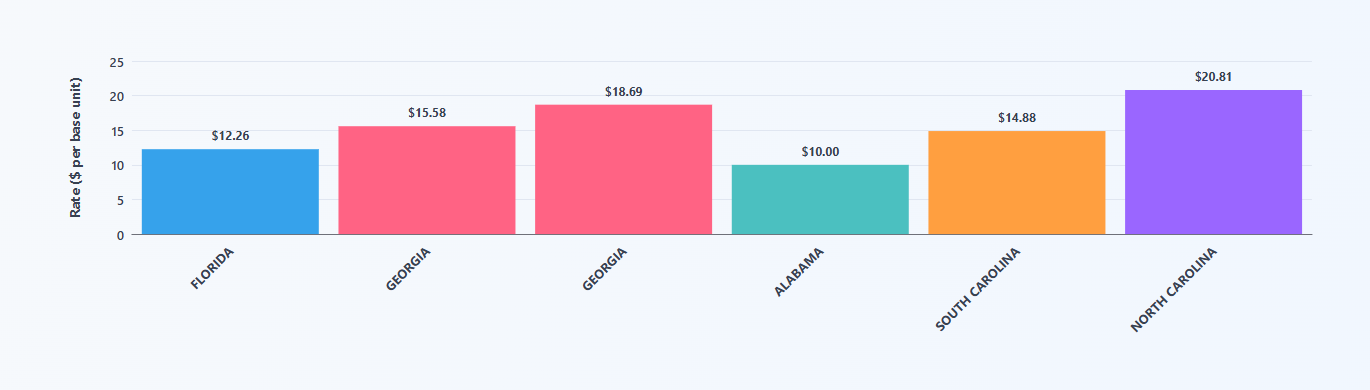
Source: MediRate. Rates shown reflect each state’s Medicaid fee schedule maximum per 15-minute unit for the indicated provider tier and service location. Georgia’s fee schedule differentiates by in-clinic and out-of-clinic delivery, which is why two Georgia bars appear.
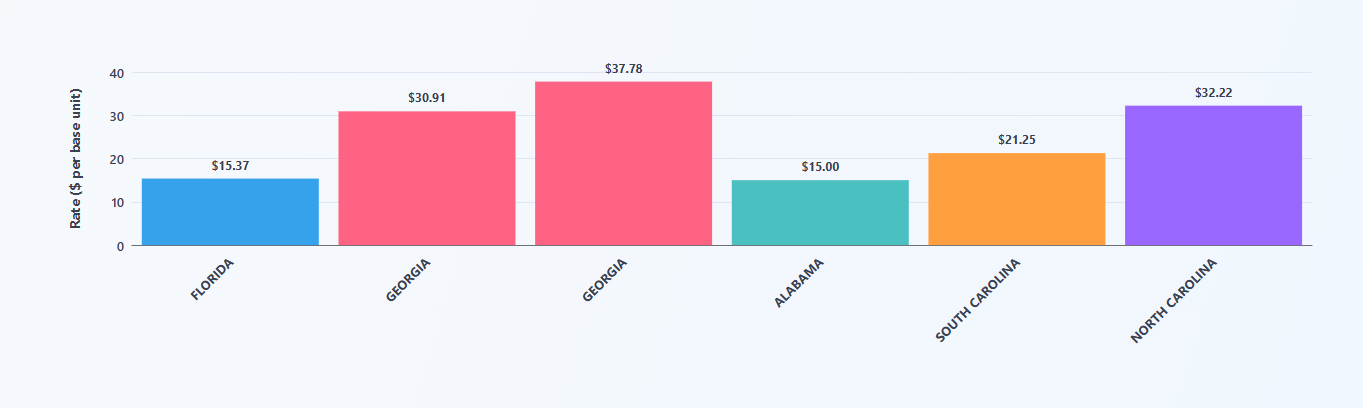
Source: MediRate. Rates shown reflect each state’s Medicaid fee schedule maximum per 15-minute unit for the indicated provider tier and service location. For granular fee schedule detail across all 50 states, MediRate maintains the underlying datasets that support this regional view.
Florida’s rate stability has been a recurring point of advocacy. The Florida Association for Behavior Analysis has documented its ongoing engagement with AHCA on fee schedule design, including the 2022 transition that introduced modifier-based credential differentiation for 97155 in response to FABA’s pushback against a flat 97153 rate. The fee schedule operative through 2026 preserves that credentialing logic without introducing new rate adjustments.
What Florida ABA Providers Should Be Watching in 2026
Three operational issues will likely shape Florida ABA economics through the year. First, MMA plan-level rate setting under SMMC 3.0. The published AHCA fee schedule applies to fee-for-service, but plan-negotiated rates determine what providers actually receive for the vast majority of Florida Medicaid ABA volume. Provider organizations should be tracking which plans pay at, above, or below the published fee schedule and watching for unilateral plan amendments. Georgia ABA providers received a 20-percent rate cut from CareSource in March 2026, delivered by certified mail with a 45-day acceptance window. A similar amendment from any Florida MMA plan would have outsized impact given the concentration of volume in managed care.
Second, the documentation regime under the December 2024 Coverage Policy. The new CDE requirement, the established Vineland-3 and BASC-3 PRQ assessment requirements, and the six-month reauthorization cycle introduce workflow expectations that providers must integrate into their clinical operations. Documentation failures are the most common audit finding in OIG ABA reviews nationally, and Florida’s refreshed policy gives auditors a clearer standard to measure against. Larger multi-state ABA operators with mature compliance functions may absorb the CDE workflow more easily than smaller, BCBA-owned practices that may not have established referring-physician relationships to deliver CDEs.
Third, the broader payer-scrutiny environment. The Point32Health $19 million fraud counterclaim against ABA Centers of America alleges patterns of billing in non-clinical settings and concurrent supervision practices that mirror what AHCA’s coverage policy explicitly addresses through the XP non-reimbursable supervision codes and the medical necessity standard. Whether or not the Point32 case produces a judgment that affects industry practice, the broader trajectory of payer enforcement is one Florida providers cannot ignore.
Florida’s 2026 picture is not one of crisis. The fee schedule has held, the carve-in is operational, and AHCA has updated its policy framework without imposing the kind of lifetime caps or rate phase-downs that Indiana adopted. For providers, the year ahead is more about adaptation to the new managed care environment, attention to documentation, and engagement with plan-level contract terms than about responding to a single disruptive regulatory event.