
Key Takeaways
- AAC abandonment remains a structural problem in autism services: peer-reviewed research estimates that 30 to 50 percent of users abandon or under-use their augmentative and alternative communication devices, limiting the communication gains those systems were prescribed to produce.
- Talkido is positioned as a speech-acquisition bridge, not a lifelong AAC replacement: children tap a portable speaker on tagged objects or cards to hear caregiver-recorded words, and families gradually fade the recordings as the child imitates and produces language independently.
- A Princeton Child Development Institute case study documented a 16x increase in communication initiations: PCDI, a nationally recognized ABA research program founded in 1970, ran a single-subject baseline-versus-intervention comparison across 21 activities in a 1:1 classroom setting.
- Adoption spans ABA centers, public school districts, and home use: named deployment sites include Eden II Programs, Denver Public Schools, Northshore Education Consortium, Eureka City Schools, and KPS4Parents, alongside more than 30,000 children in family and school settings globally.
Can Yildiz was not looking for a career in autism care. He was a computer engineer visiting his uncle in Turkey when he watched his cousin, a three-year-old who had recently stopped speaking after an autism diagnosis, refuse to engage with the flashcards his father was holding up. What the boy did engage with was sound. He would turn his head toward the television to locate a speaker. He would hunt through a pile of toys for the one that squeaked.
Yildiz went home and wired together an early hardware prototype using off-the-shelf microcontroller components, a 3D-printed shell, and a set of tags that could trigger a pre-recorded clip when tapped. He gave it to his cousin. The boy tapped the device on an object, heard his father’s voice say the word, and then, for the first time in months, imitated it.
That prototype, built around 2018, is the ancestor of Talkido, the screen-free speech-acquisition platform Yildiz now runs with co-founder Ege Cakaloz out of Massachusetts. The current production device is a purpose-built embedded system with custom firmware, NFC, and BLE connectivity to a companion iOS app. It consists of a small yellow speaker the size of a deck of cards (branded Mio), physical flashcards with embedded tags, and stickers that can be affixed to any object a family or therapist wants to turn into a language cue. A companion app lets caregivers record audio and assign it to specific cards or tags. Tap the speaker to the card, and the recording plays.
The AAC Abandonment Problem Talkido Is Trying to Solve
The structural problem is well documented. Peer-reviewed qualitative research on AAC use among minimally verbal autistic children estimates that 30 to 50 percent of users abandon or under-use their devices, a figure that holds across parent-carer, educator, and clinician accounts. The reasons are familiar to any Board Certified Behavior Analyst who has tried to get a tablet-based speech-generating device into regular use: cognitive load from navigating icon grids, communication partners who believe they understand the child without the device, and a steep training curve for both the child and the adults around them.
Cakaloz framed the issue in terms of where iPad-based AAC keeps the child’s attention. “When they’re using the iPad, they have to navigate around those icons and folders, which is also a cognitive load, and it keeps children inside the iPads,” he said. With a physical device tapped against a physical object or card, the interaction stays in the room, which he said correlates with measurable gains in eye contact and joint attention during therapy sessions.
That framing aligns with where the autism services industry has been heading on outcomes measurement. As Acuity has reported, the accountability era has arrived for autism care, with payers increasingly asking providers to demonstrate that a given intervention produced a measurable change rather than simply that hours were delivered. A low-tech adjunct that produces documentable gains in initiation and attention span fits that shift.

How the Talkido System Works in an ABA or SLP Session
The mechanics are simple enough that a parent can set up the first card within minutes of unboxing the kit. A caregiver or therapist opens the companion app, records a word or short phrase, and assigns it to a specific Talkido card or tag. The card gets placed on a flat surface, or the tag gets stuck to an object (a stuffed animal, a water bottle, a photograph of a parent). The child taps the Mio speaker on the card or tag, and the recording plays.
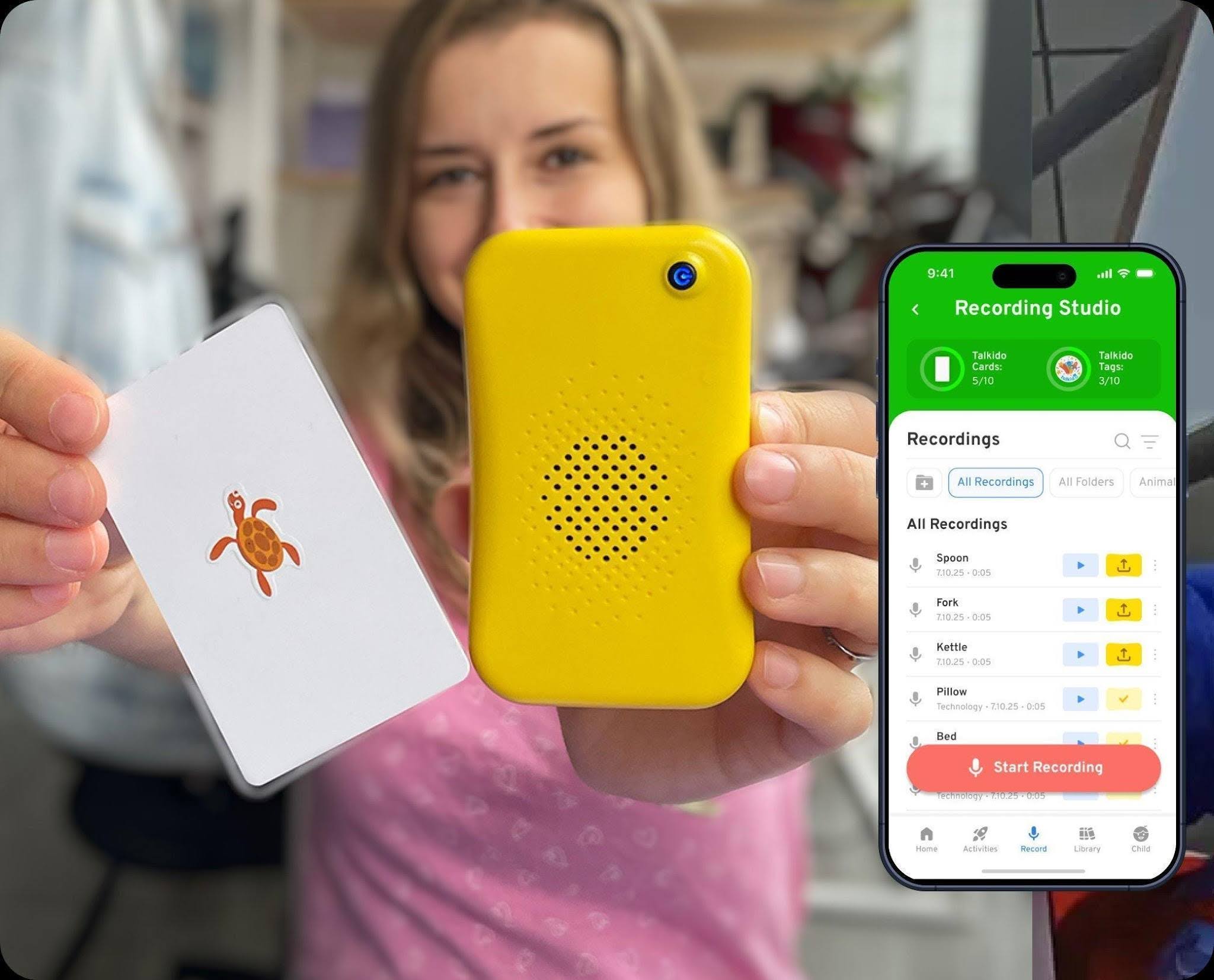
Figure 1: The Talkido system consists of the Mio speaker, physical flashcards with embedded tags, and a companion app that lets caregivers record audio and assign it to specific cards or tags. Tapping the Mio on a card plays the recording. Source: Talkido.
Cakaloz described the typical treatment arc as a fading protocol. The recording provides a consistent language model the child hears each time a given object is engaged. As the child begins to imitate the sound, the therapist or parent shortens the recording, changes it, or removes it altogether, prompting the child toward independent production. The tags then migrate to new objects as target vocabulary expands. For children on the higher-functioning end of the spectrum, the stated goal is that the device eventually becomes unnecessary.
“Our aim is not to make them addicted to the device,” Cakaloz said. “Our aim is to teach them how to communicate, and at the end they wouldn’t need Talkido at all.”
That positioning distinguishes Talkido from speech-generating devices like Proloquo2Go, TouchChat HD, or LAMP Words for Life, all designed for long-term use as a child’s primary communication mode. For children who will remain nonverbal long-term, traditional AAC software remains the appropriate intervention. Talkido’s addressable population is the one sitting between flashcards and full speech-generating devices.
What the Princeton Child Development Institute Case Study Showed
The most frequently cited outcomes data point in Talkido’s marketing is a 16x increase in communication initiations, documented in a case study run at the Princeton Child Development Institute (PCDI), a Princeton, New Jersey-based nonprofit founded in 1970 that is nationally recognized for its ABA research and intervention programs. The study used a baseline-versus-intervention comparison design across 21 teaching activities in a 1:1 classroom setting. During the four-week baseline phase, the subject’s rate of communication initiation with adults stayed near zero. After Talkido was introduced in week five, initiations climbed into the 20 to 45 percent range and remained elevated through week 11. The broader challenge of collecting and acting on outcomes data in behavioral health has been a persistent industry problem, which makes structured case studies like PCDI’s useful even at single-subject scale.
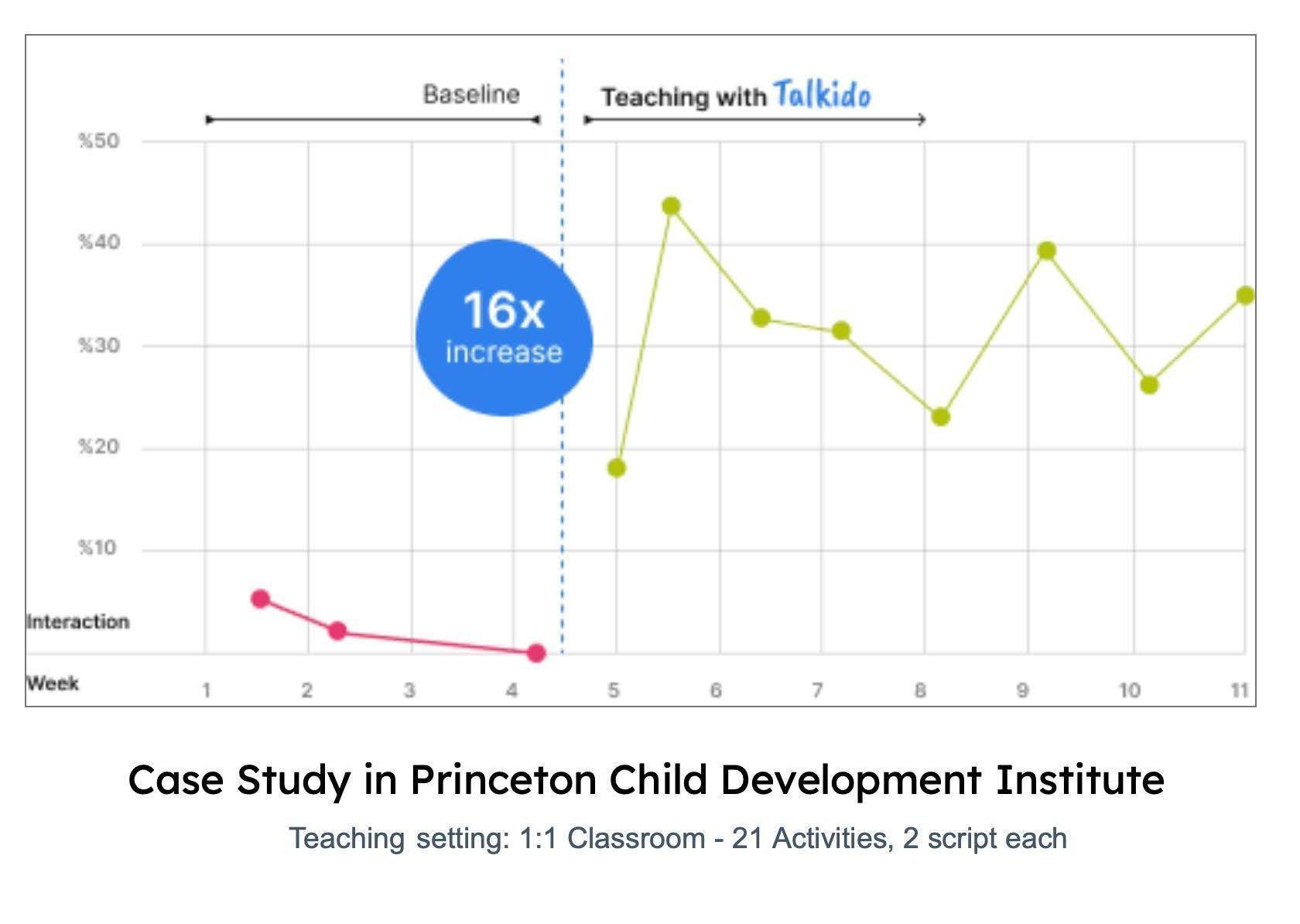
Figure 2: Princeton Child Development Institute case study. During the four-week baseline phase (left, pink), the subject’s rate of communication initiation with adults stayed near zero. After Talkido was introduced in week five (right, green), initiations climbed into the 20 to 45 percent range and remained elevated through week 11. The 16x headline figure is the ratio of average initiation rate during the intervention phase to average rate during baseline. Source: Talkido / PCDI case study.
The 16x figure is a single-subject baseline-versus-intervention comparison, not a randomized controlled trial, and Talkido’s founders present it that way. It is the kind of within-subject design that is standard in applied behavior analysis research and that appears throughout PCDI’s own published body of work on script-fading and joint attention interventions.
Other deployment sites have generated similar qualitative observations without comparable formal measurement. Northshore Education Consortium reported reductions in student echolalia and growth in vocabulary and social initiation. Speech-language pathologists at Denver Public Schools reported that students picked up the device faster than iPad-based AAC. Janine Kipp, Director of Speech Services at Eden II Programs, reported that Talkido was useful both for peer-to-peer reading activities and for vocational job-site prompting, with the auditory feedback helping to fade clinician verbal prompts. Those are testimonials rather than measured outcomes, and the founders are clear about the distinction.
Why the ESSA Tier IV Building Evidence Badge Matters for School District Buyers
In 2025, Talkido earned the ESSA Tier IV Building Evidence badge from Leanlab Education, a Kansas City-based research organization that partners with edtech companies to align their products with the Every Student Succeeds Act’s four tiers of evidence. Tier IV, the Building Evidence tier, requires a company to produce a logic model or theory of change grounded in existing research, and to have a study plan or research already underway to measure the product’s effects. Other companies that received the same designation in Leanlab’s 2025 cohort include Amplify, MagicSchool AI, Kyron Learning, and The ASSISTments Foundation.
For a school district weighing whether a given tool is eligible for federal funding under ESSA, the tier designation is a practical gate. Tier IV is the lowest of the four tiers and does not carry the weight of a Tier I randomized controlled trial, but it does provide a procurement-friendly marker that the product is not being sold on anecdote alone. In the FDA-regulated corner of autism technology, EarliPoint Health recently secured expanded clearance for its eye-tracking autism assessment up to age eight. On the school district side, ESSA tier designations play an analogous role: they are the credentials that move a tool from pilot to line-item budget.
Talkido’s Deployment Footprint Across ABA Centers, Public Schools, and Homes
Talkido reports use by more than 30,000 students globally, with current U.S. adoption spanning 60+ schools and 100+ families. The platform began as an academic research project in Turkey, where the founders tested early versions with 500 children across 50 educational centers over an 18-month period before turning the project into a company. The founders relocated to the United States three years ago and are based in Massachusetts, a state whose behavioral health procurement landscape has been unusually active lately. Acuity has covered the state’s own school-based mental health funding cliff arriving in June 2026, which is putting pressure on districts to evaluate lower-cost, evidence-aligned tools in the intervention stack.
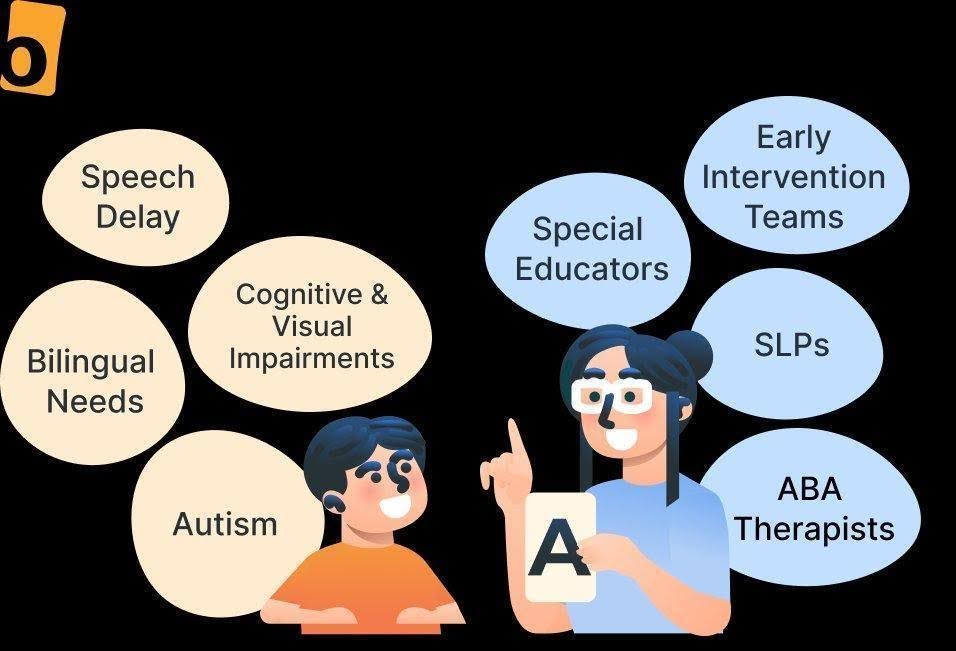
Figure 3: Target child populations (left) and clinician and educator categories using the platform (right). Source: Talkido.
Named clinical and educational deployment sites include Eden II Programs, the autism services organization founded in 1976 and serving the New York City region, where Director of Speech Services Janine Kipp has described use cases ranging from peer reading activities to vocational job-site prompting. Denver Public Schools speech-language pathologists have used the platform for WH-question work, sound production, and multilingual vocabulary expansion. Northshore Education Consortium, based in Massachusetts, has used it with students on the autism spectrum and with early childhood populations. Eureka City Schools in California and KPS4Parents have also been named as deployment sites. On the consumer side, the system is available on Amazon and direct through the company, with a starter set designed for home use.
Where Talkido Fits in the Broader ABA Technology and AAC Market
The ABA industry has been moving toward more rigorous technology adoption over the past several years, driven by both clinical demand and payer pressure. Acuity’s coverage of the 10 largest ABA providers reshaping autism care has tracked how those operators are differentiating on clinical quality and outcomes infrastructure, not just footprint. The tech and care models transforming autism and IDD in 2026 have trended the same direction, with AI, virtual reality, and decision-support tools all claiming share of the ABA workflow.
Talkido’s commercial position inside that landscape is as a point solution rather than a platform. It does not capture session data, integrate with practice management systems, or produce clinical documentation. What it does is fill a specific gap in the skill-acquisition toolkit: a low-friction, low-cognitive-load, screen-free language prompt that a BCBA, SLP, or parent can deploy in minutes without extensive training. The founders said the company is preparing to launch AI-assisted session-capture and language-tracking features on the Mio device in the coming weeks, which they characterize as augmenting the existing point-of-use workflow rather than expanding into adjacent categories like practice management or clinical documentation.
The near-term questions facing Talkido are the ones facing any early-stage behavioral health technology company. Acuity has reported that the most expensive mistake in behavioral health tech is buying before an organization is ready to absorb it, and the same dynamic applies to adjunct tools at the ABA center level. The ESSA Tier IV designation and the PCDI case study are the early artifacts of a company trying to answer procurement questions on the record, rather than through marketing copy alone.