
Notes from two days at the ABA C.A.R.E.S. Summit in Boston, where the workforce crisis got a ballroom, an agenda, and a fair amount of honesty.
By Ethan Webb
I stepped out of my apartment, tucked in the western edge of Boston, and got on a Green Line train to attend a conference down on the waterfront. The summer air smelt pure, the sun shining. I threw my “cool guy” shades on and set forth on an adventure.
I have worked for Acuity Media Network for almost a year now, and attending healthcare conferences is a rather “routine” aspect of the job, but one that I really enjoy. I like seeing new cities, flying out to interview people, sometimes with a camera crew in tow, and networking with strangers in venues I would never otherwise set foot in.
Conferences are always fun, but not always as “special” as this one was.
The ABA C.A.R.E.S. Summit ran for four days at the Boston Marriott Long Wharf, and the organizers had given Acuity a press pass. I arrived for the last two days. In a field full of clinical and political noise, the summit is built around one question that gets asked constantly, yet still does not get answered enough: Why does the autism therapy industry struggle to keep the people it hires?
Many Acuity readers will know that I have reported on this extensively. Turnover among behavior technicians runs high enough that some organizations replace their entire front line inside a year. Everyone in this field already knows that. What is unusual is a conference built end to end around it.
The program ran across four tracks: Executive, People Operations, Career Counseling, and Clinical Leadership. Unlike most other ABA conferences I’ve attended, there was not one session about treatment models or the underlying science. In our field guide to behavioral health conferences this spring, I called it the rare event that treats staffing as the central problem instead of a footnote. Having sat in the rooms, I would add that nobody there is short on theories. Most have cycled through several.
In a nutshell, ABA C.A.R.E.S. exists because Holli Beth Clauser spent 2016 running a training room and watching the hiring pipeline deliver people who could not picture what the job actually looked like. When I profiled her in July, she told me the first edition, at Lake Nona in 2023, came back with a phrase that stuck: attendees kept calling it an industry offsite rather than a conference. Three years on it fills a waterfront hotel in Boston in August.
Thursday, and the problem with four rooms at once
While every hour was packed with four different sessions to choose from, the keynote focused on empathetic leadership. Damona Hoffman is a communication strategist and a regular on Drew Barrymore’s show, which you would never guess from meeting her (none of that drab “Hollywood” ego is present). She joked onstage about her coffee dependency, and I confirmed it the next morning from two spots behind her in the Starbucks line. Her argument was that most of what companies call a personality conflict is really an expectation nobody bothered to write down.
Later, I took Alison Betz and Adam Hockman on workforce training, highlighting a case study of Little Leaves, acquired by LEARN Behavioral in May. They cut onboarding in half and retention improved, the reverse of what everyone assumes. Hockman’s candor highlighted what most might question: your Training Director probably should not be a behavior analyst.
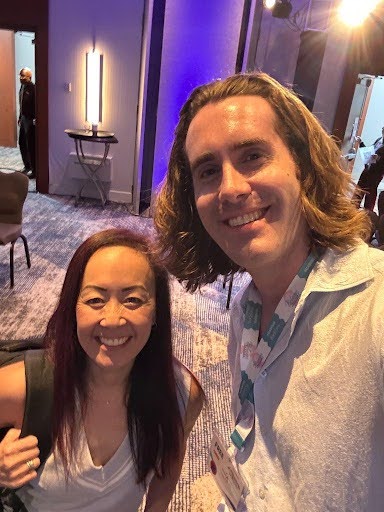
Dr. Ivy Chong, who ran clinical at Little Leaves through that project and has since moved to Autism Care Partners.
Next, five software vendors sat down together to explain how badly implemented technology pushes people out of the field: Silna, Office Puzzle, RMS ABA, Vivantium, and Boost, with Lexi Rand of Autism First moderating. Charlene Kurth of Office Puzzle offered a test I found very interesting: if one person is quietly holding your software together, that is not adoption. Jeffrey Morelli of Silna asked a harder question: how many minutes of paperwork prop up a single hour of care.
In the afternoon, Stephanie Bates got into the cold war between the clinical side of these companies and the business side, each convinced the other does not understand the work. Her line about silos—that we are not solving problems, we are moving problems—is the one I underlined.
Thursday night, on the water
After the conference ended, I walked back down to the harbor for a private reception hosted by Rami Paulus, who runs We Clean ABA, a janitorial company that works exclusively with behavioral health clinics. The reception was not part of the summit program. By my rough count, more than fifty people came: two hours out on the water with the sun going down over the city. (More on him in a bit.)
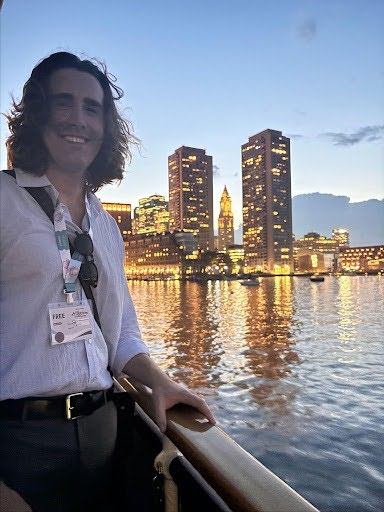
I spent a while out there talking about fraud and abuse, Medicaid rates, and a fair amount of nothing in particular, with the harbor going past.
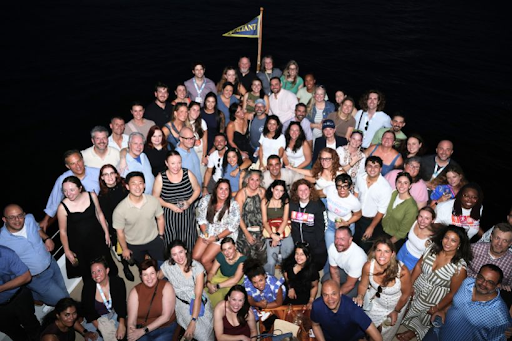
A group picture from the yacht. I’m in the top right corner, wearing the blue shirt with my shades dangling from the collar.
Friday, and an early exit
Friday included an ethics panel on artificial intelligence that produced three stories inside a single hour. Adam Ventura described something two private equity-backed clients asked him to build, and his team refused to hand over. Dr. Ellie Kazemi argued that AI has already crossed from tool to decision-maker. Shelby Dorsey, who emphasized that she is autistic and has ADHD, trained a model on her own speech to work around apraxia and aphasia, and went from never having presented to speaking around the country within a year. All three are coming.
Then a panel on how provider organizations and universities work together, the place where the pipeline for new clinicians actually begins. We have covered the BACB tightening its certification rules. What that room made clear is that the timeline is shorter and the reach is wider than most operators think. Of everything I carried out of Boston, this one feels like the only real policy piece, and I am excited to write it.
Meanwhile, Rami Paulus made his case to me over tacos. His argument is that a clinic’s environment either steadies the people working in it or becomes one more thing the staff have to manage, and that operators who treat the physical space as an afterthought are adding load to people already carrying plenty. Melissa Rigby, who owns Gateway ABA Therapy and had been on a staffing panel that morning, joined partway through and made the same case from the operator’s chair: disorder shows up in turnover before it ever shows up in clinical outcomes. What was scheduled as a conversation about cleaning contracts ran ninety minutes and turned into one about delegation, clinic culture, and who wipes down the bathroom between sessions.
And then I left. Paulus had a flight, the interview had been on both calendars for weeks, and neither of us wanted to move it. So, I missed Hot Ones, in which several well-known figures in the field took questions while working through progressively hostile chicken wings.
Ten recorded sessions came home with me, and plenty is still in the notebook. Fifty-one behavior analysts who could not reliably tell a chatbot’s clinical answers from an expert team’s. What the collapse of one AI vendor this spring should have taught operators about interrogating the next one.
The thread through all of it is a change in how this industry talks about its workforce. The old story was scarcity, a shortage of people willing to do the job. What I heard in Boston sounded more like a list of decisions about training, scheduling, software, supervision and, yes, cleaning, most of which could have gone differently. Our April reporting on recruitment versus retention made that case from the outside. This was several hundred people making it from the inside, out loud, in front of the operators who made the calls.