
Mississippi Medicaid ABA rates rose again December 1, 2025 under SPA 25-0003, the second increase in nine months. Two assessment codes have not moved since 2019.
Key Takeaways
- Eight of the ten codes rose on December 1, 2025, and the two oldest assessment codes did not move. Code 97153 went from $13.42 to $15.08 per 15-minute unit and 97155 from $21.19 to $24.35, increases of 12.4 and 14.9 percent, while 97151 and 97152 have held their 2019 rates.
- It was the second increase of 2025, not the first. Both 97153 and 97155 also moved on March 1, 2025, while the other six codes that rose in December had carried January 2023 rates until then. Mississippi is one of the few states repricing ABA twice in the same year.
- The rate action came through State Plan Amendment 25-0003, which DOM still lists among submissions to CMS. The Division of Medicaid published the amendment on December 30, 2025 after public notice under Section 43-13-116, and the accompanying rate table matches the December 1 fee schedule. Federal approval has not yet been posted.
- The same codes pay roughly five times more in an outpatient hospital setting. The April 2026 Comprehensive Fee Schedule prices 97153 at $70.49 and 97155 at $122.44 under the outpatient hospital rate table, against $15.08 and $24.35 professionally. Most ABA is delivered outside hospitals, so the professional tier drives access.
Mississippi Medicaid’s Applied Behavior Analysis rates changed on December 1, 2025, though the fee schedule providers are working from does not announce it. Eight of the ten codes on the July 2026 Autism Spectrum Disorder Services Fee Schedule show a begin date of December 1, 2025, and the professional rates on those eight sit above where they stood in the spring. Code 97153, the workhorse of technician-delivered treatment, moved from $13.42 to $15.08 per 15-minute unit. Code 97155, the analyst code for protocol modification, moved from $21.19 to $24.35. Two codes did not move at all: 97151, the analyst assessment, and 97152, its technician-delivered supporting assessment, both still price at rates the state set in 2019.
The increase traces to State Plan Amendment 25-0003, posted on December 30, 2025 with a December 1 effective date contingent on federal approval. DOM published a second notice when CMS signed off on that year’s prior amendment, but SPA 25-0003 remains in the queue of submissions the agency still lists. That leaves providers billing at the new rates while the paper trail continues to catch up.
What Mississippi Medicaid Pays for ABA in 2026
All ten codes are priced per 15-minute unit and limited to beneficiaries from birth through age 20. Every code except 97151 requires prior authorization. In hourly terms, technician-delivered treatment now runs at $60.32, analyst-directed protocol modification at $97.40, family adaptive behavior guidance without the patient present at $124.24, and the corresponding code with the patient present at $95.16. The current schedule shows begin dates that split the codes into three vintages: eight at December 1, 2025, one at March 1, 2025 (97155 shares that date), and two at July 1, 2019 (97151 and 97152).
The distribution matters as much as the range. The smallest increase of the eight went to 97153, the code covering direct one-to-one therapy hours, at 12.4 percent. The largest went to the group and telephone-supported family codes at 30 to 37 percent. Between them, the individual family adaptive behavior codes rose 20 percent and 17 percent respectively.
December was also the second increase of the year. On the schedule in force in July 2025, 97153 and 97155 carried a begin date of March 1, 2025, while the six other codes that rose in December still carried a January 1, 2023 begin date. That first move raised 97153 to $13.42 from $11.90 and 97155 to $21.19 from $18.02, increases of 12.8 and 17.6 percent respectively. So in the space of nine months Mississippi moved 97153 from $11.90 to $15.08 (up 26.7 percent) and 97155 from $18.02 to $24.35 (up 35.1 percent).
Two structural points sit alongside the numbers. Maximum units run on the Medicaid National Correct Coding Initiative medically unlikely edit rather than state-set caps; an April 5, 2022 print of the fee schedule made that explicit, and the July 2026 version continues to omit posted maximums for the treatment codes. And several codes carry billing modifiers, including HN, HO, HP, and TS for tiered reimbursement on adaptive behavior treatment codes, plus 95 for interactive telecommunications. That structure gives Mississippi a lever to fine-tune reimbursement by delivery mode and provider level without changing the top-line rate, though it also lands as concurrent-billing pressure similar to what Acuity has reported as restrictions on concurrent billing have spread through neighboring states.
One oddity survives from 2019: 97152, the technician-delivered supporting assessment, pays more than 97151, the assessment it supports. The benefit itself runs through Early and Periodic Screening, Diagnostic, and Treatment. There is no adult ABA line on the fee schedule, and the Section 1915(i) Intellectual and Developmental Disabilities Community Support Program that serves adults does not include ABA codes among its 20 covered services.
The Outpatient Hospital Tier the Autism Schedule Does Not Show
The standalone autism schedule publishes one rate per code. The April 2026 Comprehensive Fee Schedule publishes two for most of them. Alongside the professional rate for each of the eight 97-series codes sits an outpatient hospital rate that DOM calculates from an Outpatient Prospective Payment System weight, so the same 15-minute unit of 97153 that pays $15.08 professionally pays $70.49 in an outpatient hospital setting, and 97155 pays $122.44 against $24.35 professionally. Family adaptive behavior guidance under 97156 pays $22.70 in the hospital tier and $24.35 professionally, one of the few codes where the hospital rate sits below the professional rate.
Against the professional rates that is a 4.7 times differential on 97153 and 5.0 times on 97155. The direction reverses on one code: 97156 pays $24.35 professionally against $22.70 in the hospital tier. Whether a Mississippi child receives service at a hospital rate depends on the credential and setting of the billing provider, not on the child’s clinical need. In practice most ABA reaches families through center-based, home, and community delivery under the professional schedule, so the hospital rates function as an administrative ceiling more than a routine reimbursement.
Mississippi ABA Licensure Runs Through a Dedicated Autism Board
Mississippi routes behavior analyst licensure through a board created for that purpose. The Mississippi Autism Board was established by the Legislature in 2015 under Miss. Code Ann. Section 73-75-1 et seq. and administers three credentials: Licensed Behavior Analyst, Licensed Assistant Behavior Analyst, and Registered Behavior Technician. The Board sits within the state’s occupational licensing structure and enforces its own scope-of-practice, continuing education, and supervision requirements alongside the Behavior Analyst Certification Board credentials that most licensees already hold.
A Licensed Behavior Analyst needs a master’s degree from a program approved by the Behavior Analyst Certification Board, current Board Certified Behavior Analyst certification, and passage of an oral examination administered by the state Board. Continuing education runs 32 hours every two years for LBAs and 20 for LABAs, including four hours of ethics and, for supervisors, three hours of supervision content. Renewals are annual and carry a $200 fee for LBAs and $125 for LABAs. Assistant behavior analysts must practice under a fully licensed LBA and are limited by rule from taking on independent case authority.
Technicians are registered rather than licensed, and the obligation runs to the supervisor. The supervising licensee files the application and must verify that the applicant is at least 18, holds a high school diploma or the equivalent, has completed a 40-hour training program and a competency assessment aligned with BACB standards, has cleared a criminal background check, and carries no history of Board discipline. Registration renews annually at $50 and requires proof of BACB Registered Behavior Technician certification, which itself was disrupted this summer when the certifying body’s stalled technician renewals after its June launch. The layering of state registration on top of national certification means a lapse in either can pull a technician offline, and every registered technician is billed under a specific supervisor whose license is on the line for the compliance of the person delivering care.
Mississippi ABA Rates in Regional Context
Against its Southeastern neighbors, Mississippi sits mid-band on both benchmark codes, and the two 2025 increases are what put it there.
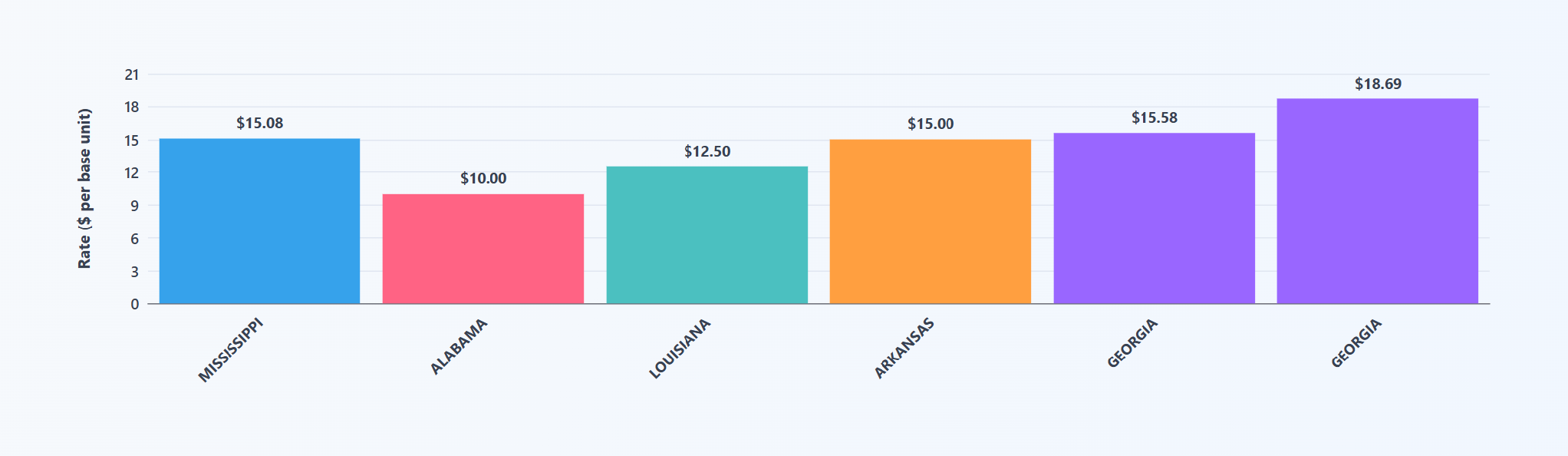
State Rate Comparison: Medicaid ABA Reimbursement, CPT 97153 (Adaptive Behavior Treatment by Protocol), per 15-minute unit. Source: MediRate. Georgia’s fee schedule differentiates by delivery setting; both values shown.
On 97153, Mississippi’s $15.08 ranks fourth of the six published rates, above Alabama’s $10.00 regional floor and Louisiana’s $12.50, eight cents above Arkansas, and below Georgia’s $15.58 in-clinic and $17.14 in-home. Floor to ceiling on that code across the six states runs about 71 percent.
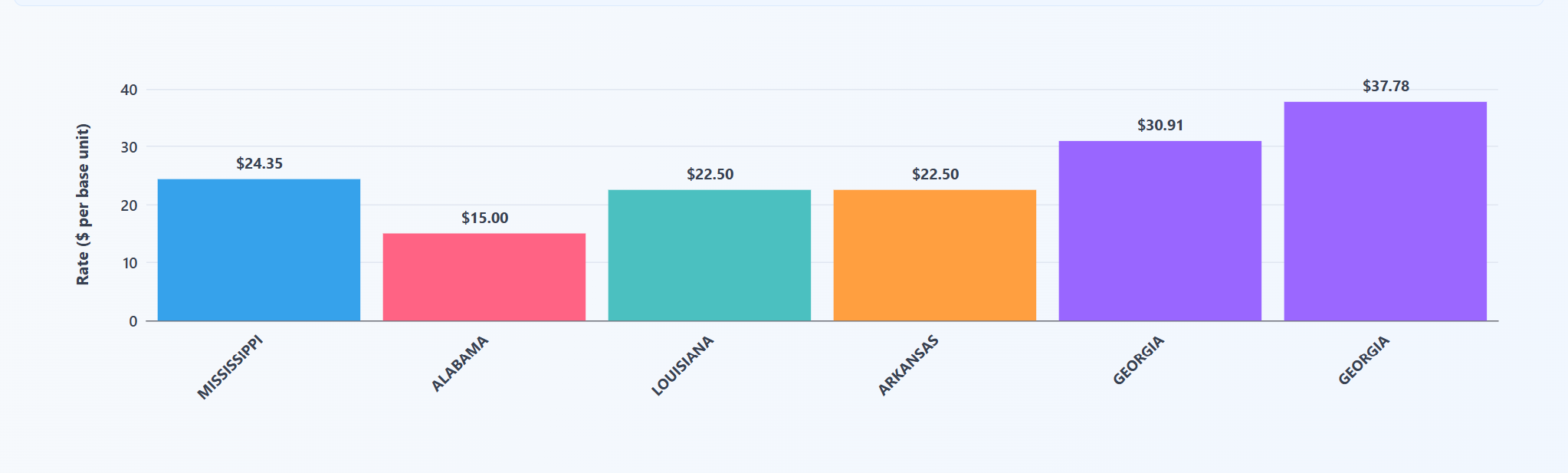
State Rate Comparison: Medicaid ABA Reimbursement, CPT 97155 (Adaptive Behavior Treatment with Protocol Modification), per 15-minute unit. Source: MediRate. Georgia’s fee schedule differentiates by delivery setting; both values shown.
The 97155 spread is wider. Mississippi’s $24.35 again ranks fourth, above Alabama at $15.00 and Louisiana and Arkansas at $22.50 each, below Georgia at $30.91 and $37.78. Floor to ceiling on that code across the six states runs above 150 percent.
One caveat applies to every bar in this series. MediRate builds these comparisons from published state fee schedules only, so they show what a state posts rather than what a managed care plan pays. Georgia is the clearest illustration: the posted schedule sits at the top of the region, but CareSource cut Medicaid ABA rates by 20 percent earlier this year during an MCO transition, so what providers actually collect can be well below what the schedule advertises.
What Mississippi ABA Providers Should Watch
Federal approval of SPA 25-0003. The rates are in production and no approval notice is on the public record. Whether DOM posts one is the cleanest available signal on whether the December structure is settled or provisional.
Whether the cadence holds. Two increases in nine months is a pattern, not an event. A third action in 2026 would make Mississippi one of the more active repricing states in the region.
Clarification of the two rate tiers. A gap between $15.08 and $70.49 on the same code is large enough to shape where services get delivered.
Regional diagnostic gatekeeping. Alabama narrowed ABA-qualifying diagnoses to licensed psychologists, psychiatrists, and pediatricians in May. Arkansas has long required agreement among at least two of a psychologist, psychiatrist, developmental-behavioral pediatrician, or neurologist. Mississippi has not moved in that direction, but if it did, it would compress the referral funnel.
Mississippi raised rates twice in 2025 while much of the country was cutting. Federal audits have exposed widespread billing failures across the ABA industry, South Carolina’s Medicaid request faces a proposed $27.5 million reduction from the state’s executive budget, and North Carolina is rewriting its ABA coverage policy. Mississippi’s posture is the exception, and whether it holds through 2026 is the question that sits underneath every rate line on the current schedule.
Frequently Asked Questions
What does Mississippi Medicaid pay for ABA in 2026?
The autism fee schedule pays $15.08 per 15-minute unit for 97153 and $24.35 for 97155, or $60.32 and $97.40 an hour. Assessment pays $34.18 for 97151 and $50.99 for 97152, unchanged since 2019. The Comprehensive Fee Schedule publishes higher outpatient hospital rates for most codes, including $70.49 for 97153 and $122.44 for 97155.
When did Mississippi Medicaid ABA rates last change?
Eight of the ten codes changed effective December 1, 2025 under State Plan Amendment 25-0003, with increases from 12.4 to 37.1 percent. Codes 97153 and 97155 also moved earlier that year on March 1, 2025. Codes 97151 and 97152 have not changed since July 1, 2019.
Does Mississippi Medicaid require prior authorization for ABA?
Yes, for every code except 97151. DOM no longer keeps authorization flags on the fee schedules and instead publishes a separate procedure code list, but the underlying rule stands: all ABA treatment codes and 97152 require prior authorization, with 97151 as the sole exception.
Does Mississippi Medicaid cover ABA for adults?
No. Every line caps at age 20 because the benefit runs through EPSDT. The state’s 1915(i) Intellectual and Developmental Disabilities Community Support Program that serves adults does not include ABA codes among its 20 covered services.