
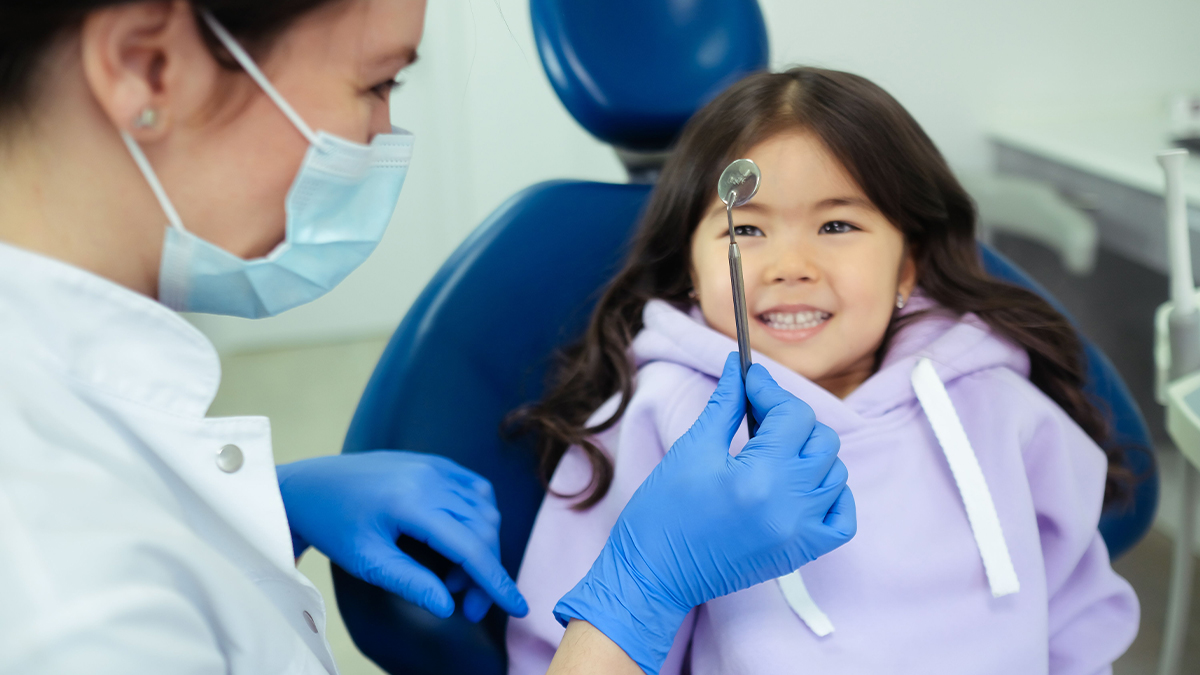
Autism New Jersey and the New Jersey Dental Foundation are building a statewide autism-friendly dental initiative. Sedation and desensitization are in play.
By Ethan Webb
Key Takeaways
- A statewide autism-friendly dental initiative is taking shape: Autism New Jersey and the New Jersey Dental Foundation have surveyed dentists and convened an advisory group of 11.
- The 1999 sedation mandate fails in implementation, not on paper: Families covered by it still hit prior authorization, paper approvals, and scarce operating room time.
- Behavior analysts already run dental desensitization, but no one funds coordination: Providers and schools use donated chairs to build tolerance, then bill separately.
- The blueprint comes from law enforcement: Autism New Jersey’s 2024 Law Enforcement Initiative produced an advisory committee, a publication, and forums, and dentistry is next.
Stacie Sherman has two children on the autism spectrum. The youngest, Brielle, is 24. She is profoundly autistic, nonverbal, and needs full support with daily living skills, brushing her teeth among them. “She has learned the sequence of the task, but not the purpose, so she needs hands-on assistance,” Sherman told Acuity.
The record of dental encounters goes back to Brielle’s childhood. “Over the years, we’ve had both wonderful and very difficult dental encounters,” she said. “One traumatic experience can have lasting effects. There were times when several staff members and I had to hold her down for even a brief exam. There was another time when a dentist wrapped her body like a mummy so he could examine her.”
Brielle’s current dentist is kind and gentle, and can look in her mouth without reinforcements. When she needs more extensive work, he arranges it under sedation in a hospital outpatient setting. He is more than an hour away. The hospital is another half hour past him. “Parents will drive any amount of distance for a provider who understands their child’s needs,” Sherman said.
Sherman spoke to Acuity as Autism New Jersey’s Communications Director, a position she left this month. She is one of four people at the organization Acuity interviewed for this story, along with Suzanne Buchanan, Psy.D., BCBA-D, LBA, the Executive Director; Darren Blough, MSW, BCaBA, LaBA, the Director of Public Policy and Clinical Partnerships; and Jon Gottlieb, Esq., the Helpline and Family Advocacy Director. Acuity also interviewed two New Jersey dentists, Daniel Di Cesare, DMD, and Poonam Gat, DDS, BDS, whose practices sit at opposite ends of the same problem. What all of them described is an attempt to turn a scattering of willing dentists into something that works like a system.
How Autism New Jersey’s Advancing Healthcare Initiative Grew Out of an Autism-Friendly Vaccine Clinic
Buchanan describes herself as a psychologist and behavior analyst turned registered lobbyist. She led the advocacy behind New Jersey’s Applied Behavior Analyst Licensing Act, signed in January 2020, which created the state board that now licenses behavior analysts. The field was smaller then. It was before private equity acquired hundreds of ABA sites in a decade, and Buchanan told Acuity that the scope of the industry today can feel overwhelming for a nonprofit of roughly 20 people.
Autism New Jersey never planned to work in healthcare proper. It advocated for insurance coverage, Medicaid, licensure, and the other things the autism community needed, and it left medicine to people with medical credentials. Then the pandemic arrived, and the Visiting Nurse Association of Central New Jersey asked whether Autism New Jersey wanted to partner on an autism-friendly vaccine clinic.
Between January and June of 2021, the partnership vaccinated more than 400 adults with autism. Some of it took nothing more than common sense and basic courtesy. Some of it took extensive planning sessions with the nurse, the parents, the individual, and the treatment team. There were vaccinations administered in cars. What Buchanan remembers is not the shots. It is what families told her once they were in the room: that a vaccine was the easy part, and that the unmet medical needs behind it went on and on.
Federal money was moving through the states at the time. Autism New Jersey’s partners at the New Jersey Department of Health asked what the organization could do with more of it. Buchanan is precise about the mechanics: the organization received state funding made possible by federal American Rescue Plan Act dollars. It hired a behavior analyst who had worked at a major urban hospital in Philadelphia, and in 2022 it launched the Advancing Healthcare Initiative, with the explicit goal of helping healthcare providers adopt autism-friendly practices.
What followed is the infrastructure the dental work now sits on. A Healthcare Consortium of clinical and provider leaders, convened in July 2023, meeting every other month. An ongoing Healthcare Experiences Survey, in which, on results the organization published in 2023, families and autistic adults rated their healthcare interactions an average of 4 out of 10. A medical equipment lending library that put exam tables and dental chairs into schools and group homes so people with autism could practice. And a self-assessment tool that lets a healthcare setting evaluate how autism-friendly it actually is.
Why Dental Care Is the Access Gap Autism New Jersey Chose to Attack First
The organization could have picked almost anything. Buchanan rattles off the specialties where the same access gap exists: gastroenterology, radiology, oncology, emergency departments, internal medicine. Callers to the helpline routinely need a specialist and are handed one or two referrals, or none within an hour and a half of where they live.
Dental won partly on the strength of the relationship. “The New Jersey Dental Association prioritizes addressing healthcare disparities, and individual dentists are active collaborators,” Buchanan told Acuity. Some relationships stick and some roll away, she said, and the arithmetic explains why. The autism community is the whole of Autism New Jersey’s work. For most healthcare providers, by her estimate, it is 1 to 3 percent of their patients.
It also won on the clinical logic. “Dentists are one of the doctors you should see regularly,” Buchanan said. “Dental issues with the autistic population are common because of sensory, communication, and behavioral difficulties.”
The research supports the premise. Dental care has long been the most frequently cited unmet healthcare need among children with special healthcare needs, and studies going back two decades have found that autistic children are less likely than their peers to have seen a dentist in the past year, with the child’s behavior, cost, and a shortage of trained providers cited as the leading barriers. The training gap is documented on the provider side as well. The National Council on Disability reported in 2017 that three quarters of dental students had little or no preparation in caring for patients with intellectual and developmental disabilities, a finding that prompted the Commission on Dental Accreditation to require, effective July 2020, that predoctoral programs train students to manage the care of patients with special needs.
The numbers in New Jersey are among the highest in the country. The Centers for Disease Control and Prevention’s most recent surveillance data, drawn from 2022 and published in 2025, put autism prevalence among 8-year-olds at 1 in 31 nationally and 1 in 29 in New Jersey, among the highest rates in the network. Because the network reports on roughly a two-year lag, those remain the most recent federal figures available. Autism New Jersey’s own analysis of census and CDC figures counts more than 242,000 New Jerseyans on the spectrum, including some 64,000 with profound autism.
Autism-Friendly Dental Practices: A Self-Assessment Tool, Not a Dental Accreditation
The tool Autism New Jersey is adapting for dentistry is not a credential, and Buchanan wants that understood. “We defer accreditation to the national organizations that specialize in developing and administering those standards,” she told Acuity. “We prefer our role as a partner and advisor.”
What a dentist-specific version would ask a practice to examine is narrower and more practical than a standard. “We’re asking dentists to evaluate their own and their team’s knowledge and skills; sensory, communication, and behavior accommodations; environmental modifications; and their overall culture and willingness to engage in quality improvement efforts to address their patients’ needs,” Buchanan said.
The list reads as procedural until it is held against Sherman’s account. Bright overhead lighting. A small room. A tray of pointed instruments. A staff that has never been told what a meltdown in the chair looks like. Those items fall under environmental modifications and team knowledge, and they are also, in Sherman’s experience, what separates an examination from a restraint.
That is roughly the reception the idea gets from the other side of the chair. Daniel Di Cesare, DMD, graduated from what is now Rutgers School of Dental Medicine in 1998, served on the New Jersey State Board of Dentistry, owns a multi-location practice, and founded the New Jersey Dental Network, one of the largest online communities for dental professionals in the state. He told Acuity he prefers what Autism New Jersey is building to the alternative. He has also advised Autism New Jersey on the dental work, though he said he was not certain whether he is formally among the 11 advisory group dentists.
“I actually like the idea of a self-assessment more than another certification,” Di Cesare said. “The goal should be continuous improvement rather than checking a box.”
What he would want it to measure is longer than Buchanan’s list and more operational: staff education and confidence, communication with parents or caregivers before the visit, scheduling flexibility, sensory accommodations in the office, behavioral guidance techniques, emergency and safety protocols, and follow-up after the appointment.
The condition he attaches is the one that determines whether a practice ever opens the tool a second time. “Most importantly, it should provide actionable recommendations,” he said. “If a practice identifies a weakness, the tool should offer realistic steps to improve rather than simply assigning a score.” It is the same objection behavior analysts have been raising about outcome measurement in their own field, where ABA has struggled to agree on what a single score can capture.
Inside the Autism New Jersey and New Jersey Dental Foundation Survey and Dental Advisory Group
Blough came to Autism New Jersey two years ago after three decades running residential and day programs for adults and children with intellectual and developmental disabilities. Blough and Gottlieb oversee the organization’s work on the joint dental initiative, which launched a survey with the New Jersey Dental Foundation this spring. The New Jersey Dental Association (NJDA) supported the initiative by promoting the survey to its members, encouraging participation, and helping connect the partnership with dentists from across the state. The questions are aimed at both ends of the field.
“We want to hear from the dentists who are already comfortable treating autistic patients,” Blough told Acuity. “How often is this happening? What training and education helped them get to where they are, and what autism-friendly practices do they use? We also want to hear from dentists who maybe aren’t there yet. What do they think would be useful in increasing their comfort level and ability to serve this community?”
The premise is that the good practices already exist and are simply unmapped. “We know that families of autistic children often wait to take their child to the dentist, if they take them at all, because of how traumatizing it can be,” Blough said. “We also know that there are dentists who have a real passion for meeting the needs of autistic patients.”
A first call for interest in an advisory group drew 11 dentists from across the state, without recruitment. Blough told Acuity the response surprised him. It also, he said, describes the working relationship the initiative needs.
“We bring expertise in autism, while the dentists bring their clinical expertise,” he said. “Our role is to help define the barriers people with autism experience in accessing oral healthcare, and their role is to ensure that any guidance we develop is practical, evidence-informed, and works in real-world dental settings.”
The Foundation’s Chair describes its role as the connective tissue between those two kinds of expertise. Mario Ramos, DMD, a Board Certified Pediatric Dentist in Midland Park whose practice treats children with special healthcare needs, said the Foundation joined the initiative to help turn what dentists and patients report into practical resources that improve access to autism-friendly oral healthcare.
“The early survey responses show that many dentists are already treating patients with autism and making meaningful accommodations, but they also need practical tools, additional training, and support that reflects the realities of dental practices,” Ramos said. “By pairing Autism New Jersey’s expertise with the experience of dental professionals, we can help turn individual efforts into a more consistent and sustainable system of care for patients with autism and their families.”
The Association sits behind that arrangement rather than inside it. Reva Brennan, Chief Executive Officer of NJDA, said the structure lets the Association support the Foundation’s public health work while keeping the profession represented in it.
“The New Jersey Dental Foundation was established with NJDA’s support to advance oral health and pursue initiatives that benefit both the public and the profession,” Brennan said. “This project demonstrates the value of that relationship. NJDA was able to provide staff support, engage dentists across the state, and help ensure that the experiences of dental professionals informed the Foundation’s partnership with Autism New Jersey.”
What Blough wants the advisory group to become is not a review committee. “Ideally, it becomes a community of champions where dentists are learning from other dentists,” Blough said. “Peer-to-peer influence is incredibly powerful, so if we can connect practices that have developed effective approaches with those looking to improve, Autism New Jersey can be the catalyst to accelerate that change.”
The 11 include both solo practitioners and dentists affiliated with larger, multi-site organizations, a mix Blough considers strategically useful rather than incidental. “Individual practitioners help us understand the realities of smaller practices, while larger organizations offer insight into how autism-friendly practices can be implemented consistently across multiple locations,” he told Acuity. “If we can identify approaches that work in both environments, we’ll have a model that is much more scalable.” The logic will be familiar to anyone watching consolidation in autism services, where researchers counted 574 private-equity-acquired autism service sites across 42 states in a single decade, and where the same paper names dental practices among the comparable roll-up markets. Whatever the advisory group produces, the multi-site groups are the ones equipped to install it in every location at once.
Di Cesare, who operates across several locations, thinks the mix is the right instinct, and he is blunt about what decides whether guidance survives contact with a schedule.
“A successful standard has to be practical, repeatable, and simple enough that every member of the dental team can implement it consistently, regardless of the size of the practice,” he told Acuity. “It starts with leadership, but it succeeds through systems.”
In an office, that means standardized protocols for scheduling, patient intake, communication with families, and clinical accommodations, with everyone in the building knowing their part. “The entire team, from the person answering the phone to the hygienist, assistant, and dentist, needs to understand their role,” Di Cesare said. “If a protocol is too complicated or only works when one passionate provider is present, it won’t be sustainable.”
That is the failure mode Autism New Jersey describes from the outside, stated from inside a practice.
He also draws a line the advisory group will have to draw somewhere. “An important part of those protocols is performing both a clinical and behavioral assessment to determine whether a patient can be safely and successfully treated in the office or whether treatment in a hospital setting is more appropriate,” he said. “Knowing when to refer a patient for hospital-based care is just as important as knowing how to provide accommodations within the practice.”
Asked whether autism-friendly accommodation is fundamentally a training problem, a scheduling problem, or a reimbursement problem, Di Cesare said it is all three, then ranked them. “If I had to rank them, I’d start with education and training,” he said. “Many dentists genuinely want to help but simply haven’t been taught how to care for patients with autism. Dental schools provide limited exposure, and many graduates feel uncomfortable because they lack experience rather than willingness.”
He serves on the advisory committee for a new dental hygiene program that is working to build special needs rotations into the curriculum, on the theory that the discomfort is cheaper to fix during training than after it. Scheduling ranks second: some patients do better with longer appointments, quieter hours, or several short visits that build familiarity before anything clinical happens.
Reimbursement ranks third, and he is deliberate about how much weight he puts on it. “Reimbursement certainly plays a role because these appointments often require additional time and resources,” Di Cesare said. “But I don’t think reimbursement should be the barrier that prevents practices from taking the first step.” The complaint is familiar in behavioral health, where some state Medicaid programs have left ABA fee schedules frozen for years while raising pay for other provider types.
The end state he describes is the one Blough wants, reached from the other direction. “The goal is to build a culture where autism-friendly care becomes part of the practice’s normal workflow rather than something that’s done only for certain patients,” he said.
Sedation Dentistry Coverage, Failed-Visit Requirements, and the Prior Authorization Maze
Gottlieb ran his own special education and disability rights firm before joining Autism New Jersey almost six years ago. He is a non-practicing attorney now, and he leads the 800.4.AUTISM helpline. Dental is not among the most common call topics. It is among the most severe.
“We also hear from families whose children have gone months or even years without dental care,” Gottlieb told Acuity. “They may have had negative experiences in the past, like a meltdown in the dental chair or experiences ranging from extreme anxiety to outright refusal. Years of limited dental access means that these individuals have cavities, infections, and pain, and their families are now desperate to find a dentist that can help.”
Buchanan offered Acuity one case from a family the organization has known for years: a 14-year-old who had not seen a dentist since he was three. The visit that finally happened took multiple planning meetings. The parents, she noted, are caring, intelligent, resourceful, and have every advantage.
An 11-year gap like that is not a lapse in parenting. It is what a decade of triage produces when every dental visit carries a real risk of trauma, when the office willing to take the case is an hour away, when the appointment requires planning meetings before anyone picks up an instrument, and when the same family is also managing school placements, therapy hours, medical appointments, and a child who cannot say where it hurts. Dental care has been the most frequently cited unmet health need among children with special healthcare needs for years, and the barriers families name in that research are the ones Autism New Jersey hears on the helpline: the child’s behavior, the cost, and the shortage of dentists prepared to treat them. Something gets postponed in a week like that, and it is usually the thing with no immediate consequence.
The second thing helpline callers ask about is sedation. It runs from the twilight of nitrous oxide up to general anesthesia, and for some autistic patients, general anesthesia is the only way any dental care happens at all. Few dentists offer it. “Coverage can be especially confusing due to the need for an anesthesiologist, coding requirements, and specific criteria for approval,” Gottlieb said. “Some insurance carriers require a set number of failed visits before they will pay for general anesthesia. In some cases, families have already completed a procedure and are then faced with unexpected bills on the order of thousands or tens of thousands of dollars when their sedation was not covered.”
Blough described the same barrier in the language of utilization management. “Some insurers require prior authorizations and supporting records, while others may have policies that require evidence that less restrictive approaches are unlikely to be successful or safe,” he told Acuity. “These issues result in delays in access to dental care for autistic patients.”
That framing matters, because the underlying mandate in New Jersey is not missing. Since 1999, state law has required group health insurance policies to cover general anesthesia and hospitalization for dental services for any covered person who is severely disabled, or who is five years old or younger. The same statute expressly permits plans to require prior authorization for that hospitalization on the same terms they apply to other conditions, and it reaches only state-regulated plans, leaving self-funded employer coverage governed by ERISA outside it. On the Medicaid side, managed care plans such as Horizon NJ Health require prior authorization for any member with special healthcare needs whose dentist determines that services should happen in an operating room or ambulatory surgical center. The mandate exists. The gate is medical necessity review, and that is the same gate behavioral health has been arguing at elsewhere: prior authorization is the single largest administrative pressure point in the field, and federal parity enforcement was paused in 2025, reverting private plans to the narrower 2013 standards and easing the pressure on payers to justify utilization management.
Autism New Jersey has not yet decided whether to take the issue on as a legislative matter. “We’re still doing our due diligence to determine if this is a policy issue or an implementation one and how to best remove systemic barriers to care,” Blough said.
Gottlieb is specific about the one change he wants, and notably reluctant to claim much more than that is broken. “The only clear-cut issue I see is to eliminate failed visit requirements before covering sedation,” he told Acuity. “For families who know their child will engage in severe challenging behavior during a dental visit, requiring a certain number of failed visits does little more than inflict unnecessary trauma on everyone involved and lay the foundation for greater medical and dental avoidance in the future.”
Poonam Gat sees that requirement from the other side of the authorization form. She is a general dentist who has treated pediatric and special needs patients for more than a decade, and she practices at Children’s Dental Care in Union City, a practice of three pediatric dentists, an orthodontist, and three general dentists that treats hundreds of patients with special needs. She holds hospital privileges at Newark Beth Israel Medical Center, where she is Division Director of Operating Room Dentistry, and at Englewood Hospital. She takes referrals from Rutgers because of the statewide backlog, and volunteers her time teaching and supervising residents who provide hospital-based dental care under general anesthesia.
Her experience does not match the pattern Gottlieb describes, at least not on the Medicaid side. “In our experience, Medicaid generally approves general anesthesia without requiring failed conventional treatment attempts when the patient has special healthcare needs and the medical necessity is well documented,” Gat told Acuity. Her office still tries the operatory first where that is appropriate. The decision to move to sedation rests on the child’s age, behavior, level of cooperation, treatment needs, medical conditions, and overall safety, all of it documented to support medical necessity.
The delay she describes sits in the machinery around the approval rather than in the standard itself. After the consultation, the provider documents medical necessity, writes the clinical notes, obtains consent, and submits insurer-specific preauthorization requests. Some carriers make that quick and some do not. “While Horizon and United Healthcare have efficient electronic authorization processes, traditional Straight Medicaid/DXC (formerly Molina) in NJ still relies on paper-based submissions and mailed approvals, leading to delays and administrative burden,” Gat said.
Then the family has to produce medical clearance and a history and physical from the child’s physician or specialists, which routinely takes several rounds of follow-up and is, in Gat’s account, a frequent cause of postponed hospital procedures. Once everything is in hand, her office coordinates with the hospital and with the anesthesiologists and medical specialists a complex case requires.
What happens next is the part that quietly determines how many of these cases a practice can afford to take. Last-minute cancellations are common, from illness or from a child who ate before anesthesia, and a canceled case cannot be backfilled on short notice, because the replacement patient has to clear the same authorization gauntlet from the beginning. “Providers receive no reimbursement for these cancellations and may lose valuable hospital block time despite maintaining a waiting list,” Gat said. The waiting list does not help. The operating room time is simply gone.
Beyond the sedation question, Gottlieb does not see dental access falling through a legal crack. “Instead, I see this primarily as an information and access issue,” Gottlieb said. “Dentists may not know what autism is or, when they do, they may not have access to training in autism-friendly dental care. Families struggle to find a good dentist and, even when they can, they may not be able to navigate the maze of insurance coverage.”
Autism New Jersey’s own referral database lists more than 70 dentists in the state, sedation providers among them, and it tells a family how far each one is from them. What it cannot tell them is which of those dentists accept their insurance, which hold hospital privileges, and which are taking new patients. Against the organization’s own count of more than 242,000 New Jerseyans on the spectrum, 70 dentists works out to roughly one for every 3,400 of them, and one for every 900 of the estimated 64,000 with profound autism, before any of those three filters is applied.
The family side of the same problem is being collected separately. Gat told Acuity that she and colleagues have built a website, Supportspecialneeds.org, where parents and caregivers can describe the barriers they hit in medical and dental care, with the intention of turning those accounts into survey data and presenting it to state and local representatives. The site is new and has produced no findings yet. The premise behind it is the one behind Autism New Jersey’s survey of dentists: what happens in these appointments is documented in individual offices and individual households, and almost nowhere else.
Gottlieb also passed along to Acuity a line a family gave the helpline. “Caring for my child’s dental needs is so much more than twice-daily brushing and going to the dentist every six months,” the parent said. “It’s a major undertaking that puts our family under emotional stress and financial pressure, but we do it because what choice do we have?”
How Behavior Analysts Prepare Autistic Patients for the Dentist, and Why Payers Fund the Pieces but Not the Coordination
For all that the two fields have in common, ABA and dentistry have had almost nothing to do with each other. Buchanan told Acuity she is aware of exactly one dentist in New Jersey who is also a Board Certified Behavior Analyst. Asked on the call how much literature, research, and awareness exists at the intersection of ABA and dental care, she answered in three words. Not a lot.
The evidence base is not empty. Behavior analysts have published on graduated exposure and reinforcement protocols that teach children with autism to tolerate an oral exam, and the dental desensitization program at the University of Washington’s Center for Pediatric Dentistry in Seattle has produced some of the strongest evidence in the area. In a two-year review published in Pediatric Dentistry in 2019, researchers followed 138 children with autism who had learned to accept a dental examination. Ninety-two percent maintained the skill. Most went on to accept a toothbrush cleaning and fluoride varnish. Twenty-two percent still needed general anesthesia for dental care. Desensitization does not replace sedation. It reduces how much of it a patient needs.
New Jersey’s version of that work is happening in schools and ABA clinics, on chairs Autism New Jersey lends. “ABA providers and schools have recreated the dental experience in more controlled settings with this donated equipment,” Blough told Acuity. “Their behavior analysts are then able to design individualized programs that systematically help children tolerate the dental experience, respond to typical dental cues and prompts, and accept contact inside the mouth for longer periods of time.”
The dentist, the behavior analyst, and the school are working on the same problem. Payers will pay for the desensitization, and payers will pay for the dental care. What nobody pays for is the two of them working as one course of treatment. “For now, each service provider bills separately,” Blough said. “While a cross-disciplinary approach is needed, we don’t see it being funded as such in the near future.” The pattern is not unique to dentistry. In behavioral health, the billing codes and regulatory frameworks still assume conditions are treated in isolation, payers have been restricting even concurrent billing within ABA itself, and services with a solid evidence base can wait years for a payment mechanism, as peer support in mental health has. So the preparation that could reduce the need for general anesthesia is funded in one silo, and the anesthesia it might avert is argued over in another.
Gat, whose practice sits at the receiving end of that preparation, had not encountered it. “I have not yet treated a patient in our office who has participated in this type of dental desensitization program,” she told Acuity. “However, I believe it is an excellent initiative, and I would strongly encourage expanding it to schools throughout the state.” Her practice runs preventive and charitable visits in local schools, including for children with special needs, and she said she has not seen donated chairs or comparable training setups in any of the schools it serves.
What a program like that would change is visible in what her office looks like when an autistic patient is on the books. The room gets quieter and darker: overhead lights dimmed or off, the television and any unnecessary equipment switched off, countertops cleared of the instruments and materials that would otherwise sit in a patient’s field of view. The appointment is longer, because treatment time and cooperation are both unpredictable, and it is scheduled early, when patients are rested and less overstimulated, which also accommodates the fasting requirement if nitrous oxide is planned. More staff are in the room than a routine visit would need, for safety.
The preparation runs to details no protocol would think to specify. One patient enjoys untying and retying shoelaces and scrub drawstrings, so the team tucks every lace away before the appointment. Another has to be premedicated because of aggression. Radiographs can take repeated attempts, behavioral modeling, and frequent pauses, and Gat said 30 minutes or more can pass before treatment planning even begins, which pushes back everyone scheduled behind that patient.
Some patients will not enter the office, or the operatory, or the chair. Some will not open their mouths or accept preventive treatment. Some are combative or self-injurious. And the whole thing can evaporate at short notice: the practice holds long blocks for these appointments and charges nothing for no-shows or last-minute cancellations, which Gat said hits the office hard when they happen.
That is the friction a donated chair in a school gym is meant to reduce. “Programs that familiarize children with the dental environment before their appointment have the potential to reduce anxiety, improve cooperation, and create a more positive experience for both the patient and the dental team,” Gat said. “Expanding these efforts could make a meaningful difference in improving access to dental care for children with autism and other special needs.”
What a Systemic Model of Autism-Friendly Dental Care Would Actually Look Like
Gottlieb describes the good outcomes he does see as individual heroics: dentists going above and beyond, rather than a system that makes the right thing easy. The outcomes are real. They are also not reproducible on demand.
Asked what a systemic version would look like, he begins broadly and then narrows. “Our vision for a supportive system is one in which families can easily identify dentists who offer all necessary accommodations and individuals with autism can access supportive dental care where and when they need it,” he told Acuity. Until that exists, families tell him the accommodations that matter most are coordination between the dentist’s office and, when needed, the anesthesiologist, so that everyone involved can choreograph the visit in advance. They tell him a practice with a billing department that actually understands sedation dentistry is worth finding. And they tell him that the dentists who offer general anesthesia almost all do it by leaning on a relationship with a nearby hospital or surgery center.
“Greater numbers of hospital-dentistry practice relationships may address this gap in access to treatment,” Gottlieb said. It is a modest sentence describing a large rearrangement. Hospitals, surgery centers, and dental practices would have to build working relationships that most of them do not currently have.
Di Cesare’s answer to the same question starts smaller, with what a dentist can do on a Monday morning without waiting for any of that. “Start with the parents,” he said. “Parents know their child better than anyone. Before the appointment, ask what has worked well in the past, what triggers anxiety, what motivates the child, and how your team can help make the visit successful. That conversation alone can dramatically improve the experience.”
He would also have dentists see these patients earlier, before anything hurts. “Early exposure and intervention are critical,” Di Cesare said. “Introducing children to the dental environment before treatment becomes urgent helps build familiarity and trust, making future visits much less stressful.”
From Law Enforcement to Dentistry: Autism New Jersey’s Path to a National Autism-Friendly Healthcare Model
Autism New Jersey has done this once already, in a sector with even less obvious overlap with autism services. Its Law Enforcement Initiative, launched in early 2024 with support from the New Jersey State Bar Foundation and still running, put a Subject Matter Expert in charge, built an advisory committee of law enforcement professionals, gathered information, developed relationships, identified and disseminated autism-friendly practices, and ran peer-to-peer support forums. It has produced a practices publication distributed in the thousands and a planning-session program that walks individual departments through adoption.
Buchanan expects most of that architecture to travel. “Generally speaking, the components and processes of our law enforcement initiative will likely serve us well in the healthcare sector,” she told Acuity, listing them almost verbatim. “There will likely be many experiences that will translate well to other healthcare specialties, and of course some that will need to be adapted.”
She is not shy about where this is supposed to end up. “With calls coming in from other states, we see our Law Enforcement Initiative as a national model,” Buchanan said. “Our healthcare work is on the same track.”
Twelve months out, the benchmarks she names are mostly relational: dentists from every corner of the state joining the effort, a set of autism-friendly dental practices developed collaboratively and actually disseminated, and, most importantly, families reporting increased access, accommodations, insurance coverage, and improved oral health. She acknowledges that Autism New Jersey still has work to do to quantify any of it.
The constraints are real. This is an organization of roughly 20 people running a statewide dental initiative out of a two-person team, with one new hire expected in September. The healthcare work was seeded with time-limited public money, the same footing that has ended other behavioral health efforts once the grant ran out. The partnership with the New Jersey Dental Foundation gives the work a route into the profession that Autism New Jersey does not have on its own. Whether that partnership and an advisory group of 11 dentists translate into a sustainable statewide model is not a question the first year will answer.
Sherman, who spent 24 years on the family side of this before she spent any of it on the organizational side, put the stakes in the terms parents use. “I have talked to so many parents over the years who have spent days, weeks, months trying to figure out what was bothering their child, only to discover it was a toothache,” she said. “Not being able to figure out what is causing your child’s pain is one of the hardest parts of being an autism parent. This is the result of our kids not getting the regular dental treatment they need and deserve. Imagine having such pain and not being able to effectively communicate this to your caregiver.”
Being autism-friendly, Sherman said, starts with being kind, patient, and compassionate. But that is where it starts, not where it ends. “It’s also about making accommodations that allow people with autism to receive the healthcare they need.”
None of what Autism New Jersey and the New Jersey Dental Foundation describe requires a discovery. The accommodations exist. The evidence for them exists. Eleven dentists raised their hands before anyone asked them to. What the partnership is building is the part that has been missing: a survey that finds the rest of them, an advisory group that writes down what the willing ones already do, and a self-assessment tool that hands it to a practice that has never treated an autistic patient in a form it can act on tomorrow. Autism New Jersey brings the autism expertise. The Foundation brings the profession.
Di Cesare, who has watched more standards get endorsed than adopted, thinks that is the right size for the ask. “Don’t feel like you have to become an expert overnight,” he said. “Start with one patient, one accommodation, and one improvement at a time. Every positive experience builds confidence for both the dental team and the family. That’s how meaningful change happens.”
Gat makes the same request of her profession in plainer terms. “If you are able, consider accepting Medicaid for children with special needs, even if only in a limited capacity,” she said. “A small act of generosity from many providers creates a tremendous impact for an entire community.”
And to the families still driving an hour each way, she has a message Sherman would recognize. “I want you to know that we see you,” Gat said. “We see the countless appointments, the anxiety before every visit, the sleepless nights, the advocacy, and the extraordinary love and strength it takes to care for a child with special needs.”