
South Dakota Medicaid leads its region on ABA reimbursement, yet bars RBTs and BCaBAs from enrolling, routing every claim through a licensed behavior analyst.
Key Takeaways
- South Dakota tops the regional rate table. The state pays $21.73 per 15-minute unit for technician-delivered treatment (97153) and $39.00 for analyst-delivered treatment (97155), the highest on both codes among its six-state neighbor set. For a small, rural market, that is an unusually strong reimbursement position.
- Technicians cannot enroll or bill directly. Registered behavior technicians and board certified assistant behavior analysts are not eligible to enroll in South Dakota Medicaid; their work bills under a supervising, licensed, enrolled behavior analyst and only on the technician codes 97152 through 97154. The rule concentrates billing authority and compliance responsibility in the analyst.
- The benefit runs through EPSDT with prior authorization. Coverage reaches members 20 and younger who have an autism spectrum disorder diagnosis within the prior twelve months, ordered by a physician, nurse practitioner, or physician assistant, with authorizations lasting six months. Telehealth is permitted, but the analyst must see the child in person within the first 30 days and every 90 days after.
- It is a quiet policy year, which puts structure in focus. South Dakota has no pending ABA rate cut, lawsuit, or federal audit, unlike several of its neighbors. The live questions are structural: who may bill, what is covered, and whether strong rates can pull providers into a thin market.
South Dakota is the rare Medicaid program that leads its region on price. The state pays $39.00 per 15-minute unit for analyst-delivered adaptive behavior treatment, the code 97155, and $21.73 for the technician-delivered code 97153. Both are the highest figures among the six states in this comparison, and the technician rate is more than double what neighboring North Dakota pays for the identical service.
For a state with a small population and a limited pool of providers, leading on reimbursement is a meaningful signal. Yet the rates come paired with a structural rule that shapes how every ABA dollar is billed, and that rule, not the rate, is where South Dakota’s program is most distinctive.
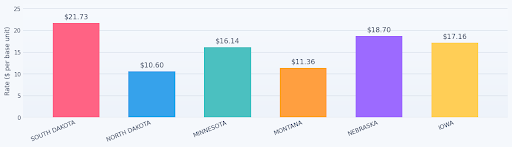
Medicaid 97153 (adaptive behavior treatment by a technician), maximum allowable rate per 15-minute unit: South Dakota and selected neighboring states. Source: MediRate.
What South Dakota Medicaid Pays for ABA
Effective July 1, 2026, South Dakota’s applied behavior analysis fee schedule pays $35.63 for behavior identification assessment by a professional (97151), $21.73 for the technician assessment (97152), $21.73 for technician treatment (97153), $5.44 for group technician treatment (97154), $39.00 for analyst-delivered protocol treatment (97155), and $22.44 for family treatment (97156). Unlike some states, South Dakota also pays the multiple-family guidance code 97157 and the professional group code 97158, both at $13.01, a fuller covered set than some neighbors, including North Dakota, which pays neither. That comparatively rich schedule, at rates that reward BCBA-led supervision, is a profile more common among higher-rate programs such as Maryland. One code, 97156, carried a July 1, 2025 date in the current schedule, meaning it was not adjusted in the latest update.
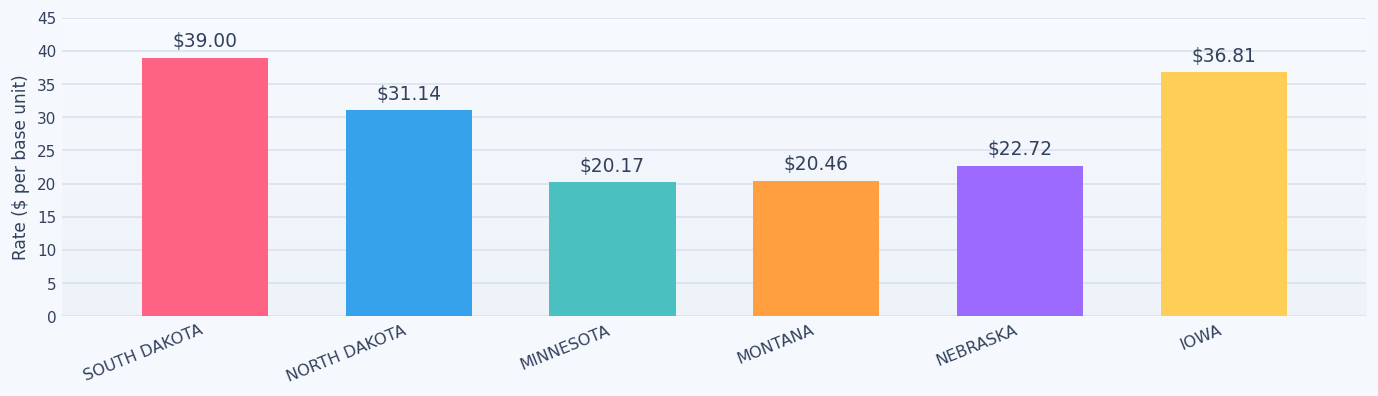
Medicaid 97155 (adaptive behavior treatment by a professional), maximum allowable rate per 15-minute unit: South Dakota and selected neighboring states. Source: MediRate.
On the analyst code 97155, South Dakota’s $39.00 tops the neighbor set, ahead of Iowa’s $36.81 and well above Minnesota and Montana, which sit near $20. On the technician code, its $21.73 again leads the group. The result is a schedule that pays comparatively well at both the technician and analyst levels, a profile few small-state Medicaid programs share.
The Enrollment Rule That Sets South Dakota Apart
South Dakota limits Medicaid enrollment to three provider types for ABA: physicians, psychologists, and licensed behavior analysts. Registered behavior technicians and board certified assistant behavior analysts, the staff who deliver most direct therapy hours, cannot enroll at all. Instead, their services must be billed under the supervising, licensed, enrolled behavior analyst, and only on the technician-specific codes 97152 through 97154. The practical effect is that the licensed analyst is the billing entity for the entire team, and carries the documentation and compliance responsibility that comes with it.
That model is not unique to South Dakota, but it places the state among the more analyst-centered programs in the country. New York similarly bars its certified assistant behavior analysts from billing Medicaid directly and routes claims through licensed behavior analysts, and Oregon limits direct Medicaid billing to licensed analysts while excluding assistant-level and interventionist staff. The contrast with a state like Indiana, which recently expanded its technician treatment code to be billable by assistant analysts and BCBAs, shows how differently states can structure who gets paid for the same work.
How the Benefit Works: Eligibility, Authorization, and Telehealth
ABA is a covered EPSDT service for South Dakota Medicaid members who are 20 or younger and have an autism spectrum disorder diagnosis from a physician or psychologist, made within the prior twelve months. Services must be ordered by a physician, nurse practitioner, or physician assistant, and prior authorized before they begin, with authorizations running in six-month periods. Prior authorization requests must include a recognized diagnostic instrument, such as the Gilliam Autism Rating Scale, the Autism Diagnostic Observation Schedule, or the Adaptive Behavior Assessment System.
Telehealth is allowed for South Dakota ABA, but with a guardrail: the board-certified behavior analyst must conduct an in-person visit within the first 30 days and again every 90 days. The program spells out a long list of services it will not pay for, including data recording and documentation time, play therapy, services that are primarily educational or recreational, provider travel time, transportation, and equine or hippotherapy.
Licensure and Oversight
South Dakota has licensed behavior analysts since 2016, when the legislature enacted House Bill 1141, codified in South Dakota Codified Laws chapter 36-38. Licensure is issued by the state Board of Social Work Examiners, advised by an Applied Behavior Analyst Advisory Committee rather than a standalone behavior-analysis board, and it carries an annual renewal cycle. Board certification through the Behavior Analyst Certification Board is the qualifying pathway.
Strong Rates in a Quiet Year
What South Dakota lacks, at least for now, is drama. There is no rate cut moving through the legislature, no provider lawsuit, and no federal audit of the state’s ABA payments on the public record, a contrast with several neighbors and with the broader national picture. Managed-care plans in states like Georgia have cut ABA rates by double digits, New York has phased in a 25 percent reduction, some states such as Illinois have simply held rates flat since 2022, and a federal audit series has recouped Medicaid ABA payments in a string of states. South Dakota sits outside that turbulence.
For providers, the calculus is straightforward but not simple. South Dakota offers among the strongest Medicaid ABA rates in its region and a stable policy environment, which on paper make it attractive. The constraint is supply: a small, rural state with a limited number of licensed analysts, each of whom must serve as the billing anchor for their team. Whether strong, stable rates are enough to draw and keep providers in a thin market is the question that will define South Dakota’s ABA benefit in the year ahead, more than any rate change, because for now there is none.