Key Takeaways
- Texas’s Medicaid ABA benefit launched February 1, 2022, more than five years after Indiana’s 2016 start.
ABA coverage is available to Medicaid-enrolled members under 21 via EPSDT through both STAR and STAR Kids programs. - Texas pays more than Indiana for BCBA-level assessments (97151 HO: $27.56 vs. $21.87) but less for every direct treatment code, a bifurcated structure that rewards clinical evaluation more than direct service delivery and diverges from states where assessment and treatment rates move in parallel.
- The STAR Kids program is undergoing active Managed Care Organization (MCO) contract reprocurement, with new contracts expected to take effect between December 2026 and February 2027, potentially reshaping the MCO landscape across Texas service delivery areas.
Texas is one of the largest Medicaid ABA markets in the country, with a provider base that has grown substantially since the benefit launched in February 2022. Two features define how the market works and what it costs to operate in it. First, Texas requires providers billing BCBA-level ABA codes to hold a Licensed Behavior Analyst credential issued by the Texas Department of Licensing and Regulation, a state-specific license that is separate from BCBA certification and must be obtained independently. As of December 2024, the QBA credential from QABA is also accepted as a qualifying pathway. Second, ABA is delivered entirely through managed care, with MCOs administering STAR and STAR Kids setting the day-to-day authorization experience within the state’s rate structure. The STAR Kids program is currently undergoing contract reprocurement, with new MCO agreements expected to take effect between December 2026 and February 2027. For context on how Medicaid policy shapes ABA provider valuations, what follows is a breakdown of how Texas’s ABA coverage and reimbursement system actually works.
How Texas Medicaid Covers ABA: STAR, STAR Kids, STAR Health, and the CHIP Exclusion
Texas covers ABA for Medicaid members under 21 through the state plan via EPSDT, but the specific managed care program depends on how a child accesses Medicaid. STAR is Texas’s standard managed care program for children and families with income-based Medicaid eligibility, and serves as the coverage vehicle for many children with autism who qualify through that pathway. STAR Kids specifically serves children and youth aged 20 and younger whose Medicaid eligibility is tied to SSI or a 1915(c) waiver program, making it the route for children with qualifying disabilities. Both programs use MCOs that administer ABA benefits through the TMHP fee schedule rates.
STAR Health covers children in the foster care system under a managed care arrangement administered through the Department of Family and Protective Services. Children enrolled in CHIP or CHIP Perinatal are not eligible for the EPSDT-based ABA benefit: THSteps, Texas’s EPSDT program, applies to children with full Medicaid coverage, not CHIP. This means some lower-income children who meet clinical criteria for ABA may not have access to the Medicaid benefit depending on their specific coverage category.
STAR+PLUS, the managed care program serving Texas Medicaid adults, does not carry ABA procedure codes in its rate schedule. Texas’s ABA coverage is therefore age-limited to members under 21. The benefit is also relatively new: LBA providers became eligible to enroll in July 2021, and the ABA benefit did not go live until February 1, 2022.
Texas Medicaid ABA Rates by CPT Code: What the Autism Services Fee Schedule Pays
Texas publishes ABA rates through a dedicated Autism Services fee schedule, distinct from its general outpatient behavioral health rate structure. The March 13, 2026 TMHP fee schedule confirms rates effective September 1, 2025. The schedule uses HN and HO modifiers to differentiate by credential level: HN designates BCaBA or Licensed Assistant Behavior Analyst services, and HO designates BCBA or Licensed Behavior Analyst services. Technician-delivered treatment under 97153 carries no credential modifier. All rates are billed in 15-minute units. For context on how CPT billing restrictions are evolving across state Medicaid programs, the Texas Autism Services fee schedule is a useful reference point.

Texas pays $14.50 per unit for RBT-delivered direct treatment under 97153, $20.08 at the BCaBA/HN level and $25.10 at the BCBA/LBA/HO level for supervision-concurrent treatment under 97155. The 97151 behavior identification assessment pays $27.56 with HO modifier. Family training under 97156 pays $18.40 at HN and $23.01 at HO. Notably, 97152 (behavior identification supporting assessment, technician-delivered) does not appear in the Texas Autism Services fee schedule at all, confirmed by the March 13, 2026 TMHP document.
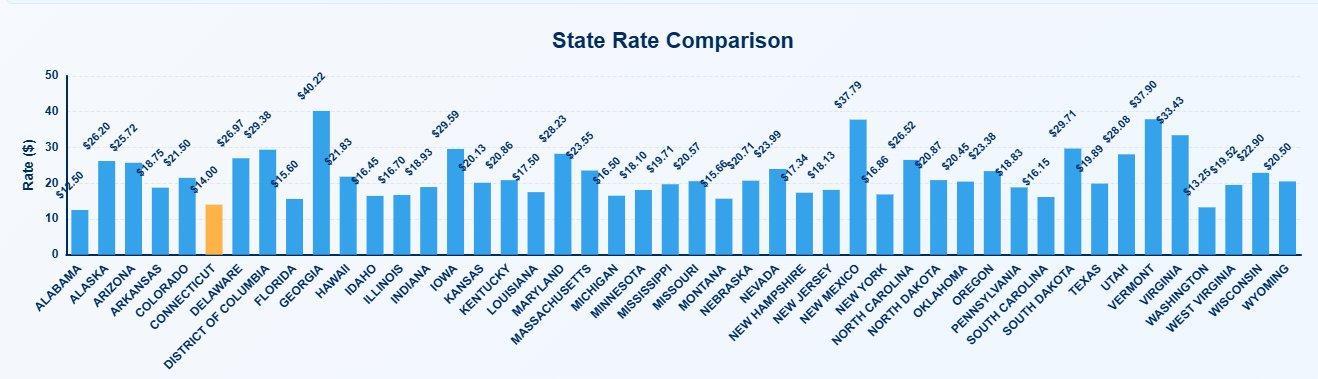
The bar chart above displays a utilization-weighted combined average across the 97153 and 97155 procedure codes; individual rates by code and credential level are shown in the rate table. Texas’s combined average of $23.71 places it above the national midpoint, with MediRate data showing per-unit rates ranging from roughly $12.50 at the low end to over $40 in states like Georgia and New Mexico. Compared to Indiana, Texas pays more for assessments (97151 HO: $27.56 vs. $21.87) but less for every direct treatment code. For providers whose revenue depends primarily on high-volume direct service delivery, Indiana’s current rates exceed Texas’s at every credential level except assessment, though Indiana’s ongoing phasedown will narrow that gap by April 2027.
The LBA Requirement, MCO Prior Authorization, and the STAR Kids Reprocurement
The LBA licensure requirement is the most operationally consequential policy condition for ABA providers in Texas. The Texas Department of Licensing and Regulation issues the LBA license under authority established by SB 589, signed June 2017 and effective September 2018. Licensure requires a separate application and fees beyond BCBA certification. BCaBAs must similarly hold a Licensed Assistant Behavior Analyst credential from TDLR to bill at the HN level.
Prior authorization requirements are administered at the MCO level. Each managed care organization in STAR, STAR Kids, and STAR Health maintains its own utilization management protocols, clinical criteria, and authorization timelines for ABA services. The current STAR Kids MCO incumbents, serving approximately 150,000 beneficiaries statewide as of late 2023, include CVS/Aetna, Elevance/Wellpoint (formerly Amerigroup, rebranded January 2024), Blue Cross Blue Shield of Texas, Centene/Superior Health Plan, Community First Health Plan, Cook Children’s Health Plan, Driscoll Children’s Health Plan, Texas Children’s Health Plan, and UnitedHealthcare. Providers operating across multiple service delivery areas navigate parallel PA systems for each MCO.
The STAR Kids program is in active reprocurement. Texas issued an RFP in 2024, with awards expected between December 2025 and February 2026 and new contracts anticipated to take effect between December 2026 and February 2027. The reprocurement may result in MCO roster changes by service delivery area. For context on how MCO transitions affect ABA provider operations, providers with significant Texas exposure should monitor HHSC award announcements and assess credentialing timelines with newly awarded plans.
For providers in Texas or evaluating entry, the market dynamics combine genuine scale with meaningful structural complexity. The LBA requirement adds a credentialing layer most states do not impose. The managed care structure distributes authorization authority across multiple MCOs across both STAR and STAR Kids. And the rate structure, while above the national midpoint in aggregate, pays less for the direct treatment codes that drive volume for most practices than several comparable Medicaid markets. For acquirers and growth-stage operators tracking private equity deployment in behavioral health, Texas’s favorable demographics remain compelling, but the LBA bottleneck and MCO complexity make market entry more capital-intensive than states with simpler credentialing and centralized PA processes.
Frequently Asked Questions
What are Texas Medicaid’s current reimbursement rates for ABA therapy?
Texas Medicaid ABA rates are published through the Texas Autism Services fee schedule (TMHP, dated March 13, 2026, with rates effective September 1, 2025). Key rates per 15-minute unit: 97153 (RBT treatment) at $14.50 with no modifier; 97155 at $20.08 with HN modifier (BCaBA/LABA) and $25.10 with HO modifier (BCBA/LBA); 97151 (behavior identification assessment) at $27.56 with HO; 97156 at $18.40 (HN) and $23.01 (HO). The code 97152 has no published rate in the Texas Autism Services fee schedule.
Does Texas Medicaid cover ABA through STAR or STAR Kids, and what is the difference?
Both STAR and STAR Kids cover ABA for eligible members under 21 via EPSDT, but through different enrollment pathways. STAR is Texas’s standard managed care program for children and families qualifying through income-based Medicaid eligibility; many children with autism access ABA through STAR. STAR Kids serves children and youth aged 20 and younger whose Medicaid eligibility is tied to SSI or a 1915(c) waiver, making it the pathway for children with qualifying disabilities. ABA rates from the Texas Autism Services fee schedule apply across both programs via TMHP, with each program’s MCOs administering prior authorization. Children enrolled in CHIP or CHIP Perinatal are not eligible for the EPSDT-based ABA benefit. STAR+PLUS for adults carries no ABA codes.
What is the Licensed Behavior Analyst (LBA) requirement in Texas?
The Texas LBA is a state-specific professional license issued by the Texas Department of Licensing and Regulation under SB 589, signed June 2017 and required for Medicaid billing since February 2022. It is distinct from BCBA certification: clinicians must separately apply for and obtain the LBA through TDLR before billing at the HO level under Texas Medicaid. As of December 2024, Texas also accepts the QBA credential from QABA as an alternative pathway to LBA licensure. BCaBAs seeking to bill at the HN level must similarly hold the Licensed Assistant Behavior Analyst credential from TDLR.
How does the Texas Medicaid ABA rate compare to Indiana and the national average?
Texas and Indiana represent two distinct rate profiles. Texas pays more for assessments: its 97151 HO rate of $27.56 exceeds Indiana’s U2 equivalent of $21.87 by nearly $6 per unit. But Indiana currently pays more for every direct treatment code. Texas’s combined average of $23.71 (MediRate, 97153 and 97155) places it above the national midpoint in aggregate. As Indiana’s phasedown brings its 2027 rates to $15.39 (97153 U1) and $19.72 (97155 U2), Indiana’s direct treatment rates will fall below Texas’s for those codes. For context on how reimbursement rates affect ABA business valuations, the assessment-versus-treatment split matters considerably depending on a practice’s service mix.
How does prior authorization for ABA work in Texas Medicaid?
Prior authorization for ABA in Texas is administered by the MCOs, not the state directly. Each MCO in STAR, STAR Kids, and STAR Health maintains its own clinical criteria, documentation requirements, and authorization timelines. Initial authorization typically requires a referral, a diagnostic evaluation no older than three years (including a DSM-5 severity level), and a PA form specific to the MCO. Providers operating across multiple service delivery areas navigate parallel PA processes for each plan. Reauthorization is required periodically to demonstrate continued medical necessity and progress.
What is the STAR Kids reprocurement and what does it mean for ABA providers?
STAR Kids is undergoing a full MCO contract reprocurement, with Texas HHSC having issued an RFP in 2024, contract awards expected between December 2025 and February 2026, and new contracts anticipated to take effect between December 2026 and February 2027. The reprocurement could bring new MCOs into some service delivery areas or change the plan mix in specific regions. For ABA providers, MCO contracting determines in-network status, PA criteria, and effective reimbursement. Providers with significant STAR Kids volume should monitor HHSC award announcements. The broader ABA M&A market is tracking the reprocurement as a potential inflection point for provider network dynamics in one of the country’s largest pediatric Medicaid markets.